


Unemployment here on the rise
County unemployment rate climbs to 6.5 percent
Graphic by Michelle Farnham


MEDINA – Unemployment in Medina County took another step higher in February according to the latest jobs report released by the Ohio Department of Job and Family Services.
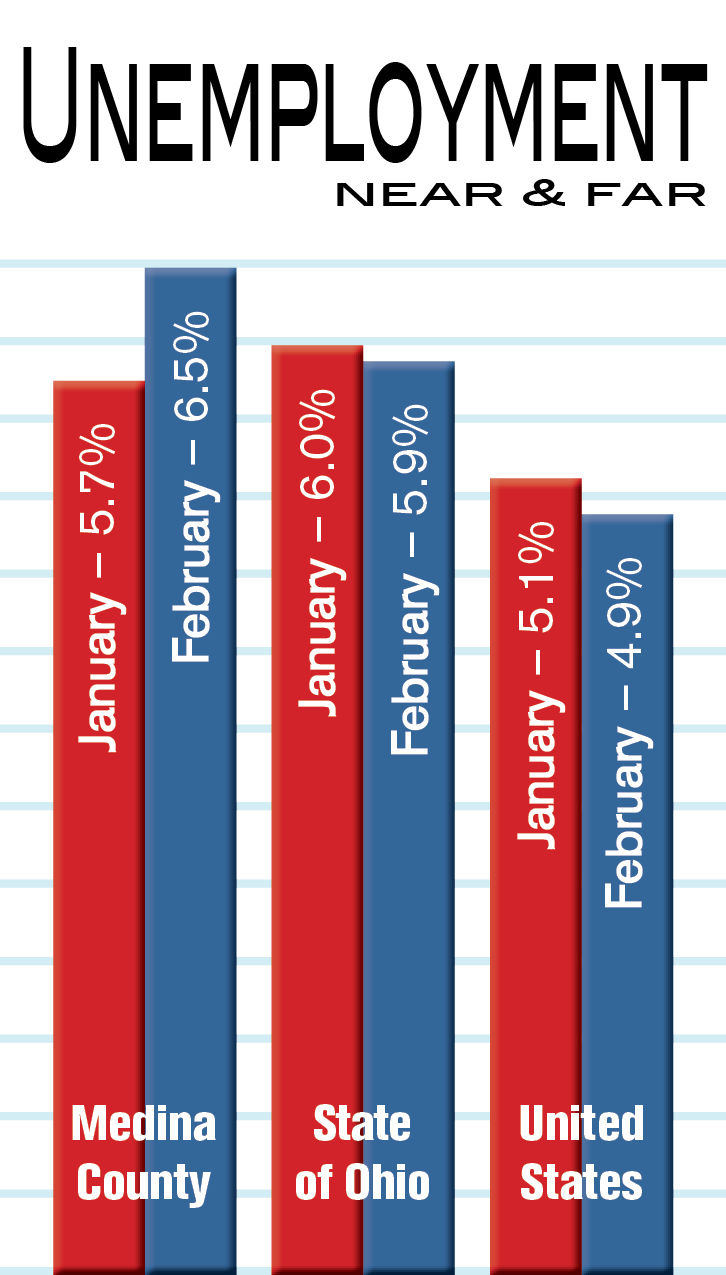
The unemployment rate for Medina County was estimated at 6.5 percent in February, the highest it’s been here since February 2014.
Unemployment rates in Ohio are typically highest in January and February after seasonal jobs for the holidays end and before construction work accelerates with the arrival of warmer weather.
However, Medina County’s rise in February contrasts with state and national averages this year. ODJF reports the unadjusted unemployment rates for Ohio dropped from 6.0 in January to 5.9 in February. Similar estimates for the nation showed unemployment dropping from 5.1 percent in January to 4.9 percent in February.
Neighboring Lorain and Cuyahoga counties also saw significant rises with February unemployment rates of 8.4 and 7.6 percent respectively. However, the February unemployment rates declined to 5.9 percent in Summit County, 4.6 percent in Wayne County and 6.0 percent in Ashland County.
Among the state’s 88 counties, preliminary February 2017 unemployment rates ranged from a low of 3.7 percent in Mercer County to a high of 11.8 percent in Monroe County. From January, unemployment rates decreased in 76 counties, increased in 11 counties, and remained the same in one.
ODJFS estimates that 6,100 county residents were unemployed in February, more than any month in 2016. However, the civilian labor force, all those with jobs or currently seeking work, climbed by 1,000 from January to 94,500. The big jump in the labor force raised the local unemployment rate even though 88,300 county residents had jobs in February, 100 more than January.
ODJFS prepares monthly job estimates in cooperation with the Bureau of Labor Statistics, U.S. Department of Labor, and are based on 2016 benchmarks and geared to county of residence.
The latest ODJFS report shows Ohio’s nonagricultural wage and salary employment increased 15,200 over the month, from a revised 5,506,800 in January to 5,522,000 in February.
The number of workers unemployed in Ohio in February was 294,000, up 7,000 from 287,000 in January. The number of unemployed has increased by 9,000 in the past 12 months from 285,000. The February unemployment rate for Ohio was up from 5.0 percent in February 2016.
The seasonally adjusted U.S. unemployment rate for February was 4.7 percent, 0.1 percentage points lower than in January, and 0.2 percentage points lower than in February 2016.
Ohio’s nonagricultural wage and salary employment increased 15,200 over the month, from a revised 5,506,800 in January to 5,522,000 in February, according to the latest business establishment survey conducted by the U.S. Bureau of Labor Statistics in cooperation with ODJFS.
Employment in goods-producing industries, at 921,600, increased 7,000 over the month. Job gains in construction (+6,300) and manufacturing (+900) outweighed job losses in mining and logging (-200).
The private service-providing sector, at 3,828,700, increased 9,200. Employment gains in leisure and hospitality (+4,000), educational and health services (+3,900), trade, transportation, and utilities (+2,000), and professional and business services (+100) surpassed losses in financial activities (-400), information (-300), and other services (-100).
Government employment, at 771,700, decreased 1,000 as losses in state government (-3,100) exceeded gains in local (+1,800) and federal (+300) government.
From February 2016 to February 2017, nonagricultural wage and salary employment grew 45,400. Employment in goods-producing industries increased 13,900. Construction added 8,900 jobs. Manufacturing added 5,700 jobs as gains in nondurable goods (+7,200) surpassed losses in durable goods (-1,500).
Mining and logging lost 700 jobs. The private service-providing sector added 36,100 jobs. Employment gains in educational and health services (+13,600), trade, transportation, and utilities (+9,900), financial activities (+6,700), leisure and hospitality (+5,200), professional and business services (+1,700), and information (+600) exceeded losses in other services (-1,600).
Government employment decreased 4,600 as losses in state (-3,800) and local (-1,500) government outweighed gains in federal government (+700).
The unemployment rate for Medina County was estimated at 6.5 percent in February, the highest it’s been here since February 2014.
Unemployment rates in Ohio are typically highest in January and February after seasonal jobs for the holidays end and before construction work accelerates with the arrival of warmer weather.
However, Medina County’s rise in February contrasts with state and national averages this year. ODJF reports the unadjusted unemployment rates for Ohio dropped from 6.0 in January to 5.9 in February. Similar estimates for the nation showed unemployment dropping from 5.1 percent in January to 4.9 percent in February.
Neighboring Lorain and Cuyahoga counties also saw significant rises with February unemployment rates of 8.4 and 7.6 percent respectively. However, the February unemployment rates declined to 5.9 percent in Summit County, 4.6 percent in Wayne County and 6.0 percent in Ashland County.
Among the state’s 88 counties, preliminary February 2017 unemployment rates ranged from a low of 3.7 percent in Mercer County to a high of 11.8 percent in Monroe County. From January, unemployment rates decreased in 76 counties, increased in 11 counties, and remained the same in one.
ODJFS estimates that 6,100 county residents were unemployed in February, more than any month in 2016. However, the civilian labor force, all those with jobs or currently seeking work, climbed by 1,000 from January to 94,500. The big jump in the labor force raised the local unemployment rate even though 88,300 county residents had jobs in February, 100 more than January.
ODJFS prepares monthly job estimates in cooperation with the Bureau of Labor Statistics, U.S. Department of Labor, and are based on 2016 benchmarks and geared to county of residence.
The latest ODJFS report shows Ohio’s nonagricultural wage and salary employment increased 15,200 over the month, from a revised 5,506,800 in January to 5,522,000 in February.
The number of workers unemployed in Ohio in February was 294,000, up 7,000 from 287,000 in January. The number of unemployed has increased by 9,000 in the past 12 months from 285,000. The February unemployment rate for Ohio was up from 5.0 percent in February 2016.
The seasonally adjusted U.S. unemployment rate for February was 4.7 percent, 0.1 percentage points lower than in January, and 0.2 percentage points lower than in February 2016.
Ohio’s nonagricultural wage and salary employment increased 15,200 over the month, from a revised 5,506,800 in January to 5,522,000 in February, according to the latest business establishment survey conducted by the U.S. Bureau of Labor Statistics in cooperation with ODJFS.
Employment in goods-producing industries, at 921,600, increased 7,000 over the month. Job gains in construction (+6,300) and manufacturing (+900) outweighed job losses in mining and logging (-200).
The private service-providing sector, at 3,828,700, increased 9,200. Employment gains in leisure and hospitality (+4,000), educational and health services (+3,900), trade, transportation, and utilities (+2,000), and professional and business services (+100) surpassed losses in financial activities (-400), information (-300), and other services (-100).
Government employment, at 771,700, decreased 1,000 as losses in state government (-3,100) exceeded gains in local (+1,800) and federal (+300) government.
From February 2016 to February 2017, nonagricultural wage and salary employment grew 45,400. Employment in goods-producing industries increased 13,900. Construction added 8,900 jobs. Manufacturing added 5,700 jobs as gains in nondurable goods (+7,200) surpassed losses in durable goods (-1,500).
Mining and logging lost 700 jobs. The private service-providing sector added 36,100 jobs. Employment gains in educational and health services (+13,600), trade, transportation, and utilities (+9,900), financial activities (+6,700), leisure and hospitality (+5,200), professional and business services (+1,700), and information (+600) exceeded losses in other services (-1,600).
Government employment decreased 4,600 as losses in state (-3,800) and local (-1,500) government outweighed gains in federal government (+700).