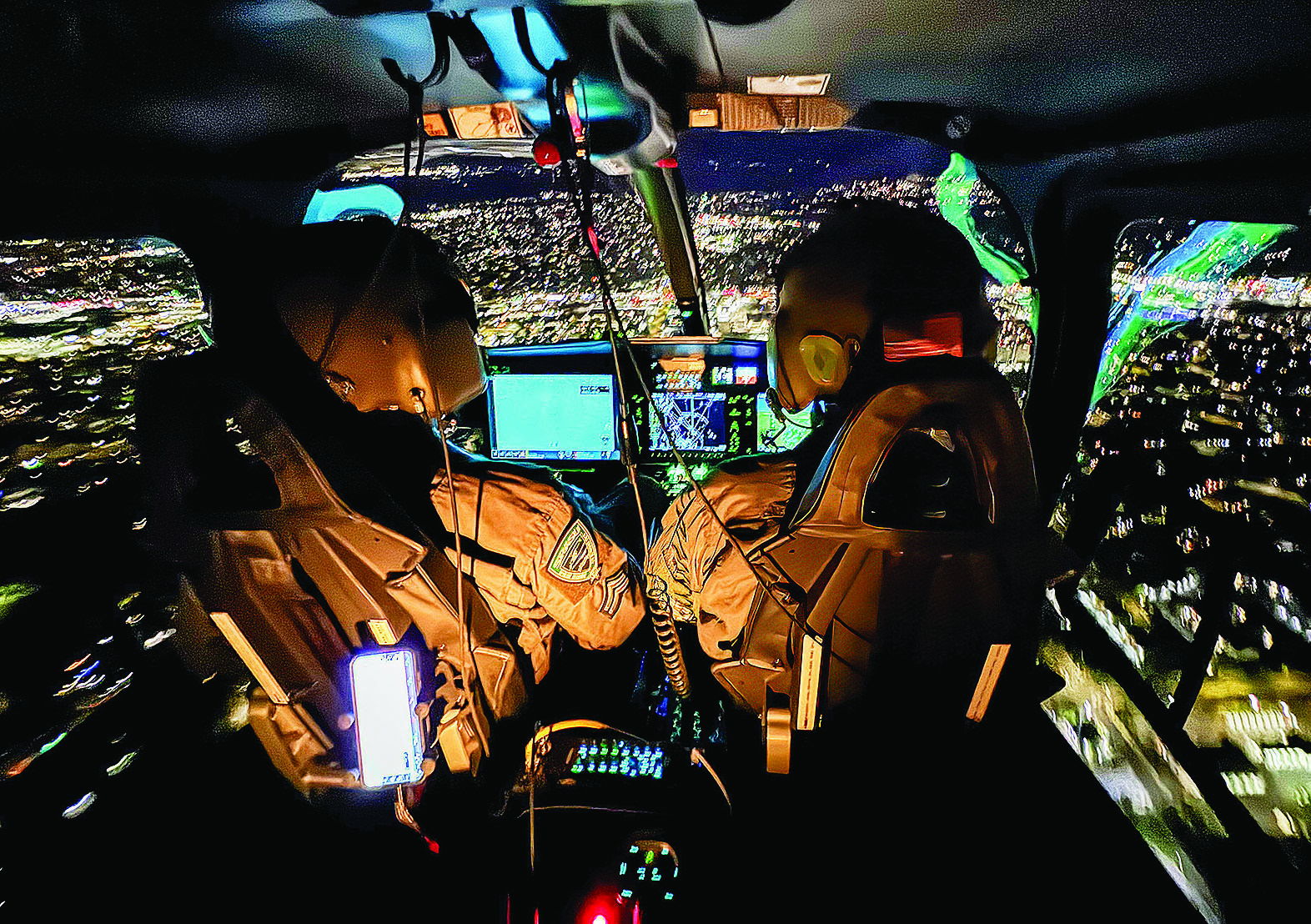
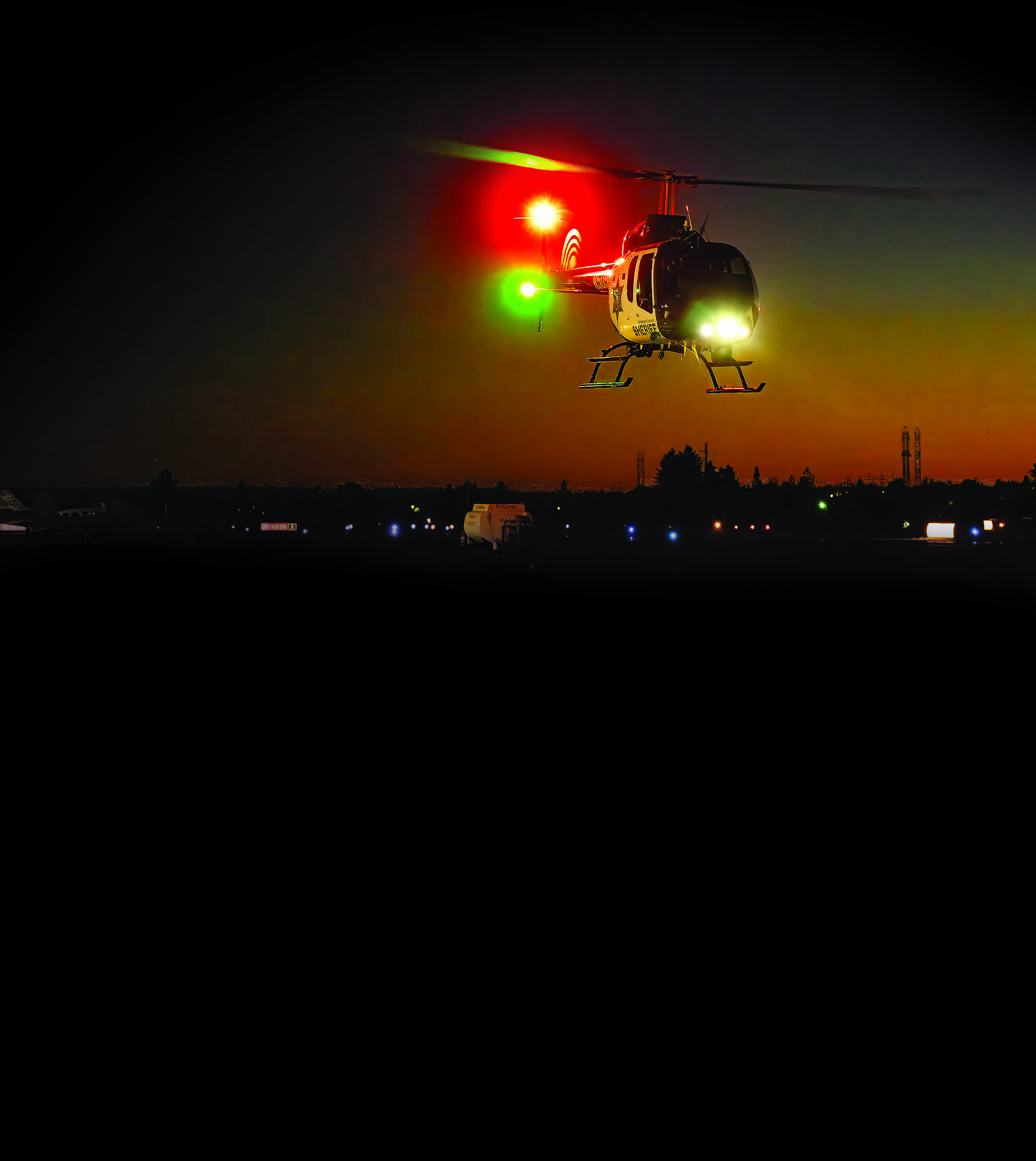


Most weekend nights, the Spokane County Sheriff’s Office uses helicopters to assist deputies by patrolling from the skies.
For four hours a night volunteers like Sam Pierce, a retired air ambulance helicopter pilot, use county-owned helicopters to help deputies with calls for service, aiding with things like missing people reports, domestic violence calls and illegal drag racing. There are about 10 pilots like Pierce in the Spokane Regional Air Support Unit. All of them are volunteers.
“We’ve got pilots who have been doing this for 20 years in bad weather and holidays, and they always answer the phone,” Spokane Valley Police Chief Dave Ellis said.
Cpl. Jeff Welton, Spokane County Sheriff’s Office Tactical Flight Officer, flies with the helicopter pilot and assists with dispatch calls as they come in.
“It’s kind of like being a cop, but instead of being in a car, we’re in a helicopter,” Welton said. “If we can get the helicopter on scene quickly, officers can stop pursuing.”
The Spokane Regional Air Support Unit was established in 2005, when the Spokane County Sheriff’s Office received a Bell OH-58 helicopter from the United States Army.
The air support unit uses three helicopters: one Bell 505 Jet Ranger-X (Air-1), one Bell OH-58 (Air-2), and one Bell UH-1H Super Huey (Rescue-3). Air-2 and Rescue-3 came to the county from government surplus programs. Air-1 is the newest helicopter in the fleet and was purchased in May 2025.
The Spokane Regional Air Support Unit helps the region in several ways, including search and rescue, apprehending fugitives, fire suppression, patrol, national disaster damage assessment and surveillance.
The goal of the program is to stop dangerous pursuits from happening, which can protect other drivers on the road from getaway cars.
The two patrol helicopters are equipped with infrared cameras that allow deputies on the ground to watch live footage from the helicopter, search lights and GPS moving map systems. The third helicopter is used for rescue missions and uses internal hoists to retrieve people who are injured or lost.
“It provides backup to officers that are on the ground, when they get somewhere and they’re all alone,” Pierce said. “We can get there quicker than anybody else from the air and provide top cover with cameras we have. We can see more than they can see sometimes.”
The unit provided key support in the search for Travis Decker in the summer of 2025 and was credited in finding evidence in the case that led to Decker’s body. Decker was a 32-year-old Wenatchee man who was wanted for the kidnapping and murder of his three daughters. The search for Decker was the largest manhunt in Chelan County history.
County helicopters were used to assist Seattle during the World Cup, the use of which was funded through federal grants, Ellis said.
In 2025, the unit along with drones responded to 37 search and rescue calls, 1,098 calls for law enforcement service and assisted in 274 arrests. The unit coordinates with drone systems often, Pierce said. He typically flies one of the helicopters a few times every month.
The program runs on grants, tax dollars, deputies and officers from police and fire departments in the region, and volunteer helicopter pilots.
Flight schedules often change based on how many missing children there are in the region, what wildfire assistance is needed and whether or not patrol needs air assistance.
“Pursuits are dangerous, so if we can have a helicopter come on the scene it’s safer,” Ellis said.
Ellis said fuel typically costs around $250 an hour for patrol helicopters.
“There’s really no direct cost assigned to doing it,” Ellis said. “We get homeland security grants that cover some equipment and portions of flights.”
Pierce got into flying after training to be a pilot with the United States Air Force. He started out flying jets, but quickly found a love for helicopters and primarily flew them for the military for 27 years as a combat rescue pilot.
“You’re making a difference on a daily basis, instead of just dropping bombs and breaking stuff,” Pierce said.
Pierce is a third-generation Air Force veteran and pilot. His father was a back seater in F-4 jets and his grandfather flew fighter jets in the Pacific during World War II.
“It’s kind of a family thing,” he said. “Being in charge of a piece of machine like that and being able to do what you want in a three-dimensional world ... it’s fun,” Pierce said.
After his time in the military, Pierce became a pilot for the Life Flight Network and still works as an aviation logistics manager for the network in Spokane.
“I wasn’t going to retire and do nothing. I still wanted to keep myself mentally challenged, and flying does that,” Pierce said. “I take pride in those piloting skills and the mental acuity that it takes to remain sharp in an aircraft and I just didn’t want that to go away. I’m a firm believer that if you don’t use it, you lose it.”
Emily White can be reached at 509- 459-5444 or by email at emilyw@ spokesman.com.