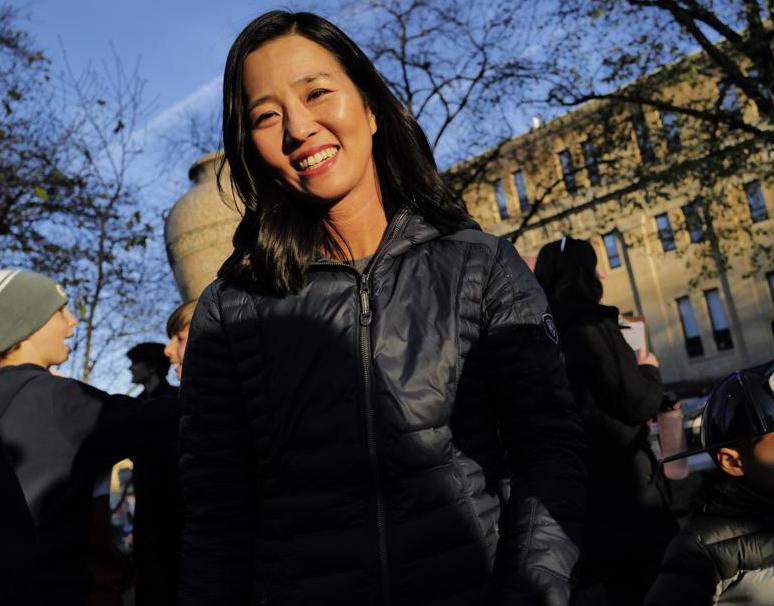


Climate Ready Boston is the city’s initiative to get Boston ready for the long-term impacts of climate change. The initiative seeks to prepare for heat, flooding, and social vulnerability. In Michelle Wu’s 2020 Planning for a Boston Green New Deal and Just Recovery campaign proposal, she committed to climate justice and a suite of policies. She said, “Cities have tremendous power to lead the charge to mitigate the threat of climate change, eliminate the violence of poverty and economic inequality, close the racial wealth gap, and dismantle structural racism.’’
Wu’s liberal credentials and commitment to justice make her like Barcelona Mayor Ada Colau. Like Wu, Colau has been clear that climate change will deepen the divisions already found in society — and Barcelona has been aggressive in pushing for a new green economic model rooted in justice and sustainability to tackle this emergency. There is growing interest in the successes and failures of the increasing number of (left/liberal) female mayors globally, from Anne Hidalgo of Paris, to Claudia Lopez of Bogota, Mónica Fein of Rosario, Argentina, and Célestine Ketcha Courtès of Bangangté, Cameroon.
Wu and Colau share many similar sentiments, but they come to their mayorships from different perspectives — Wu came up through City Hall while Colau was a grass-roots activist. Although advocating for a municipal Green New Deal, Wu does not share the municipalist politics of Colau, and although she is a progressive she is not an ideologue. Colau is an organic intellectual — not part of the traditional intelligentsia that regards itself as a separate social class — on global questions like climate resilience, but she’s not as successful on the nuts and bolts of local economic and political questions. Wu is seemingly the opposite, seen less as a global intellectual and more focused on the nuts and bolts of Boston — from graffiti to the T.
The issue of being a local versus a global mayor will be critical for Wu going forward. Colau has been elected the colead of C40 Cities, a global network of mayors taking urgent action to support cities to collaborate, share knowledge, and drive sustainable action on climate change. The absence of Wu at the 2022 C40 World Mayors Summit in Buenos Aires was notable. In a world where the mayors of other large cities globally are learning from each other about how to do climate resilience, Wu is missing out.
Wu could learn from Paris’s Hidalgo, whose Plan Velo is encouraging cycling, walking, and public transport over cars. Paris is building a cycling equivalent of the metro system — with the right infrastructure in place there is no reason why Boston could not do the same. Wu could also learn from the mayor of London, Sadiq Khan, who has managed to expand London’s Ultra Low Emission Zone to cover the entire city. Khan has been savvy in promoting this rollout in relation to public health positives, such as alleviating asthma and lung disease.
Energy efficiency for lower-income groups is critical for climate justice and equity; Barcelona has focused on this — bringing down heating costs in public housing through energy retrofits. Wu could learn from Colau on this but also from Tania Campbell, mayor of Ekurhuleni, the first city in South Africa to establish a just transition commission that has pursued a bottom-up approach, listening to and working with the workers, communities, and businesses that will be directly affected by climate change and climate resilience policies. Wu is great at listening and doing bottom-up — marrying this strategically with the global is the way forward.
Colau’s good intentions have been thwarted by a complexity of issues, not just the pushback from powerful political and economic institutions but also the political deals she had to do to retain power, the revanchist austerity state, and the changing political landscape around key issues in the city. She has become the promotor of a Smart City, which many see as just another greenwashing capitalist city model. Wu, like Colau, will be challenged over her initiatives, including on climate resilience. She will hit roadblocks, and she will need to change hearts and minds fast. Getting gas out of buildings, for example, will be hard because electric heat pumps are expensive. Boston unions, like pipefitters, will see their livelihoods threatened, but alternative jobs could be made for them, like fitting ground-source heat pumps.
Major global challenges — climate change, the economy, inequality — will be solved in cities. There was big excitement and big hope when both Ada Colau and Michelle Wu became mayors in their respective cities. Wu is still in her first term, but she could learn from Colau, and indeed other mayors globally. She has shown herself to be a nimble mayor, helping the state to manage the Orange Line closure. She must now become a global mayor on the world stage, learning from other mayors and showcasing the great work she is doing in Boston.
Loretta Lees is the faculty director of the Initiative of Cities at Boston University.