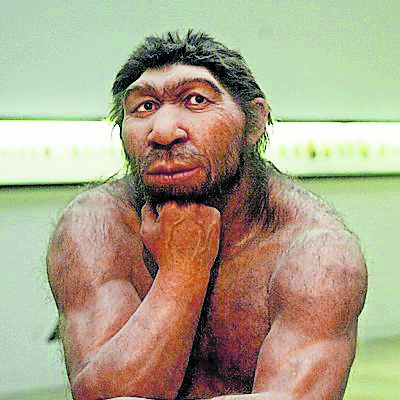


To describe someone as a Neanderthal today is to suggest they are a slowwitted dullard, too stupid to resist their primitive urges. But has history been too harsh on our extinct human cousins? The very name of our own modern human species — Homo sapiens — contains the Latin term for “wise” or “knowing”. It is no surprise, therefore, that we congratulate ourselves on having outlived our Neanderthal relatives and suppose we have our superior brain power to thank.
The cognitive abilities of Neanderthals were, however, no less powerful than those of the Homo sapiens they lived alongside in Europe for up to 5,400 years before they died out, about 40,000 years ago, a study has found.
Neanderthals had larger brains by volume compared to modern humans but also had a different brain shape. Researchers from Indiana University in the United States explained: “These shape differences have long been used to suggest Neanderthals differed cognitively from modern humans, for example by having inferior linguistic ability, poorer executive function ... and working memory capacity.”
The study, published in the journal Proceedings of the National Academy of Sciences (PNAS), compared the relative sizes of different brain regions between humans from different parts of the world, including the United States and China. They found the difference in the shape and volume of brain regions between ancient Neanderthals and Homo sapiens was no greater than the differences that exist between different modern human populations today.
There is no scientific evidence these differences in brain shape lead to people from any one part of the world having different cognitive abilities to those from others. The study concluded that the “cognitive differences between Neanderthals and modern humans would have comfortably fit within the range found among modern human populations”, noting: “This undermines the suggestion that Neanderthal replacement [by Homo sapiens] occurred because of cognitive limitations.”
So how did Homo sapiens come to outlive Neanderthals, if it was not down to our superior brains? One answer lies in the myth Neanderthals died out entirely. Though no fully Neanderthal human still exists, around 1 to 2 per cent of the DNA carried by a modern European can be traced back to Neanderthal heritage, because of the period in which our two species lived side-byside as neighbours and also interbred as mates.
This led to a phenomenon known as “genetic swamping”, the study suggests.
As Homo sapiens migrated out of Africa and into Eurasia between 60,000 and 70,000 years ago, they expanded to outnumber Neanderthals who tended to live in smaller, more isolated groups.
Through interbreeding, Neanderthal DNA was effectively absorbed into the Homo sapiens lineage, until there were no fully Neanderthal people left.