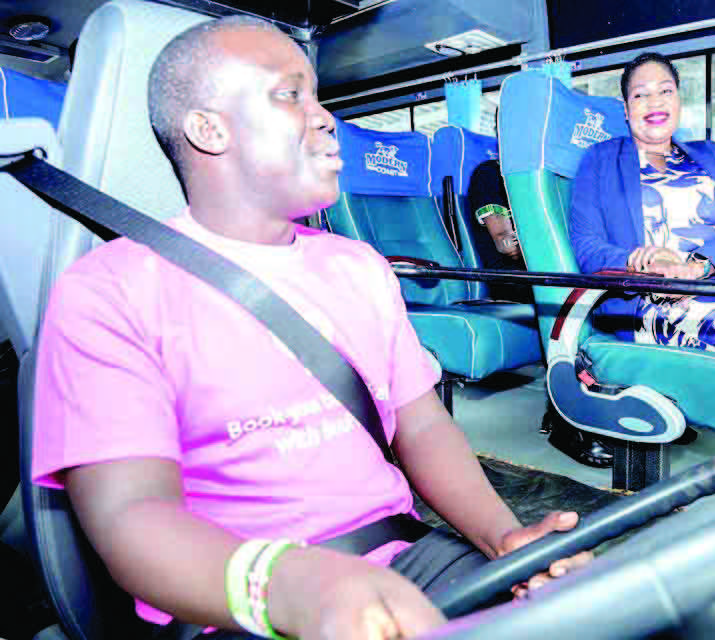



While Wycliffe Omondi was an Economics degree student, Sonia Kabra pursued a degree in Biochemistry at Earlham College in the United States. They took part in the 2016 Hult Prize competition and won a grant of US$1 million (Sh125 million) to start BuuPass, a software to help transport operators manage their ticket sales and fleet, then connect them with online ticketing platforms where travellers could book their intercity buses.
The platform, which initially focused on online bus booking only, has now expanded to also offer train, hotel and flight tickets. Both Wycliffe and Sonia have been negatively affected by the inconsistencies in long-haul bus travel while living in smaller towns in their respective countries of Kenya and India, respectively. Yet, at the same time, they have experienced living in countries such as China, Singapore and USA and learnt how organised transport could boost economic growth.
“We first approached this challenge by solving it for the end-consumer by providing digital ticketing and payments and creating the bus and train booking portals. However, we were reaching a level of stagnation and soon realised that it was a much bigger problem for the transport operators, as they didn’t have the infrastructure to go digital. For them, that meant no centralised place to track sales and operational finances, no transparency on revenue, creating loopholes for cash leakages and fraud, no data on customers, sales, routes or fleet to make data-driven business decisions and no way to connect to the growing internet users to boost sales,” Wycliffe starts.
That’s when they built customised Bus Management Systems (BMS) for 22 different transport operators with unique operations to address these problems.
He says: “We closely led the product discovery process. Next, we trained the transport operator teams to start using digital services. Many of our clients were getting connected to online services for the first time. This process has also helped us create an effective training programme for bus operator staff onboarded on the bus management system.
“Lastly, we realised that a high volume of parcels passes through bus operators because we don’t have the equivalent of well-designed postal services. So, we added a parcel module to the BMS, thus improving our value proposition to bus operators. Interestingly, our data tells us that 35 per cent of users who use buses to travel also send parcels to different cities via the same bus company.”
Customised structures
Wycliffe spent some years in Nairobi before going to study abroad and this made him get to interact with the Nairobians where he got the prefix of the company name “Buu” which is Sheng for bus. They started a pilot in 2017 by digital ticketing for matatus that plied within the city of Nairobi.
“We did a five-month pilot test with Ongataline Sacco matatus that ply the Nairobi City Centre-Rongai route, where we had more than 5,000 tickets sold, and 73 per cent of our customers booked tickets more than three times.
“We later shifted to the intercity market where we now have more than 30 bus operators in Kenya and Uganda. We also handle Standard Gauge Railway (SGR) train ticketing with Safaricom. Lastly, we partnered with Safaricom to develop “Book- A-Flight”, the only platform in Kenya that aggregates all flight options and enables you to pay via M-Pesa. The name BuuPass remains, but our services have expanded beyond Bus,” he says.
BuuPass has brought different solutions to the market including the BMS, which enables transport operators to manage their fleet and ticket sales as well as providing them with business analytics.
Wycliffe points out that digitising ticket sales helps bus operators in various ways including reducing fraud.
“Bus operators are connected to an online marketplace where they sell tickets and get extra revenue. Customers access the service through the BuuPass website and BuuPass app. They can also use Unstructured Supplementary Service Data (USSD) to access tickets in real time without requiring a smartphone or internet connection. We also offer a parcel management system that allows individuals and SMEs to send goods intercounty using the bus operators. Customers can track their parcels and pay via cashless methods,” explains Wycliffe.
Just recently, BuuPass was recognised as one of the 60 start-up beneficiaries in Google’s Black Founders Fund (BFF) in Africa, an initiative giving access to funding to Black-founded start-ups in Africa.
“The access to experts and mentors from the Google BFF network has helped us with various elements of the business such as cloud infrastructure, growth and marketing, product and partnerships. The network of fellow start-ups has been valuable for us to share knowledge and opportunities,” he says.
Fear of change
Tech being the enabler of the global digital transition, some companies are still reluctant to adapt to the new trends. Some transport and hotel companies are still hesitant about what Wycliffe describes as “fear of change”, as some bus operators think that digitising their operations would require a lot of effort and investment.
“Rebellion from the staff who are used to manual methods and who benefit from cash leakages can also be a blocker. Digital illiteracy in general makes it harder for them to understand the benefits of optimising operations via technology,” he ascribes.
Through insights and interactions with different stakeholders, Wycliffe reveals that they are moving to the next version of BMS, which will have a multi-tenant software as a service (SaaS) infrastructure with flexible features to onboard multiple bus operators simultaneously.
“We are onto something here; we have 50 bus operators on the waitlist, banks and telcos wanting to partner in different markets and more people wanting to book bus tickets online. We are the first ones in the market and have worked on this problem full-time for the past five years,” he intimates.
Wycliffe has worked as a transportation consultant for the World Bank, building the digital ticketing blueprint for African and Latin American markets. Sonia Kabra has led a two-week sprint with limited resources to make the booking portal for Kenya Railways, beating 54 other companies. They urge the government to promote the digitisation of the transportation industry.
WYCLIFFE
"Rebellion from the staff who are used to manual methods and who beneit from cash leakages can also be a blocker"