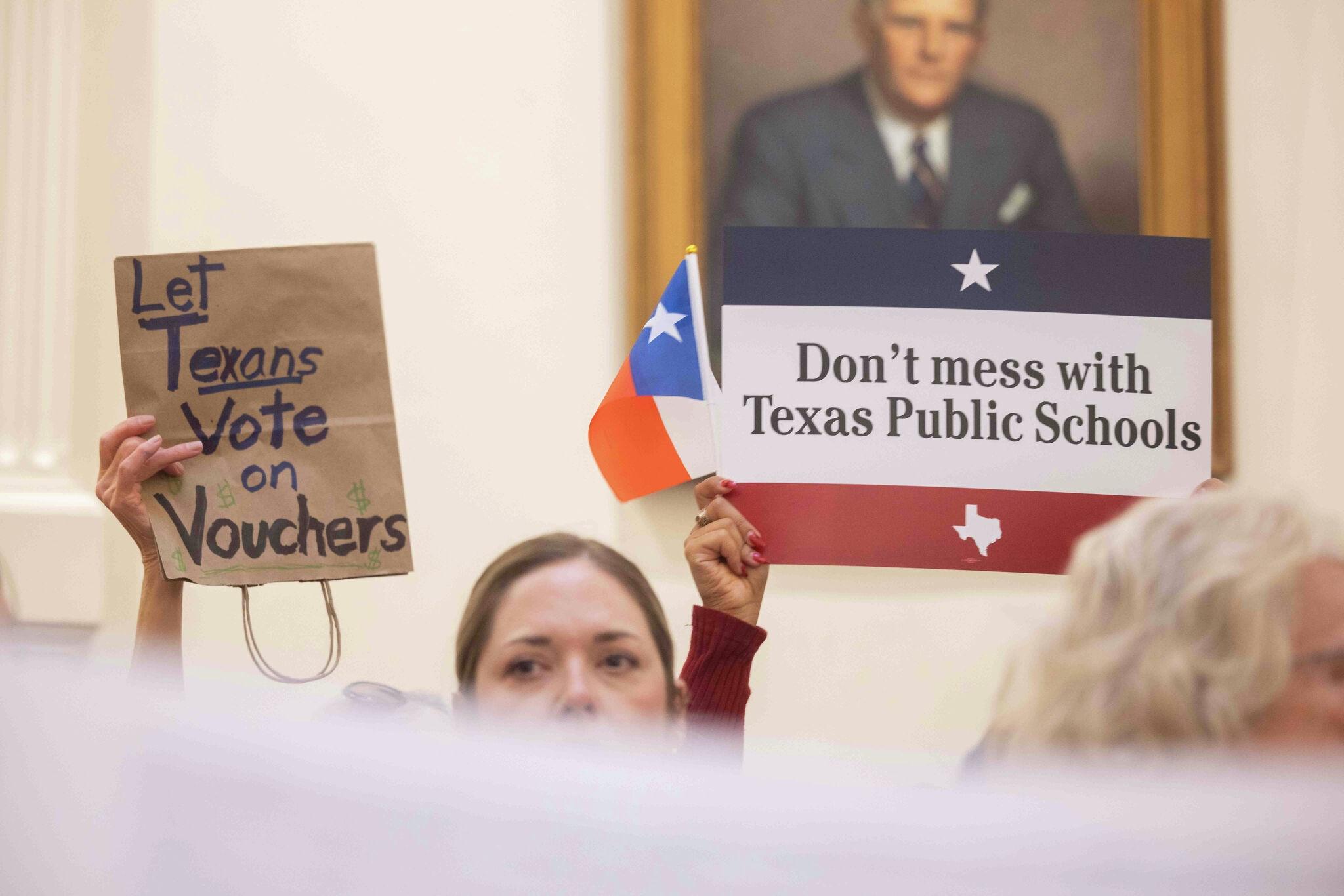


North Texas school districts could lose an estimated $68.8 million in state funding after students used vouchers to leave their public schools, according to a new estimate.
Across the region, at least 8,300 students used voucher funds to leave more than 50 ISDs, from large urban districts like Dallas, to rural ones like Milford, which has roughly 300 students.
Two education nonprofits, Texas Center for Voucher Transparency and Every Texan, analyzed state data to come up with the estimate for funding loss. It’s an early look into what impact the voucher program could have on public education. The Texas Education Freedom Accounts’ launch deepens the enrollment crisis confronting many districts.
“It’s important that Texas families and taxpayers and lawmakers know that vouchers have a public school price tag — and what choices may be lost to public [school] families as a result,” said Dee Carney, director of the Texas Center for Voucher Transparency.
To conduct the analysis, Texas Center for Voucher Transparency and Every Texan filed public records requests for the number of prior public school students leaving each district. The Dallas Morning News verified the data, which is a snapshot of students who left by Aug. 10, with the Comptroller’s Office.
Every Texan estimates the departure of one student translates to a loss of $8,198.69 in state funding. The rate was calculated using statewide weighted daily attendance from the 2023-24 school year. Different districts may have different per-student losses depending on attendance, demographics and other factors.
In a statement, Nathan Cunneen, Texas state director of the American Federation for Children, said the “loss” is misleading. The Legislature allocated a separate pool of money in the budget to pay for the voucher program.
“The TEFA program does not “take” or utilize a single dollar of public-school funds,” Cunneen wrote. “Nowhere in the bill is any money ‘taken’ from the public school.”
Public school districts receive state funding based on student attendance. Generally, the fewer students in seats, the less money public schools get.
The voucher program promises to give families educational options beyond public school. They can use taxpayer dollars to cover expenses related to private school or homeschooling. Homeschooled students can receive $2,000, while private school students get $10,474. Students with disabilities are eligible to receive up to $30,000.
TEFA’s first year cost about $1 billion. When lawmakers meet in January, they will consider the Comptroller’s Office’s request for an additional $2.3 billion to expand the program in the next biennium.
Across the state, 28,200 former public school students are using a voucher, which could result in an estimated reduction of $227 million in state funding, according to the Houston Chronicle’s calculations.
In North Texas, the largest districts experienced the biggest blows. In Dallas ISD, 807 students used the state aid, resulting in an expected loss of $6.6 million. Fort Worth ISD could miss out on $4.7 million, with the departure of 576 students.
Spokespeople for Fort Worth ISD and Dallas ISD did not provide comment by the time of publication.
Twenty-two North Texas districts had zero students accept vouchers. Four districts had between one and 29 students use the state aid to leave their public schools. The exact number is unknown because the Comptroller’s Office does not release fields of less than 30, citing privacy concerns.
The launch of the voucher-like program coincides with a difficult time for several North Texas districts. To balance budgets, district leaders have been cornered into making tough calls, like shuttering campuses and letting staff go.
$68.8 million is enough money to pay 1,100 K-12 teachers an average salary from 2025 — about $62,000 — in the D-FW area, according to the U.S. Bureau of Labor Statistics.
The lost money could “ensure every Texas child has access to certified teachers, occupational therapists,” pay for “band instruments, athletic equipment,” and “keep the lights on,” said Carrie Griffith, executive director of Our Schools Our Democracy, during a news conference following a Texas Senate hearing on school choice this month.
“It isn’t just a dollar figure,” Griffith said. “It represents tangible harm.”
Dallas ISD parent Holly Bandel said during the news conference that the district has provided “incredible experiences” for her kids, which are now at risk.
Bandel, the executive director of Pastors for Texas Children, also serves as a pastor in Garland. That district could lose $2.6 million.
“These are two of our best districts in the metroplex area,” she said. “The impact of the voucher program is real.”
The DMN Education Lab deepens the coverage and conversation about urgent education issues critical to the future of North Texas.
The DMN Education Lab is a community-funded journalism initiative, with support from Bobby and Lottye Lyle, Communities Foundation of Texas, The Dallas Foundation, Dallas Regional Chamber, Deedie Rose, Garrett and Cecilia Boone, Judy and Jim Gibbs, The Meadows Foundation, The Murrell Foundation, Ron Steinhart, Solutions Journalism Network, Southern Methodist University, Sydney Smith Hicks, and the University of Texas at Dallas. The Dallas Morning News retains full editorial control of the Education Lab’s journalism.
jessica.ma@dallasnews.com, william.tong@dallasnews.com