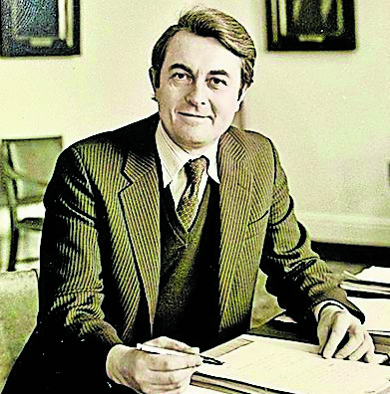


Simon Langdale, 88
When Simon Langdale walked into his first governors’ meeting at Eastbourne College, one member recalled: “You could feel the temperature change in the room.”
Tall, impeccably dressed and blessed with what colleagues called “Gregory Peck looks”, Simon had a gift for making authority appear effortless.
Over the next 15 years, at Eastbourne and later Shrewsbury, he became one of the most respected headmasters of his generation, steering two independent schools through a period of social and educational change without sacrificing their character.
Simon John Bartholomew Langdale was born in 1937 in Port of Spain, Trinidad, to Geoffrey Langdale, an accountant, and Joan (née Bartholomew), the secretary of the Kent branch of the Guide Dogs for the Blind Association. He was educated at Tonbridge School in Kent, where he absorbed the traditions of English public school life and developed a lifelong love of cricket and fives. From Tonbridge he went to St Catharine’s College, Cambridge, reading history, and became a rugby fives blue and later captain. His competitiveness continued throughout his lifetime and extended to fiercely fought games of corridor cricket and impromptu fives matches played in any suitable wood-panelled hallway.
Nudged into teaching by Jock Burnet, the Magdalene College bursar and fives president, he joined Radley College in Oxfordshire as an assistant master in 1959, later becoming a housemaster and master in charge of cricket. Those years under the Radley warden Dennis Silk were formative: Simon learnt that leadership was as much about listening as instructing, and that schools thrived on a balance of scholarship, challenge and humanity.
His appointment to Eastbourne College on the edge of the South Downs in 1973 came after a turbulent period. The previous headmaster had lost the confidence of the common room and the governors needed a steady hand. They found it in Langdale. Admiral Sir Derek Empson, then the chairman of governors, wrote in 1980: “The selection of a headmaster is an act of faith and an awesome responsibility ... it is a source of relief and delight when the chosen candidate proves himself within months to be a total success, as Simon Langdale did ... The college has been transformed under his leadership, not only materially, but academically and spiritually ... Simon is the outstanding headmaster of his generation.”
Simon raised academic standards, appointed bright, young teachers, modernised facilities and instilled what one governor called “a businesslike atmosphere”.
He left Eastbourne in 1980 with record numbers and a renewed reputation to move to Shrewsbury School in Shropshire. Shrewsbury was a more traditional boarding school, founded in 1552, where he presided over a period of consolidation and growth.
Simon believed that schools should produce not only scholars but well-rounded individuals. His friend from university days and fellow head David Summerscale noted his “innate authority yet understanding especially of adolescent uncertainties”.
Simon insisted that music, drama and sport were integral to education and his own enthusiasm for cricket was infectious. He saw in team games a metaphor for life: discipline, resilience and camaraderie. He once commented in an end-of-term report that a boy “needed to apply more of Geoffrey Boycott’s tenacity and less of Derek Randall’s flair”. He instituted the annual Langdale cricket cup, now a T20 cricket competition between nine independent schools in Sussex.
Leaving Shrewsbury in 1988, for the next 20 years Simon worked for the Rank Foundation, a charity set up to provide work-based training for disadvantaged young people.
In 1962 he married Diana Hall, who was a vital presence in school communities, hosting events and supporting pupils with warmth and grace. They had three children: Andrew, who is a chief executive; Philippa, a TV director; and Mark, a consultant.
Simon was a devoted family man, a lover of literature and music with a passion for horse racing as well as cricket. He served as a steward at Brighton and as a trustee of the British Racing School. In his spare time, he enjoyed painting and collecting China fairings, small porcelain ornaments depicting humorous or political scenes popular in Victorian times.
If you would like to commemorate the life of a relative, friend or colleague, call 020 7782 5583 to discuss the content and cost, or
email: readerslives@thetimes.co.uk.
thetimes.co.uk/static/terms-and-conditions