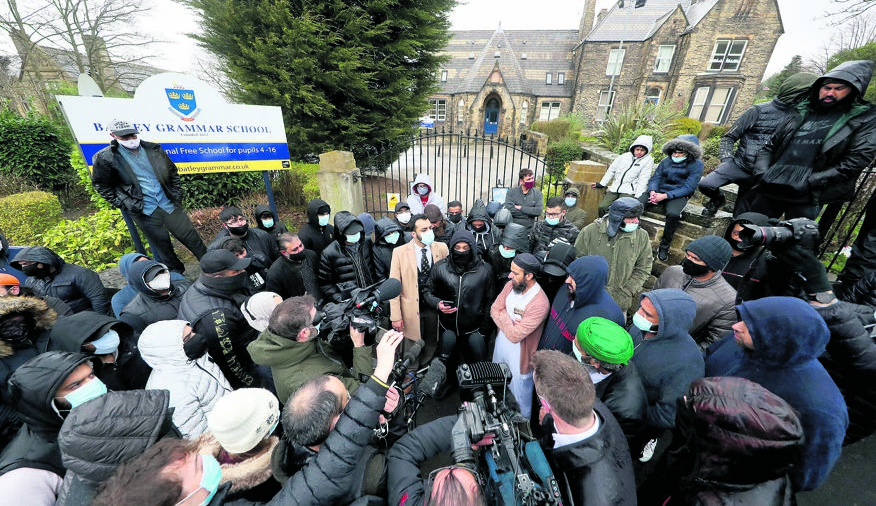


Protests should be banned outside schools, an official review will recommend, as it highlights how a teacher forced into hiding after showing pupils a cartoon of the Prophet Muhammad was failed by his school and the authorities.
Dame Sara Khan, the independent social cohesion adviser, will issue a damning indictment tomorrow of the police force, school leadership, and local council involved in the Batley Grammar School scandal.
Three years later, the teacher from West Yorkshire is still in hiding and suffering from post-traumatic stress disorder (PTSD).
Khan, a British Muslim raised in Bradford, is calling on the government to establish legal buffer zones outside schools. They would ban all forms of protest activity within 150 metres, except striking teachers on picket lines. The review into social cohesion in Britain also reveals the scale of intimidation and harassment faced by ordinary Britons and how this is leading them to self-censor and modify their behaviour.
It comes amid mounting concern over the abuse and intimidation faced by MPs and figures in public life, with the Israel-Hamas war also unleashing a torrent of antisemitic abuse and Islamophobia across Britain.
In response, Michael Gove, the levelling-up secretary, announced a new definition of extremism and vowed to cut government ties with organisations who breach it. However, Khan said her review showed the rise of intimidation and abuse was far more “insidious” and widespread than many appreciated.
In March 2021 the head of religious studies at Batley Grammar School was forced to flee with his family after he showed a drawing taken from the French satirical magazine Charlie Hebdo during a lesson on blasphemy.
Despite the lesson having been taught for two years, it provoked demonstrations at the school and led to groups of men gathering outside the teacher’s family home. It came less than six months after Samuel Paty, a 47-yearold teacher, was beheaded in Paris by an Islamist terrorist after showing pupils a cartoon of the prophet from the same magazine.
Khan’s review will reveal how the Batley teacher felt “totally isolated”, “abandoned” and “suicidal” owing to a lack of support from those who should have protected him, with West Yorkshire police failing to understand the threat he was under.
Despite the scale of intimidation and threats the teacher faced, with groups of men gathering outside his home, Khan notes no one has been arrested. A local policeman, who spoke to Khan anonymously, claimed the training given to officers to deal with complex theological interpretations and the beliefs of ethnic minorities was “shockingly dismal”.
Speaking before the review’s publication, Khan, the former Home Office’s lead commissioner on counter-extremism, said the incident was “incredibly shocking”.
“What struck me is that could literally happen to anybody in our country, just because of the job they are doing, their academic research, or because of something they have taught in school, or because of their civic society activism. The fact that we have so little awareness of what to do, how to help, how we should respond, is just not good enough.”
It boils down to what it means to live in Britain
The review is highly critical of the school, which suspended the teacher and later two other members of his department. Batley Grammar claimed that support for the staff involved was a “priority from the start” and it had made counselling available to the main teacher for several months. However, he told the Khan review he did not receive any support when the incident was occurring and that senior leadership had little contact with him.
While an investigation by the school’s trust later cleared the teacher of wrongdoing, it found the use of the image in a lesson was inappropriate. Khan challenged this, arguing that “protecting pupils from offence, which is often subjective, should not be the priority”, and suspending the teacher, “a victim of harassment”, gave the impression to some protesters they had secured a “win against a blasphemer”. Khan said a more appropriate response would have been to pause teaching of the lesson pending the investigation.
Her review calls on the government to recognise victims of this type of harassment as being on a par with victims of crime, and for formal action plans to be drawn up to better deal with such incidents. They are among 15 official recommendations she has submitted to ministers.
Gove is expected to back the majority of them this week and to incorporate her findings into a wider social cohesion and counterextremism plan due within weeks.
The review highlights how this type of abuse, termed freedom-restricting harassment, is forcing individuals, institutions, academics, councillors and professionals from all backgrounds to self-censor and make changes to their daily lives owing to the fear of threatening, intimidatory or abusive harassment, online and offline.
Polling commissioned by the review found 76 per cent of the public have refrained from expressing their views in public owing to this phenomenon. This has been witnessed equally online and in person, with 60 per cent of respondents claiming the trend has worsened in the past five years. Some of it was so severe that 27 per cent of respondents said they had experienced “life-altering” harassment, with 15 per cent either losing or changing jobs and 13 per cent moving house. The online survey was carried out in October 2023 and involved 1,279 respondents from across the UK, aged 16 or over.
Khan said there was a “whole range of different actors and groups” involved. However, she warned that unlike counterterrorism, there was no government body or organisation monitoring or “addressing these threats to cohesion”.
While a number of her recommendations centre on the need for a new joined-up approach, she also warned that legislation alone would fail to reverse the trend.
“This is fundamentally a behavioural issue about how we treat each other as citizens and what it means to live in a socially cohesive society and how we treat each other’s democratic rights and freedoms,” she said. “It boils down to what does it mean to live in a country like ours, a plural democratic country. I genuinely believe that Britain’s strongest asset is our inclusive and cohesive democracy.”