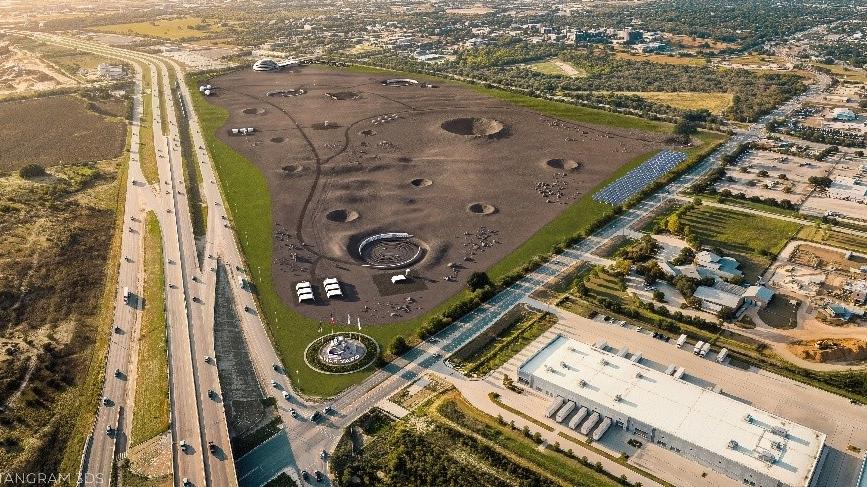


Three San Antonio-based research institutions are partnering to propel lunar exploration and construction to help NASA use the moon for science, discovery and economic benefit and to set the stage for Mars exploration.
The National Lunar Research Center initiative is a collaboration between Southwest Research Institute and the WEX Foundation — both nonprofits — and Astroport Space Technologies Inc.
Their agreement announced Tuesday aims to bring the moon to San Antonio on a 180-acre swath of land owned by and adjacent to SwRI’s headquarters on the city’s West Side. The site will be used to simulate the geography of the moon’s de Gerlache Ridge, a ridge between craters near the moon’s South Pole.
The center will be a full-scale analog of NASA’s Artemis Moon Base, which has a goal of a semi-permanent crew presence on the moon by 2032.
“NASA is committed to achieving the near-impossible once again, to return to the Moon before the end of President Trump’s term, build a Moon base, establish an enduring presence, and do the other things needed to ensure American leadership in space,” NASA Administrator Jared Isaacman said in March.
Astroport founder and CEO Sam Ximenes said his firm’s lunar civil engineering work for NASA has established “a clear engineering baseline for construction on the Moon.” The Port San Antonio-based company recently partnered with space robotics company Venturi Astrolab Inc. to build self-driving rovers that can move lunar soil to make landing sites, launch pads, berms and roads on the moon.
The new center initiative “will provide the infrastructure needed to rehearse these complex operations at scale, validating site preparation and infrastructure tools on Earth for safety and endurance before they are committed to a lunar manifest,” Ximenes said.
Louise Cantwell, executive director of the WEX Foundation, called the center a turning point in how humans prepare for an increased presence in space.
“The space industry needs welders, electricians, and all manner of skilled workers,” she said. “By integrating physical infrastructure testing at the NLRC site with skilled space technology training and certification, the Artemis generation will be prepared to build and scale the national space economy.”
The local foundation Cantwell leads integrates space technology with project-based learning for STEM education.
SwRI’s space business has grown rapidly in the past decade. It has added staff, tripled the number of researchers in its Small Spacecraft Development program and built a $35 million space system integration facility. In 2022, SwRI created its Space Sector to better organize its work. In 2023, it generated $200 million in revenue, a significant chunk of the institute’s $798 million total that year. In 2024, sector revenue was more than $223 million, according to previous reporting.
In 2025, SwRI reported its consolidated revenues hit a record high of $966 million and that the organization contributed more than $1.7 billion to San Antonio’s economy.