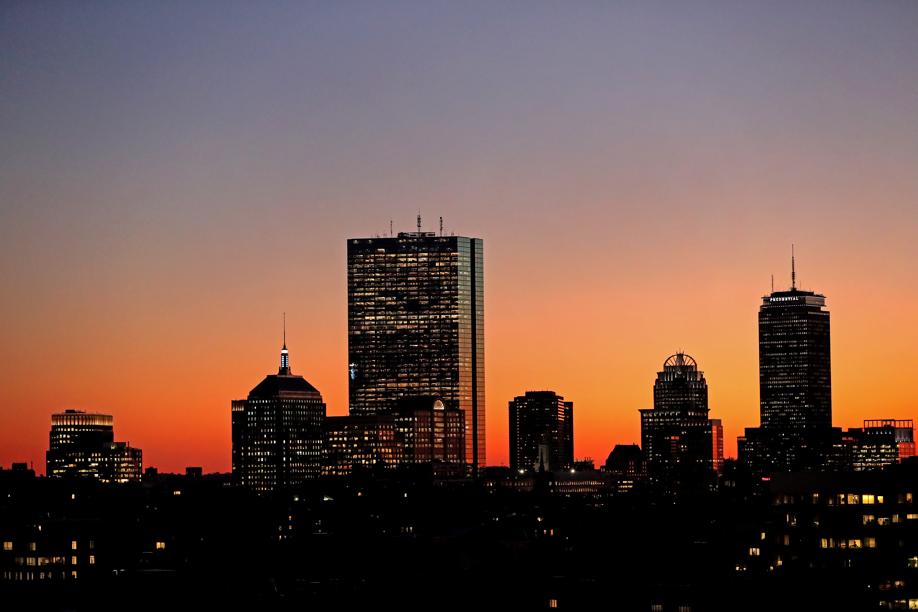
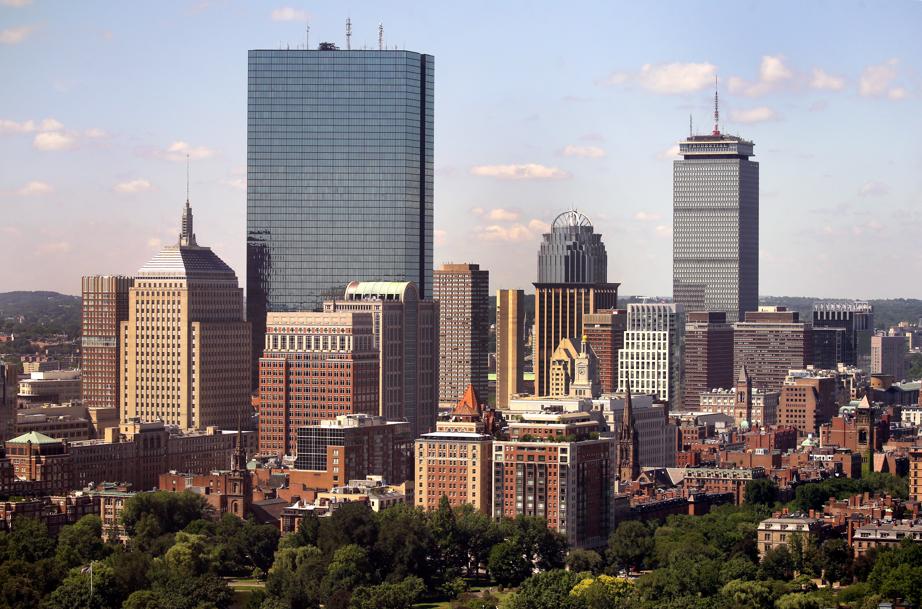


When office workers return to the Prudential Center, the Hancock Tower, 100 Federal St., and other downtown skyscrapers, they will sit farther apart, they may have their temperatures taken in the lobby, and they’ll probably have a harder time finding a place to grab lunch.
But they will return, and those partially built towers dotting the skyline will get finished and filled up. And — in the long run — the technology and life-sciences companies that have fueled so much growth in Boston and Cambridge will keep coming.
At least that’s the vision of life during and after the pandemic that was laid out Wednesday by one of the city’s largest commercial landlords.
Executives of Boston Properties, which owns the Prudential, 200 Clarendon (formerly the Hancock), a chunk of Kendall Square in Cambridge, and other prominent downtown buildings — said they plan in the next few days to roll out detailed procedures for how their high-rises will function as workers return in coming months. In the short-term, that means social distancing and safety precautions. Longer-term, it’s likely to mean more people working from home, and other flexible arrangements.
But they say it won’t mean that big companies will balk at being in dense downtown business districts, including the company’s core markets of Boston, Manhattan, and San Francisco.
“There’s the short-term issues and the much longer-term issues. I think the longer-term issue is less of a concern,’’ said Boston Properties’ president, Doug Linde. “Once we get through this particular virus, people will get back to being comfortable not wearing a mask in the office and being able to be in close proximity to each other.’’
For now, though, much is on hold.
Leasing has slowed to a crawl, as in-person tours of space are largely out of the question.
Construction shutdowns in most of Boston Properties’ major markets have stopped work both on renovations for new tenants and on new projects — though Linde said he was “highly confident’’ that towers the company is now building in Boston, such as one for Google in Kendall Square and for Verizon atop North Station, will be finished and occupied. And the company is readying plans for how everything from floor plans to elevators to HVAC systems will operate as workers return over the next few months.
“Both landlords and their customers are figuring this out right now, because the return to work is happening,’’ said chief executive Owen Thomas. “Some of our customers are just literally going to take out chairs. They’re not rebuilding their space. They’re taking out chairs.’’
So far, despite job cuts that are increasingly hitting white-collar office workers, most Boston Properties tenants are still paying the bills. Linde told the analysts that 95 percent of its office tenants paid their April rent, the exceptions being co-working providers and the corporate offices of a few large retailers. Linde didn’t divulge names, but struggling WeWork is a major Boston Properties tenant in New York.
But for ground-floor retail, particularly restaurants and quick-serve lunch spots, it’s a different story. All told, Boston Properties’ restaurant tenants paid less than one-fourth of the rent they owed in April, Linde said. With May’s rent due soon, the company is trying to work out deferments and other lease deals that it hopes will help those restaurants survive.
“It’s going to be a longer road for those [restaurants] to decide whether their businesses are sustainable,’’ he said. “But we know in almost every case they want to come back.’’
Still, there will be changes. Thomas said he expects some office tenants may try to get out of their leases, or sublease space, if layoffs spread through the white-collar economy. Work on new projects — unless there’s a tenant lined up — is on hold for the foreseeable future. And the days of piling as many workers as possible into bustling open-plan bullpens — a trend that was waning even before the pandemic — are probably over.
That will mean fewer people moving through lobbies, crowding once-bustling sidewalks, and buying lunch and after-work beers. But, Thomas predicted, it won’t mean the end of the office environment.
“Everyone I speak with wants to go back to their office,’’ he said. “They miss the efficiency of it, the camaraderie of it. I don’t think the need for office space is going to go away.’’
Tim Logan can be reached at timothy.logan@globe.com.