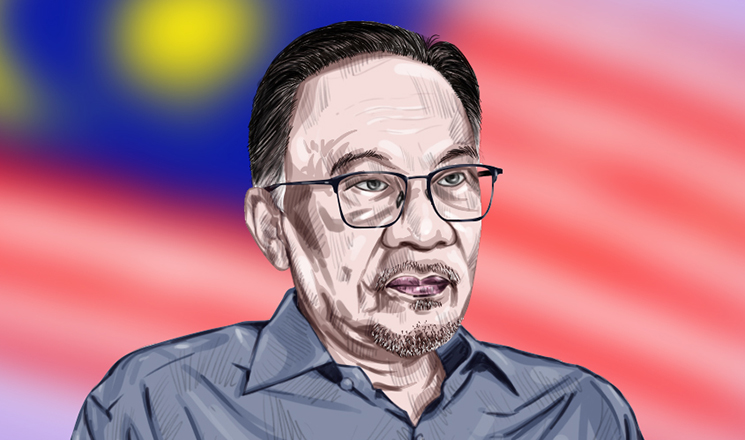


After days of political gridlock following divisive national elections that produced a hung Parliament this month, Mr. Anwar, long-time opposition leader and Malaysia’s face of democratic resistance, was named by the country’s king as its 10th Prime Minister on Thursday, November 24.
He was born in 1947 to a family of politically active parents in the small town of Cherok Tok Kun in Malaysia’s Penang, and thus his path to student politics was only natural. While his father, Ibrahim Abdul Rahman, was a hospital porter-turned-MP, his mother Che Yan Hussein was a grassroots organiser against the then-British rule in Penang. Mr. Anwar’s career began as a firebrand, charismatic student activist in the 1970s, who built on the Muslim empowerment movement and protested against the then long-ruling party United Malays National Organisation (UMNO).
He co-founded the Angkatan Belia Islam Malaysia, the country’s Islamic youth movement in 1971. He was arrested and jailed for 20 months for participating in a student protest for rural farmers. In what came as a twist in the early 1980s, he was co-opted by Mr. Mahathir into the UMNO, the very party he first opposed.
Rapidly rising up the political ranks from successively becoming the Culture, Agriculture, and Education Minister in the 1980s to assuming the Finance Minister and Deputy Prime Minister post in the 1990s, Mr. Anwar began to be seen in the country’s political circles as the protégé and heir-apparent of Mr. Mahathir. It was in this period that economic policy differences began to surface between him and Mr. Mahathir.
Split with Mahathir
Tensions in what Mr. Anwar often described as the ‘father-son’ relationship came to a head when he began advocating political reform within the UMNO and challenged the leadership of his boss, accusing him of nepotism and cronyism. In retaliation, Mr. Mahathir sacked him from the deputy’s post in 1998, which marked the start of his protests for reforms, inviting his arrest. In the next two years, he was sentenced to a total of 15 years in prison for separate charges of corruption and homosexual acts, both of which he denied and described as politically motivated.
Despite the strong caution and disapproval of his children, the politician, in what came as the biggest twist in the roller-coaster relationship between him and Mr. Mahathir, decided to collaborate with his foe for the 2018 general election as Najib Razak faced the damning 1MDB corruption scandal. After a prison visit from his former boss, Mr. Anwar said he was “forgiving”, even though an apology never came from Mr. Mahathir, for the sake of propelling the Opposition’s reform agenda. The new coalition, Pakatan Harapan, won the election while Mr. Anwar led from inside prison. Mr. Mahathir secured him a royal pardon and settled on a deal that he would be handing over the premiership to Mr. Anwar in 2020. The nonagenarian leader and longest-serving Malaysian Prime Minister, however, did not stand by his promise and refused to pass the baton, leading to political instability.
As the pillar of the Malaysian reform movement finally takes charge, it remains to be seen how he tackles the problems of corruption, inequality and inflation with his road map for a better Malaysia.