Photo by Joseph Painter Handout
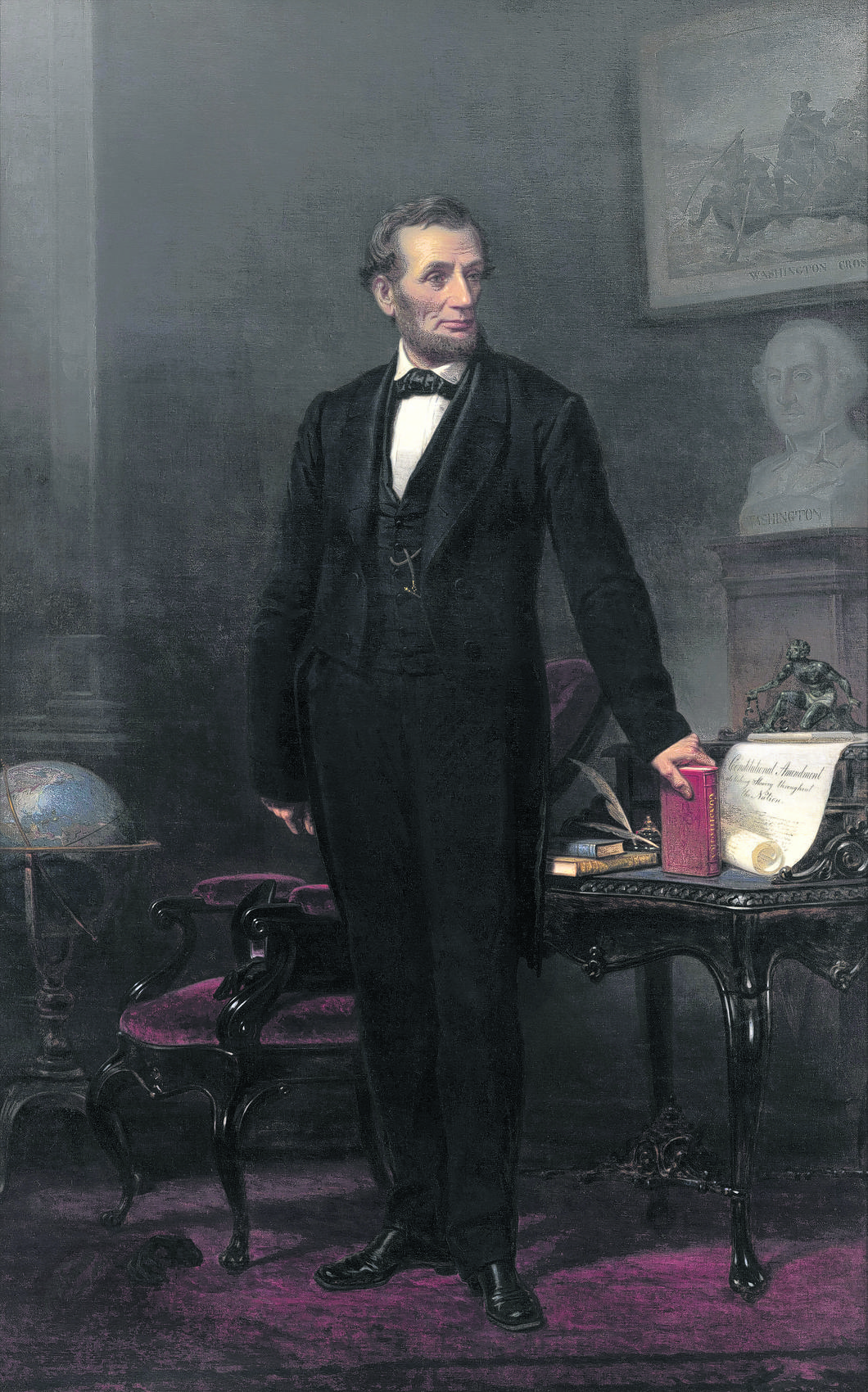
Abraham Lincoln, painted by W.F.K. Travers in 1864 or 1865.


Americans have grown used to the Abraham Lincoln of black and white photographs, reproduced in the halftones of our history books. The images remain essential – has any president ever used photography more effectively? – but they dull us into overfamiliarity. Thomas Jones, a sculptor who studied Lincoln’s face closely, noted that he put on a formal expression – an “iron mask” – whenever he needed to look presidential. That look is present in every photograph; in only one is there even a half-smile.
But three years ago, in a municipal building in New Jersey, I stood before a splendid living Lincoln, life size, in full color, with realistic skin tone, bright eyes staring off into the distance, the play of light flickering on his face. It was one of only three full-length paintings of Lincoln I know to exist, and the best of the lot. I was finishing a book about Lincoln’s 1861 train trip to Washington and trying to find accounts of what it felt like to be in his presence as he traveled through the country. Suddenly, I had that experience.
The immense painting, 9 feet tall, towers over any visitor; it overwhelmed me during that first visit. To encounter this huge Lincoln reaffirms his physical and moral presence at a time when nearly every aspect of our history feels up for grabs. To an extent, he is a guardian of tradition, touching a copy of the Constitution, while George Washington appears over his left shoulder in a framed picture and bust. But the portrait also reasserts a claim that was obvious to the Americans of Lincoln’s time: that he was the driving force behind emancipation. It portrays a president with a conscience, determined to end slavery. Next to the Constitution, the 13th Amendment is pictured on a table near a statue of a liberated African American. Behind him, a globe is turned so that the viewer can see Haiti, the country Lincoln officially recognized for the first time in 1862.
This lively portrait of our 16th president, recently restored, has resurfaced after decades of near-oblivion, hiding in plain sight where it was seen by very few Americans outside the townspeople who filed past it on their way to pay parking tickets and water bills.
How such an imposing work faded from view is an intriguing story in its own right. Congress debated its purchase for the Capitol on numerous occasions in the late 19th and early 20th centuries but balked at the price. As lawmakers considered its fate during those years, it hung in the Capitol, usually in the Naval Committee Room. Eventually, it was bought by one Rockefeller, then acquired by another, Geraldine Rockefeller Dodge, who installed it in a building she donated to the town of Madison, N.J., in memory of her son. That building, dedicated in 1935, became the borough hall and a shrine to local democracy. There, Madison’s citizens could crowd in and conduct the noisy business of self-government (for a time, an alarm on the roof summoned volunteers whenever anyone saw a fire), and the painting slowly disappeared into the background.
In recent years, however, the trustees of the foundation that maintains the building began to realize that they had something special. In 2017, they learned that a bust in their possession was a creation of the great French sculptor Auguste Rodin. Looking around at other artifacts, they saw the Lincoln painting in a new light and set out to study its provenance.
Since then, they have uncovered new information, thanks to an internal report by a scholar at Marshall University, Stefan Schoeberlein. To begin, they had to unlearn some of shaky assertions in the historical record. When Congress was debating the purchase, many stories were told of the artist, W.F.K. Travers, who was described as a German immigrant eager to fight in the Civil War but rejected for a medical condition. According to these accounts, Travers met Lincoln on the street in 1864 and offered to do his part by creating a great painting. Lincoln acceded to the request and sat for Travers.
After the assassination, Travers completed the painting in Europe, then sold it to an American diplomat in Frankfurt. In 1876, it was prominently displayed at the Centennial Exposition in Philadelphia, where, according to lore, Mary Todd Lincoln fainted upon seeing it.
Schoeberlein has discovered some holes in this record: It is not clear that Travers ever tried to join the army. He may have painted Lincoln in 1865, not 1864 – that would explain the prominence of the 13th Amendment. And he was more Dutch than German, although he had lived in a dizzying array of places, including Honduras, Greece and Italy. Also, there is no evidence that anyone ever fainted. None of this diminishes the power of the painting.
As Lincoln’s friends knew well, there was an infinite range to his facial expressions – a lip that curled a certain way, creases that crinkled with mirth when he told a story, and those “faraway eyes,” as one close acquaintance described them. Walt Whitman wrote that Lincoln had a face “like a Hoosier Michelangelo, so awful ugly it becomes beautiful,” but also endowed with rare qualities, as hard to capture as “a wild perfume or a fruit-taste.” He hoped a great painter would someday capture its “peculiar color,” and “the lines of it, the eyes, mouth, expression.” He was not optimistic. “The current portraits are all failures,” he concluded.
Did Travers rise to Whitman’s almost unattainable level? That is for the public to decide. But the faraway eyes are present here, and the iron mask is gone. It’s an arresting portrait, better than the others, and worthy of a wider audience. Washington is filled with mediocre paintings of Lincoln, including an undistinguished portrait hanging in the Oval Office, painted in 1915, and a problematic painting in the White House’s State Dining Room, of a seated Lincoln, by G.P.A Healy. It has redeeming qualities – the face is well rendered – but it was cut away from a larger project, a group study, and it shows Lincoln in an awkward position, his long legs tucked uncomfortably beneath him. Nearby, in the East Room, George Washington is shown standing to his full height in the famous Lansdowne Portrait by Gilbert Stuart.
Lincoln should be standing up, too.
During his political rise, audience members would thrill as he stood, a towering 6-foot-4, and rhapsodized about the promises of the Declaration of Independence, to all Americans. Something of that feeling is present here. A close friend of Lincoln’s, Ward Hill Lamon, wrote, “in my judgment the Travis [sic] portrait is the most lifelike picture of Mr. Lincoln that I have ever seen on canvas . . ., [it] presents a real likeness of the man, with his rugged features and irregularities of personal appearance, true to life.”
It is unclear what lies ahead for the portrait, which narrowly escaped destruction in a warehouse fire early in its history. But the Hartley Dodge Foundation, which owns it, seems more than willing to share. Nicolas W. Platt, the foundation’s president, said they would consider lending to an institution “that can make viewing this extraordinary piece of our nation’s heritage available to a large audience.” In any event, it is exciting to know that our most familiar president has become a bit less familiar, thanks to the restoration, and a colorful new way of seeing him.