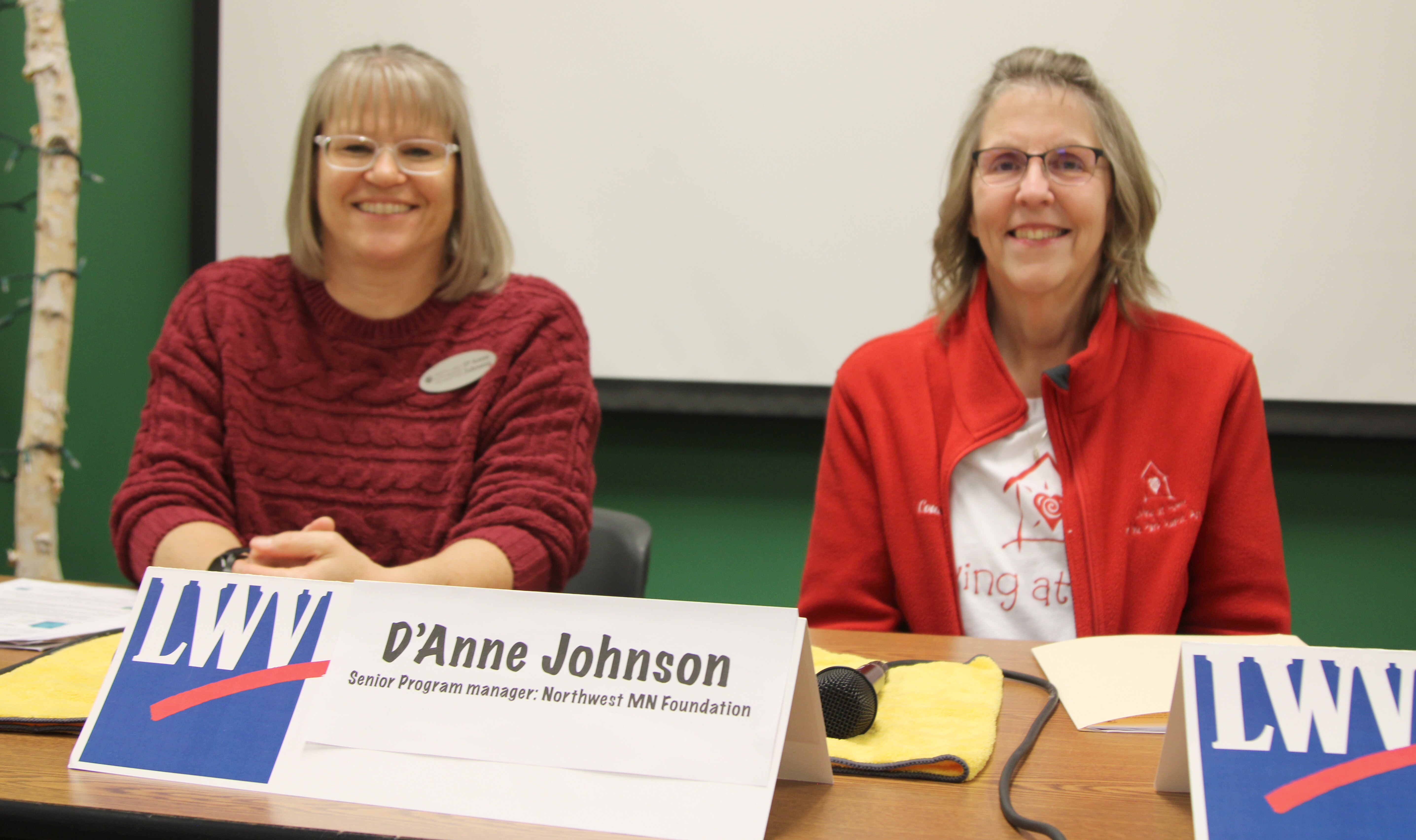
D’Anne Johnson and Connie Carmichael addressed the challenges and solutions for aging in the Northwoods at a Nov. 19 forum.


Twenty-six percent of Hubbard County’s population is over 65 years old. The statewide average is about 17%, said Living at Home of the Park Rapids Area Director Connie Carmichael.
She spoke at an “Aging in the Heartland” forum hosted by the Park Rapids Area League of Women Voters on Nov. 19.
Currently, Carmichael said roughly 5,600 out of 21,500 county residents are over 65.
By 2030, the county’s population is projected to grow to 31 to 33%, she said.
“This area of the state is the first area where the population 65 and older is now larger than the population in public school K-12. We’re growing. It’s not about birth rate at this point. It’s about who is already here,” said D’Anne Johnson, senior program manager for community health and wellness for the Northwest Minnesota Foundation (NMF).
Johnson’s primary focus is strengthening elder care, working with local organizations, service providers and policymakers to address the evolving needs of the aging population.
Challenges facing Hubbard County seniors
There are senior services, Johnson said, but the problem is a communication gap. “You may not know how to get a referral to somewhere. You might not know where their phone number is. You might not trust them because you don’t know them,” she said. “That’s where we found the problem is: We don’t know what we don’t know.”
Dancing Sky of Area Agency on Aging conducted a survey of 309 people in a 12-county region, with 5% of results coming from Hubbard County, according to Johnson.
Among the top challenges listed by Hubbard County seniors in the focus group were as follows:
• affordable services for home repairs or yard work;
• affordable home care services;
• safety;
• emergency preparedness.
Regarding the emergency preparedness, Johnson explained, “The older population didn’t know what the plans were. They didn’t feel comfortable with what they were supposed to do, and they didn’t know who to ask questions of.”
In the NMF region, they identified the highest needs based on the survey. “The top occurring themes across the region aren’t going to shock you,” she said. They are the following:
• housing;
• transportation;
• in-home services;
• legal services;
• mental health services;
• social connections;
• emergency and disaster planning;
• and safety.
NMF connects people with resources, Johnson emphasized. They don’t provide direct services.
Johnson said elderly can be divided into two populations: those who embrace technology and those who don’t use it at all.
As a result, there needs to be both print and web-based resource guides, Johnson said.
Access to in-home services in more rural, remote parts of the county is more challenging because of increased travel times and lack of public transportation, Johnson said.
Carmichael agreed. The cost of mileage is higher, for example, to travel from Park Rapids to Laporte and back again.
There are willing volunteers, Carmichael said, “it’s just a much bigger ask,” so the pool of volunteers “gets much smaller.”
Paid staff have the same problem. “I hate to say this, but it comes down to funding,” Carmichael said.
Johnson said Medicaid, Medicare and private pay insurance don’t reimburse for “empty load time.”
And older adults have a limited income, Johnson added.
Carmichael said seniors have been known to sit in the lobby of a hospital in their jammies after being discharged, waiting until 8 a.m. when a neighbor wakes up. There is a Lyft service in Park Rapids now, but LAH has been trying to meet this problem, she said.
LAH encourages seniors to have a backup plan in case of emergency, such as knowing who can care for your pet.
“We just have to be there for each other. It’s neighbor helping neighbor. You want to thrive in the community that you love and we want you here,” she said.
Technology hub and food security for seniors
Seniors want to remain in their homes and independent, Johnson said, adding, “We found out that’s the cheapest place to live as you age. If we’re going to continue to care for people we’ve got to figure out how to serve people in their homes,” particularly in rural Minnesota.
Older Minnesotans have big decisions to make, Johnson said, and they prefer one-on-one legal help. That’s one problem to solve, perhaps by recruiting law students from area universities, she suggested.
Mental health providers are using telehealth, but that doesn’t suit the elderly who shy away from technology, Johnson noted.
Carmichael said she wants to put a technology hub in the Park Rapids Senior Connections.
“Exciting things are coming down the pipe, but it all costs money,” she said.
Food security is “more and more important every day,” Johnson said, with SNAP benefits being cut off. For the same money that one food shelf meal provides a senior, SNAP can create nine meals, she noted. “So we really need to be talking to our legislators about the importance of SNAP.”
The federal bill will cut 27,000 Minnesotans off of SNAP, according Brian Long, a Hubbard County Food Shelf board member. In Hubbard County, he said that’ll put about 150 people “in serious change.”
Carmichael shared a recent occasion where a gentleman noticed a jar of peanut butter donated to Senior Connections in Park Rapids.
“He was almost in tears because he got a free jar of peanut butter. That just happened two weeks ago. It makes me choked up just to think about it,” Carmichael said. “He went home and had peanut butter toast, right? And didn’t have to worry.”
Johnson said, “We have so many people in the world who are just a paycheck away from being homeless. A paycheck away from not being able to feed their families.”
Becoming an Age-Friendly Community
Johnson said there’s a need for a “community navigator” to direct seniors to resources.
Cities can also become “age-friendly communities” (www.aarp.org/livable-communities/network-age-friendly-communities and mn.gov/dhs/age-friendly-mn).
Bemidji just started the process, Johnson said, and grants are available for community-based projects that address all ages and all needs. For example, sidewalk cutouts benefit baby strollers, crutches and wheelchairs.
Through NMF’s subsidiary North Star Neighbors (northstarneighbors.org) program, energy-efficient, high-quality homes are being built. The goal is to sell them at a much lower price through a community land trust, with some earmarked for the aging, Johnson explained. Examples are in Ada and Bemidji.
NWF found the fastest growing demographic of homelessness is the elderly, Johnson said.
She talked to Akeley Regional Emergency Shelter staff, who said their biggest struggle is helping an elderly homeless person who has medical needs, like diabetes or a hip replacement. Without additional training, shelter staff isn’t qualified to provide medical assistance.
“Not that people don’t want to serve them. They just want to make sure they’re serving them with respect and the care that they need,” Johnson said.
Both Thief River Falls and Bemidji received Age-Friendly Minnesota Grants to conduct housing studies. 55-plus housing is workforce housing, Johnson explained. Seniors need right-sized housing in their communities so their four- or five-bedroom house becomes available for families moving into town for a new job, she explained.
Carmichael invites the public to tour Senior Connections and learn about local resources.
“As a senior, we just want you to come in the door and have a cup of coffee with us and we will walk the journey with you,” she said.
Caregiver Closet served 441 people in a fourth-month period, according to Carmichael. They served over 1,000 people in Senior Connections “and it’s growing and changing every week and every month.” That’s over and above LAH’s regular clients, she added.
With over 100 volunteers mobilized, Carmichael said, “Just point people to us and we’ll take it from there.”
Shannon Geisen can be reached at sgeisen@parkrapidsenterprise.com.