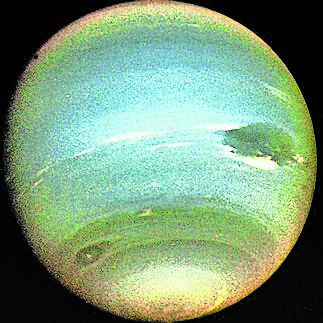


Deep in the frozen outer reaches of the solar system, the James Webb Space Telescope has discovered a stubborn survivor that was not believed to exist by astronomers.
The major moons swirling in wide orbits around Neptune were thought to be bits of cosmic debris — from embryonic planets to icy rubble — that had been captured by gravity and sucked into the Neptunian orbit.
But one of them stands out as different, scientists have discovered. Nereid, the third largest of Neptune’s satellites, is an original Neptunian moon that has accompanied the planet since the dawn of its creation and has defied the odds to survive obliteration when larger objects came crashing in from deep space.
Rather than being an alien object hoovered up by Neptune’s gravity, Nereid is likely to have formed at about the same time as the planet itself.
It managed to remain intact even after the much larger object Triton, which is thought to have been a Plutolike embryonic planet or “planetesimal”, was captured by Neptune and came thundering in like a wrecking ball to cause chaos in orbit around the giant icy blue planet, becoming the largest Neptunian moon.
Triton’s arrival threw Nereid into an unusual “eccentric” orbit around Neptune, leading astronomers to think it was unlikely to be an original moon, as these tend to follow more circular orbits, but observations with the James Webb telescope have now changed their view.
Neptune is the eighth and most distant planet in our solar system, orbiting at about 2.8 billion miles from the sun.
The solar system continues to stretch past Neptune for many billions of miles, however, out into the Kuiper Belt, a region of icy objects including dwarf planets such as Pluto, and far beyond.
Until the Voyager 2 probe reached Neptune in 1989, only three moons around the planet were known about, including Nereid, which was first spotted in 1949 from an Earth-based telescope. Voyager 2 discovered five more, and more powerful modern telescopes have taken the number of large moons to 16.
The outer moons were thought to be KBOs, or Kuiper Belt objects, that had been dragged out of the belt into Neptune’s orbit.
The Nasa website says Nereid is “so far from Neptune that it requires 360 Earth days to make one orbit. This odd orbit suggests that Nereid may be a captured asteroid or Kuiper Belt object or that it was greatly disturbed during the capture of Neptune’s largest moon, Triton.”
However, the James Webb telescope has now observed the moon in near-infrared light and found it has a highly reflective icy surface made of crystalline water ice that reflects more light at the cooler or bluer end of the infrared spectrum, making it different from all other known Kuiper Belt objects.
The study, published in Science Advances, suggests that some of Neptune’s inner moons, such as Proteus, are likely to have formed from the debris left behind after some of Neptune’s other original moons were torn apart.
It said: “Our proposed ‘regular satellite genesis’ story for the moon leaves Nereid as the singular intact original satellite of Neptune. Neptune’s innermost moons, such as Proteus, are reaccreted pieces of satellites destroyed by Triton’s capture.”