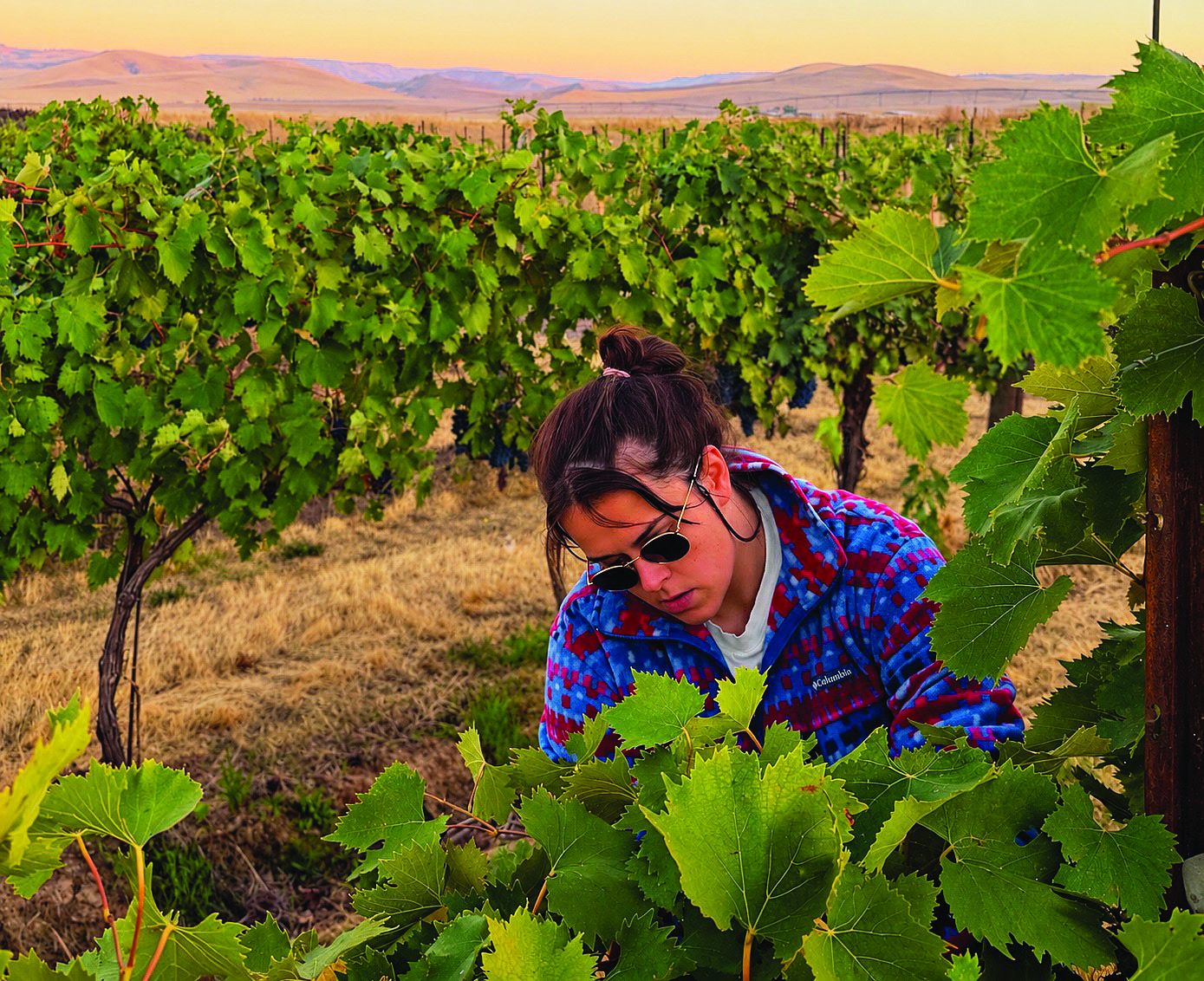
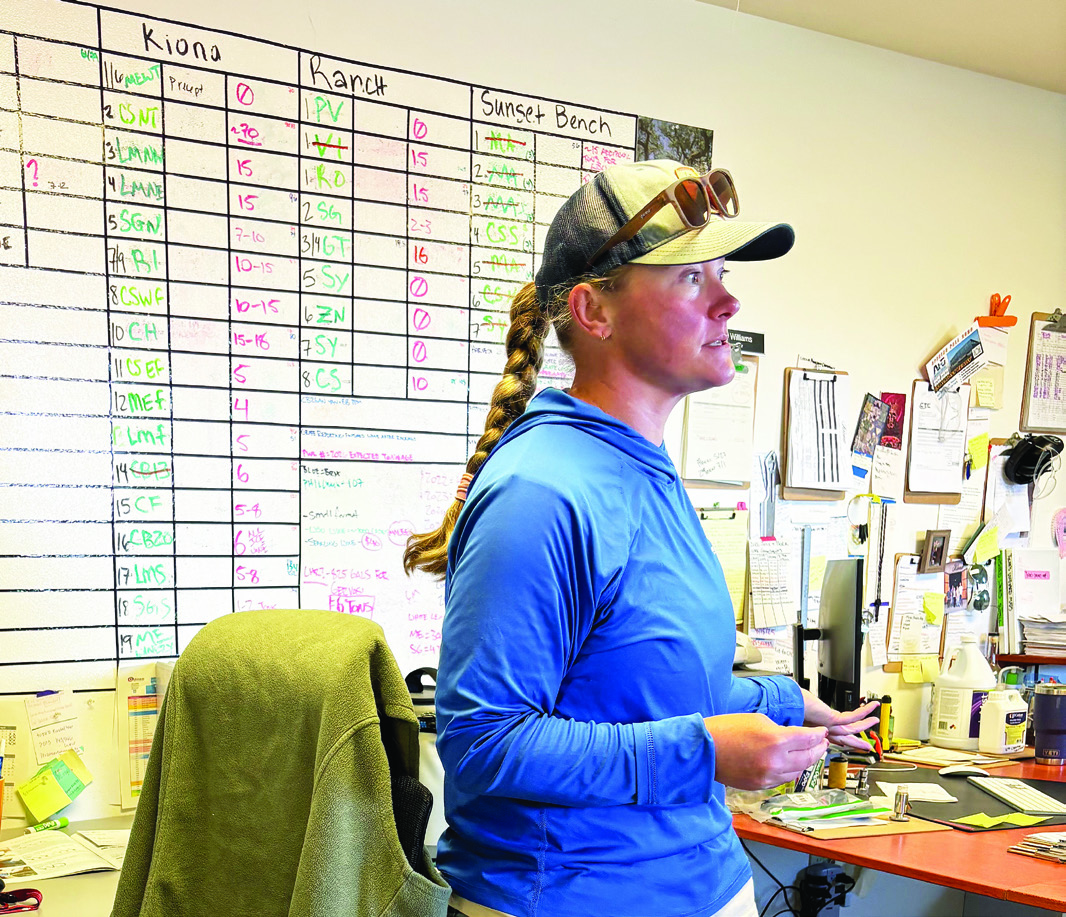


It’s the middle of grape harvest at Kiona Vineyard in Benton City, and enologist and grape contracts manager Mellissa Whitaker, like everyone at the place, is busy.
She’s crushing a sample of grapes to prepare them for testing. She will return to various rows in the vineyards during the day to collect more samples with a practiced approach as she walks, reaching in at intervals, pulling some grapes high, some low, some more shaded, others more exposed, to get a representative sample of that block of grapes.
Each sample will be carefully labeled, juice will be extracted and tested for pH, Brix (sugar levels) and more.
Her phone rings. A grape buyer saw a picture on social media about a grass fire and is worried their grapes could be impacted (the fire, and smoke, were nowhere near).
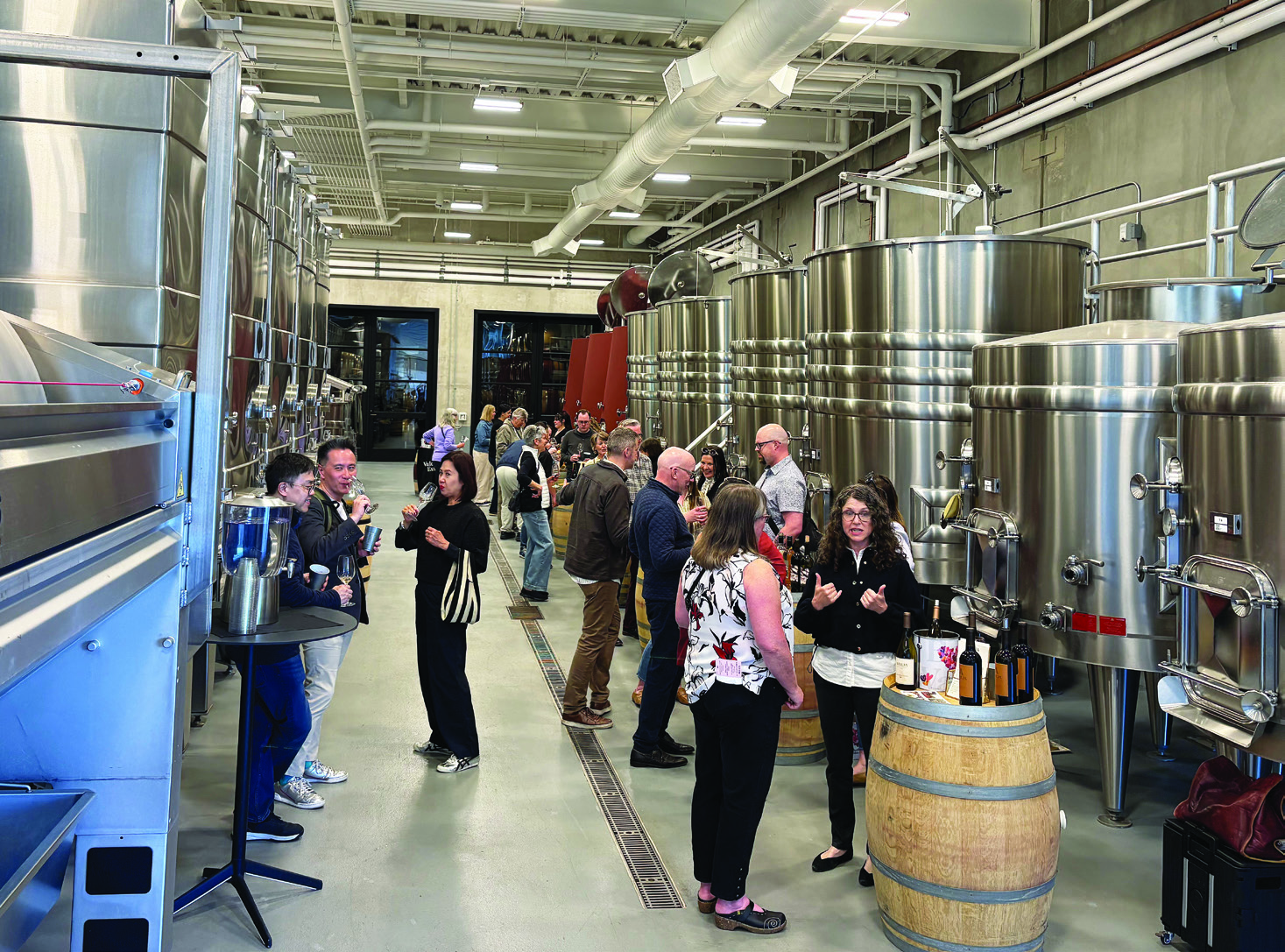
On her way back to the lab and office, she checks on the tank cleaning in prep for a press the next day. Showing a visitor the pressing equipment, she spots some residue from the previous pressing, grabs a spray bottle of ethanol and cleans it away.
Her phone rings again, another buyer with questions.
Heading toward the lab, she stops to confer with her boss, discussing wine that just started its fermentation a few days earlier. Now at the lab, Whitaker prepares the samples she’s gathered, carefully labeling each vial, washing her hands between every step and gloving up.
So goes the glamorous life in wine.
Most of us don’t know about the years and layers of work that go into every bottle of wine, nor the people responsible for that work, which include more and more women.
Female-owned wineries accounted for about 11% of Washington’s more than 1,000 wineries in a recent Washington State Wine Commission estimate; 18% had women in ownership or winemaking roles. Also, women account for 59% of U.S. wine purchases.
To support and recognize those women, the nonprofit Alliance of Women in Washington Wine launched in 2021.
According to President Megan Simmons, the Alliance “cultivates a more inclusive and equitable wine industry.” She notes that the alliance sponsors professional development and promotes leadership opportunities for women.
The alliance also highlights the work of women who helped pioneer the state’s modern wine industry through its biennial Great Women of Washington Wine awards.
Honorees include growers, winemakers, researchers, marketers and consultants.
The group also awards scholarships and hosts events.
“The women who came before me made my experience possible, allowing me to focus on learning the craft, building my knowledge, and growing in the industry,” said Kacie Salon, a viticulturist in Walla Walla with Results Partners.
One of those women is Mimi Nye.
Nye was the vineyard manager at Chateau Ste.
Michelle’s Canoe Ridge Estate Vineyard in the Horse Heaven Hills AVA near Paterson from its inception in 1991 until she retired in 2016. She said she “didn’t mind being one of the only women in my field. I got lots of encouragement from the people around me.”
As women lead in an increasing variety of roles, they continue to pave the way for those who come after them.
“One of the most rewarding parts of my career now is helping create opportunities for the next generation,” said Katie Nelson, vice president of winemaking for Ste. Michelle Wine Estates, who’s been in the industry nearly 30 years. “It’s exciting to see more women pursuing careers in viticulture, winemaking and leadership across Washington wine.”
“People often underestimate how much knowledge and experience is required to produce a bottle of wine,” said Jean Peterson, professor and the founding chair of WSU’s Viticulture and Enology Department. “Wine is agriculture, chemistry, microbiology, engineering, sensory science, economics, hospitality, marketing, regulation, environmental stewardship and workforce development, all at once.”
All ag-related programs, but the wine field particularly, require collaboration and “trust building among groups that may have very different priorities,” she said. The bridges between “scientific knowledge and practical experience” take constant maintenance.
Julie Tarara, research program manager for the Washington Wine Commission, came to wine after years of experience and training in agriculture, including a doctorate in agronomy. She has worked as a USDA researcher, viticulturalist and consultant, and now helps prioritize wine-related research and foster collaboration across the industry and region.
She said that “there have been more women in the winery than the vineyard in the past, but that’s changing.” Tarara, like others, encourages women not to wait until they feel ready. “Good people will grow into their role.”
Brooke Delmas Robertson helped launch Delmas Winery/SJR Vineyard, operating on both sides of the border in the Walla Walla Valley, with her parents in 2009 before gaining experience in every part of winemaking at wineries in the U.S. and abroad. In 2023, she took on leadership of the family business as director of winegrowing.
Delmas Robertson said that lifelong learning is essential to good winemaking, and that includes travel. “Travel, experience the world and the wines of the world,” she said. “Work for as many people as you can, in as many different regions and countries as you can. Taste everything. Attend every lecture, seminar, visiting winemaker chat you can.”
Back at Kiona, Whitaker is coordinating a grape harvest with Liberty Lake Wine Cellars, owned by Mark and Sarah Lathrop.
Sarah Lathrop is also president of the Spokane Winery Association – and the group’s board is all women.
She sees more young women “at the table in industry meetings, in a variety of roles” including “marketing and the business side.” Lathrop thinks that women may be more often attuned to helping make wine more accessible, “less snobby.” For her, “wine is a kind of community – something to share, and a chance to join with friends over a bottle.”
Wine’s ability to bring people together is part of the draw for people in the industry.
“For millennia, wine has been a facilitator of conversations, like-minded and otherwise,” Delmas Robertson said.
For Nelson, it “started around my Italian grandparents’ kitchen table. I saw firsthand how wine could bring people together, spark conversation and make an ordinary meal feel special.”
Whitaker came to the wine industry after serving in the military. She wanted “something where people had the gumption and work ethic” she had experienced in her Marine career, and with the determination summed up by the motto: “adapt and overcome.”
Looking ahead, Salon said “the greatest opportunities over the next decade will come from embracing that evolution: being willing to move beyond certain traditions, experimenting with new styles, and meeting consumers where they are while continuing to produce quality grapes and wines. I think there’s a lot to be optimistic about if we are willing to evolve.”