

DALLAS — On Sunday, a team of Wylie East High School students packed their bags and set out on a five-day, 631.7-mile journey across Texas in a solar-powered car they built with their own hands.
These students will be participating in the 30th annual Solar Car Challenge, a program founded in 1993 by educator Lehman Marks to help motivate students in science, engineering and alternative energy.
The race is the culmination of anywhere from 1 to 2 years of preparation by teams of high schoolers, in which students plan, design, engineer and build a roadworthy solar car from scratch.
“It’s about taking a vehicle, building it, and then learning how to efficiently use it,” Marks said, “so that the energy you get into your batteries during the day will last you throughout the day.”
The Solar Car Challenge is often called a “brain sport,” said Marks, the founder and president of the Solar Car Challenge Foundation.
Since its establishment, the challenge has been named one of the top science and engineering programs in the country by Tech & Learning magazine and has exploded in scope with more than 261 solar car projects currently underway across 39 U.S. states and countries including Singapore, China and Spain.
This year, 24 teams from seven states across the U.S. will race from Fort Worth to Fort Stockton, competing to see which team’s car can cover the greatest distance. Ten of the teams are from Texas, seven from California, three from Oregon, and one each from Michigan, Florida, New York and Washington. The race is sponsored by companies including Dell and Lockheed Martin.
The race route threads through some of Texas’ most varied terrain, with overnight stops in Palestine, Round Rock, Fredericksburg, San Angelo and Fort Stockton. And as part of a tradition started by Marks, teams will stop for photos at each historic Texas courthouse they pass along the way.
During the race, teams must run constant calculations and monitor channels of communication. Most teams have a “strategy group” in a chase car following the solar car, radioing the driver about whether to speed up, slow down or pull over to recharge.
There are five divisions students can participate in, each with its own requirements: the classic, advanced classic, advanced, electric-solar powered and cruiser.
During the race, car breakdowns, weather conditions, terrain and team experience will limit the miles a team can drive per day. To ensure the cars are race-ready, they each must face something called “scrutineering”: a rigorous evaluation by a panel of experienced judges where the cars are tested to see if they meet safety and technical standards.
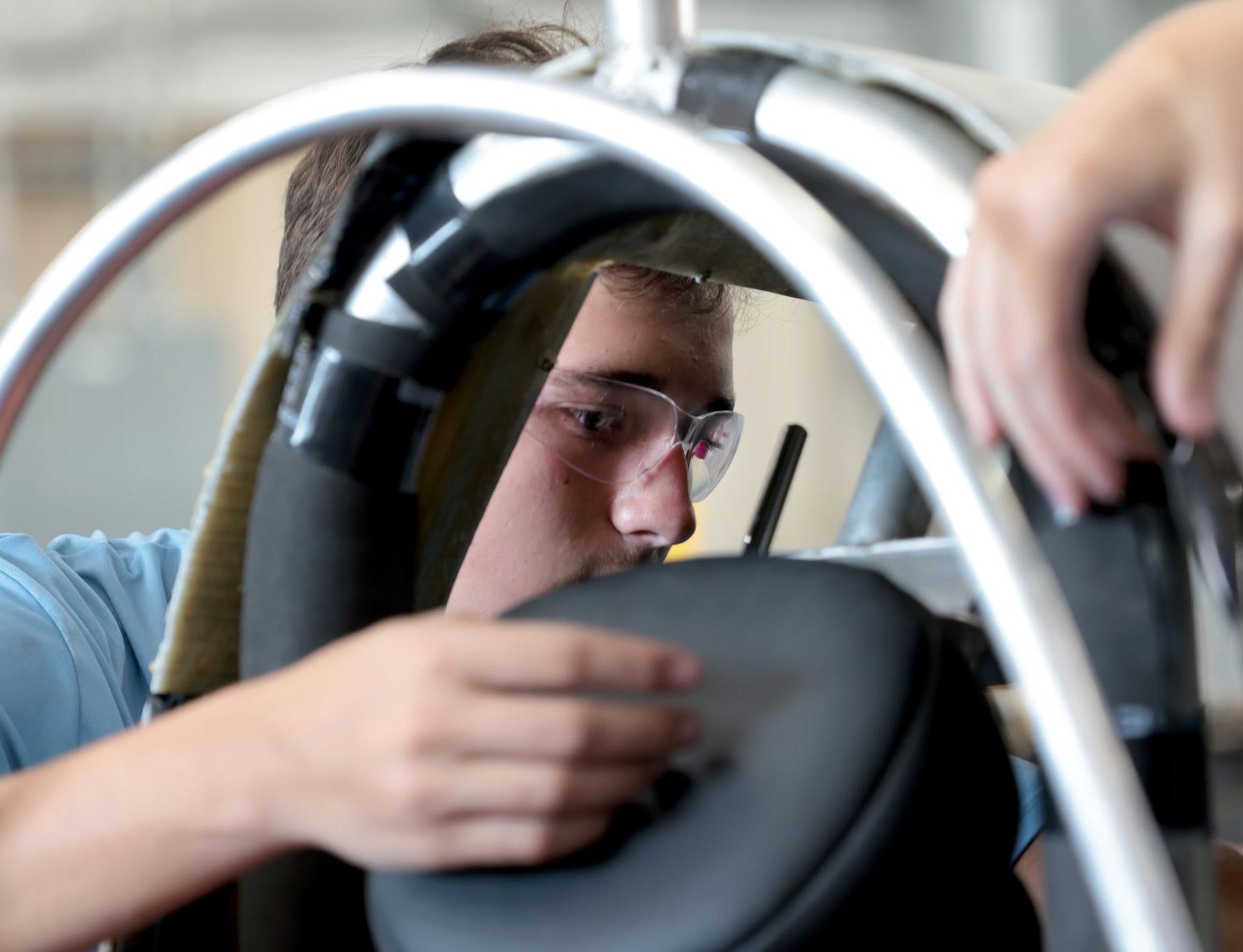
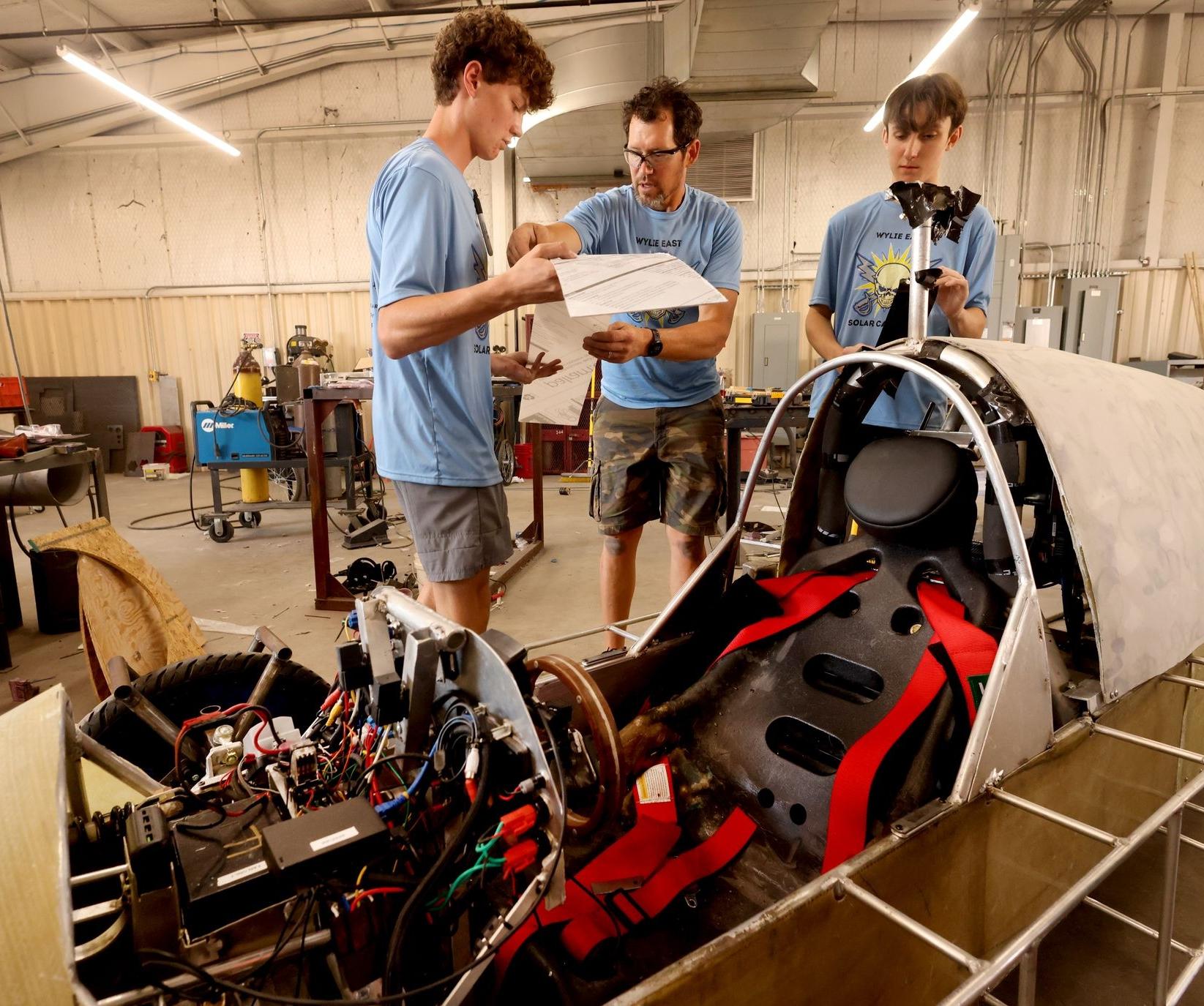
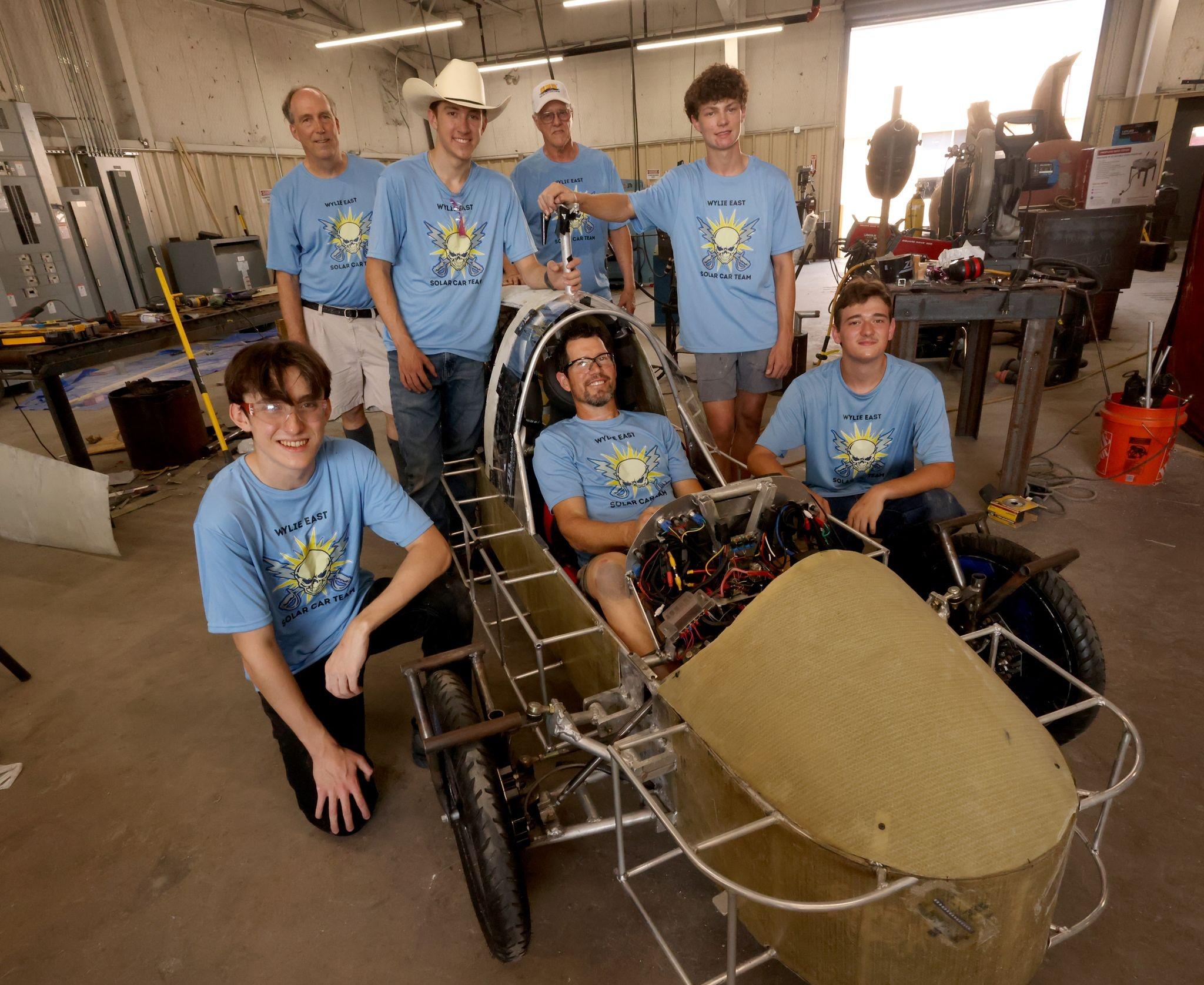
Reigning championsInside a hot, noisy garage tucked behind Burnett Junior High School in Wylie, northeast of Dallas, a team of Wylie East High School students has been hard at work welding, wiring and fine-tuning the car they will be driving across the state.
About eight students will be participating in the race, but more than 20 have cycled through the team throughout the school year. The core team, including Dylan Nord, Jayden Guild, Trevor Scott and Wes Robinson, have shown up to every building and design meeting, spending countless hours perfecting their vehicle.
The team derived a lot of design inspiration from their previous car, which carried them to first place during races at the Texas Motor Speedway the last two years.
“What we had last year worked really well,” Guild said. “But this year we had to incorporate a larger crush zone and a safety cell, so we had to modify it and make our car a little bit wider, a little bit bigger in general.”
Nord, Guild, Scott and Robinson will each take turns driving the vehicle throughout the duration of the over 600-mile race and will be competing in the advanced classic division.
When asked if they were nervous for the race, Scott said, “No, ‘cause we know we’re gonna win.”
Student outcomesThe students from Wylie East initially joined the club due to their interests in racing, engineering and hands-on mechanical work.
Nord and Guild aim to use the knowledge gained from their involvement in pursuing careers in construction and mechanics, respectively. And Scott, who aims to become a motorsports mechanic for a racing team, expressed his gratitude for the hands-on experience with fabrication he gained from the program.
Robinson explained he wasn’t planning on going down the STEM pipeline, and rather expressed an interest in law. “The solar car challenge has a very lengthy list of rules,” he said. “And you have to be able to remember and apply a lot of them, especially in scrutineering.”
Students from Wylie East who have participated in the program have already seen incredible career success and frequently cite the Solar Car Challenge as a pivotal moment in their paths, said Tony Roseberry, one of the assistant sponsors and a former welding teacher at Wylie East High School.
“There’s former students that will be in town and drop by to visit,” said Charles Livingston, a mentor for the Wylie East solar car team. “You can just tell by their eyes. They still love it, and love that it’s still going on.”
Some students even come back after graduating to assist with the program as interns, Marks said.
Roseberry recalled how one former student, who was the captain of Wylie East’s solar car team, attended Harvard and went on to build satellites for NASA’s Jet Propulsion Laboratory in California.
“He wrote us a letter explaining that out of all the things he did in high school, Solar Car was it for him,” Roseberry said.
Other students have received grants and internships thanks to their involvement in the program.
“Last year we had a student have an internship offered to them from Lockheed Martin at the race, just for talking to him and being part of Solar Car,” said Matt Karlsen, the current welding teacher and adviser for the Solar Car Challenge at Wylie East.
“What they’re going to learn is how to be a success, how to fail and how to pick themselves back up again. How to work together as a team,” Marks said. “That’s something that most high schoolers never have a chance to learn.”
Niamh Ordner is a science reporting fellow at the Dallas Morning News. Her fellowship is supported by the University of Texas at Dallas. The News makes all editorial decisions.