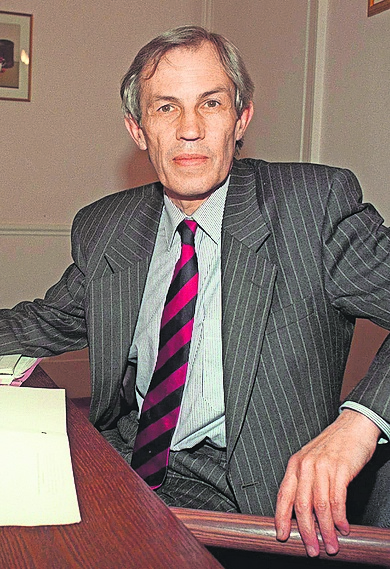


The present system of having a crossparty “select” committee of backbench MPs to scrutinise the work of each government department was introduced in 1980, during Margaret Thatcher’s first term as prime minister. The committees were empowered to summon and cross-examine ministers, but their powers regarding civil servants were less clear-cut. To what extent could officials be held accountable, and how much could they be expected to reveal? After all, their job was to advise ministers and implement government policy — not to decide it.
To resolve that question Edward Osmotherly, a courteous, well-respected, old-school civil servant in the Machinery of Government Division of the Cabinet Office was asked to develop a set of guidelines which became known as the “Osmotherly rules” and have largely survived to this day. They stipulate that civil servants are not directly accountable to parliament and cannot be summoned by select committees; if their appearance is disputed, their minister should attend instead.
The rules also cover other potentially problematic situations. Can a select committee summon a retired civil servant? Do civil servants enjoy parliamentary privilege? At what point does the cost of them supplying information become excessive? Are they covered by sub judice laws? Can they withhold and redact evidence on national security and public interest grounds? Osmotherly believed the select committee system was an essential component of a parliamentary democracy, and his rules struck a balance between the rights of the committees and those of civil servants. He was rewarded for that, and for a lifetime of public service, with a knighthood in 2002, and by having a rodent-catching cat named after him by the Cabinet Office in 2016.
Edward Benjamin Crofton Osmotherly was born in Down Hatherley in Gloucestershire in 1942, the second child and only son of Crofton and Elsie Osmotherly, both teachers. He was raised in East Ham, east London, and attended the local grammar school where his academic talent secured him a place at Fitzwilliam College, Cambridge.
After graduating with a degree in history and anthropology in 1963, he joined the Ministry of Housing and Local Government, and within three years was serving as a ministerial private secretary. One of his ministers, Bob Mellish, liked to relax in a sauna at the end of the week and expected Osmotherly to accompany him with his box of official papers.
In 1970 he married Valerie Mustill, his boss’s daughter. They settled in north London where they had a daughter, Zoe, who works as an administrator at a barristers’ chambers, and a son, John, a technician at University College London.
In 1972 Osmotherly won a year-long Harkness fellowship which took him to the Brookings Institution in Washington and — after a road trip across the US — to the University of California at Berkeley. On his return he joined the Department of the Environment, spent a year on secondment to the board of British Railways, and in 1980 joined the Cabinet Office where he was given the task of developing what a journalist dubbed the “Osmotherly rules”.
In 1982 he joined the Department of Transport where he occupied several senior roles over the following decade and was closely involved in the privatisation of British Railways during John Major’s premiership. In 1993 he left the civil service after 30 years, but remained a public servant. He spent eight years as a local government ombudsman, investigating complaints against local councils. He also chaired a review of ways to improve the government’s business statistics. His report was published in 1996, and led to the creation of the independent Office for National Statistics through a merger of the Central Statistical Office and the Office of Population Censuses and Surveys.
He was rewarded with a knighthood and having a cat named after him
Finding himself bored after leaving the ombudsman’s job, he became an adviser to the European scrutiny committee of the House of Commons — one of the committees to which the Osmotherly Rules applied.
He finally retired in 2010, and indulged his love of reading. A few years later he was diagnosed with a rare form of dementia called posterior cortical atrophy (PCA) which affected his sight and spatial awareness but not, at least to begin with, his memory and cognitive abilities.
In 2018 he participated in a research project at University College London where he was asked to perform tasks such as painting lines on a canvas with motion sensors attached to his body.
There he was interviewed by Fergus Walsh, the BBC’s medical correspondent.
The project was “much more fun than a drug trial”, he joked before issuing a heartfelt plea to the public: “Please talk to people with dementia as if they were human beings. Don’t be frightened of them.”
Sir Edward Osmotherly, civil servant, was born on August 1, 1942. He died of PCA on February 18, 2025, aged 82
Email: obituaries@thetimes.co.uk