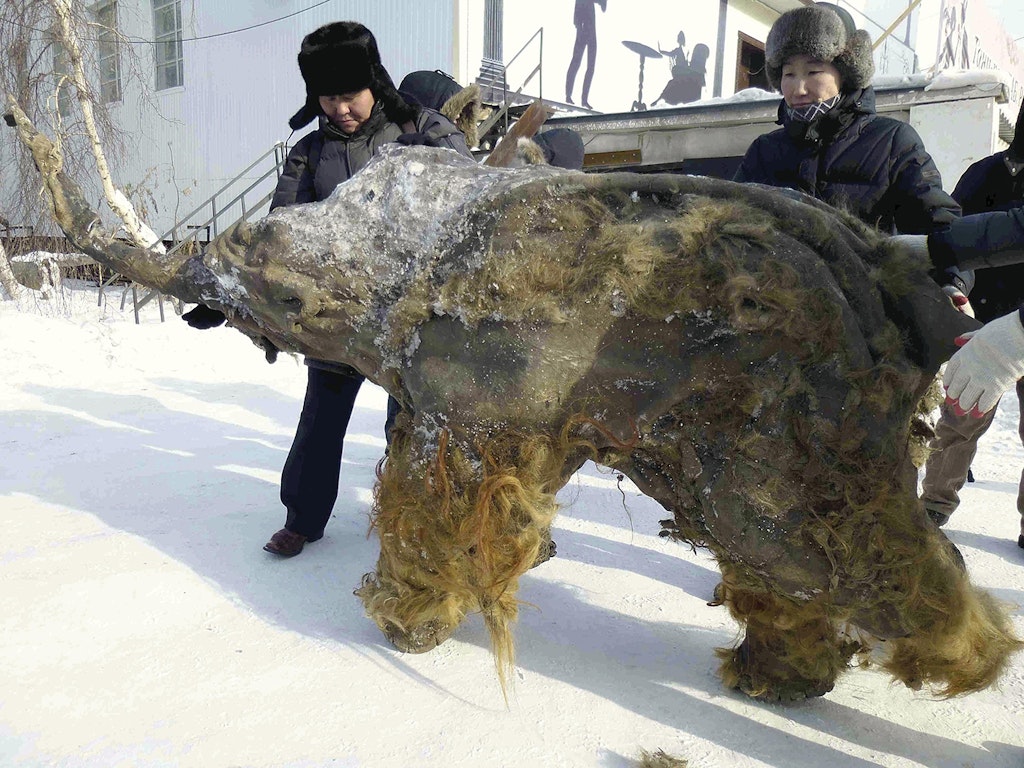


Scientists have sequenced the oldest-ever RNA from a 39,000-year-old woolly mammoth named Yuka, whose remains were found frozen on a bluff in northeastern Siberia. The discovery contradicts the prevailing dogma that RNA, the genetic material that orchestrates the most basic activities of life, is so fragile and degrades so quickly that it is futile to search for it in ancient samples.
The research, published in the journal Cell, opens a new window on past life. DNA is famously known as the genetic blueprint of living things, but RNA determines how those genes turn on in different tissues such as muscle, skin or liver.
In the new study, researchers recovered thousands of fragments of mammoth RNA, showing it was possible. They then connected those to the activity of specific genes in the muscle tissue of Yuka the mammoth, showing genes involved in slow-twitch muscle fibers involved in endurance activities were turned on. They also found that genes involved in metabolic stress were active, allowing them to speculate about the last moments of this mammoth, which is thought to have been attacked by a cave lion before its death.
“You can imagine a situation where it had been trying to run away from the predator and got attacked,” said Marc Friedländer, an RNA biologist at Stockholm University and one of the authors of the paper. “It’s kind of stunning we can see this stress response from the active genes.”
The researchers acknowledge that recovering ancient RNA requires specimens with exceptional preservation conditions — in this case by being frozen in permafrost. The new study shows that researchers cannot only gain broader information about past biology — making it possible to reconstruct gene expression in ancient animal tissues — but also ancient RNA viruses such as influenza or coronaviruses.
For years, the science of ancient DNA has been growing. It has helped illuminate historical events, such as the volcanic eruption that preserved Pompeii in ash or the final days of Napoleon’s army. But DNA’s close molecule cousin, ancient RNA, remained on the margins.
About four decades ago, an Italian researcher found RNA in seeds that were thousands of years old. He published a letter in the journal Nature, responding to Nobel Prize winner Svante Pääbo’s work on ancient DNA from an Egyptian mummy with a paper called “Mummy RNA lasts longer.”
But many scientists ignored it. The field began to wake up over the past 15 years — particularly in 2019, when scientists recovered fragments of RNA from the tissues of a 14,300-year-old wolflike puppy.
That study showed that RNA can survive and can be used to distinguish the genes active in different tissues.
“We thought, OK this is kind of a ‘hold my beer’ moment,” Friedländer said.
Friedländer’s team set out to take tiny bits of woolly mammoth tissue to determine whether they could find mammoth RNA . They started with 10 tiny vials with bits of muscle or skin tissue from 10 mammoth specimens.
Three of the mammoth samples yielded ancient RNA fragments, particularly the sample from Yuka. Previously assumed to be a female mammoth, their analysis showed that Yuka was actually a male.