

Located within Brasso Venado is another legally protected site, the Central Range Wildlife Sanctuary.
Established in 1934 with an area of 2,128 hectares, the sanctuary reaches altitudes, in some parts, close to 200 metres. But the protection of animals in the sanctuary, villagers said, is at an all-time low.
“There’s a lot of hunting taking place out of season here. It’s a serious kind of extinction taking place around here. The monkeys used to be in the forest nearer to the dam’s side. These people shoot these things, kill them and eat them,” one of the villagers told the T&T Guardian, shaking his head.
There are 13 wildlife or game sanctuaries in Trinidad and Tobago aimed at protecting wild animal species by restricting hunting and collection of animals in the protected areas.
As defined by the 2013 National Wildlife Policy, a protected animal is any animal not included in the second and third schedules of the Conservation of Wild Life Act. These schedules catalogue animals that may be hunted during the open season, which runs annually from October to February.
Part 1 of the second schedule lists agouti, armadillo, deer, lappe, quenk and lizards.
Part 2 of that schedule lists several birds, including the corbeaux, orange-winged amazon parrot, pigeons, doves and wild ducks.
Animals considered to be vermin such as rats, mice, coral snakes, manicou, red-tailed squirrels and mongooses are indexed in schedule three of the act.
But these scheduled animals, most of which are present in the sanctuary, are being hunted outside of the legal season, villagers said. Meanwhile, animals not listed and considered protected are also being killed and captured regularly.
Monkey meat in high demand
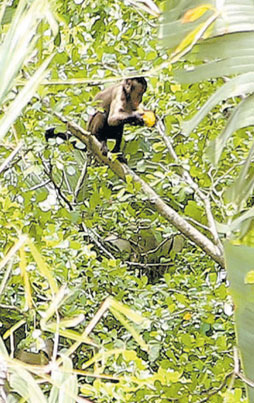
Troops of the critically-endangered Cebus Albifrons, or white-fronted capuchin, were once seen fairly regularly in the sanctuary. That’s no longer the case.
In 2008, it was estimated that only 61 white-fronted capuchins were living in the wild. It is uncertain as to whether this number increased or decreased in the years since.
The sight and sounds of red howler monkeys are more common than the capuchins in the sanctuary these days. However, their meat is in high demand by hunters. According to the International Union for the Conservation of Nature, IUCN, the Guyanan Red Howler Monkey, found in parts of Brasso Venado, is a vulnerable species.
The situation has developed due to the mismanagement of hunting across the country, said UWI Professor John Agard.
“That is not really being monitored, so people go and kill more than they are supposed to, unregulated really. Because we don’t have enough forestry officers and wildlife officers to monitor people for compliance, and there’s basically no enforcement,”
Agard said.
A person convicted of hunting protected species without a special game licence faces a fine of $10,000 or three months in prison.
“You can go up on the web and see people hunting endangered and rare animals that they are not supposed to, but nothing happens because the Forestry Division does not have the resources to enforce this,” he said.
“There are a large number of forest and wildlife officer posts unfilled.”
Pointing out that the consequence of a lack of enforcement is alarming, Agard said the belief that animals cannot be hunted to extinction in T&T is misplaced.
“Let me give you an example.
There’s no deer in Tobago because the deer were hunted out. I think the last one that anybody has seen was shot 20 years ago. There are none,”
Agard, who holds a PhD in Zoology, said.
“Are there wild hogs in Tobago? No. Because they’ve all been shot out, all. They are exterminated.”
According to the Conservation of Wild Life Act Chapter 67:01 Section 4, except as provided by sections 9 and 10 of the act, any person who hunts any animal in a game sanctuary or is found within a game sanctuary under circumstances showing that he was hunting any animal is liable to a fine of $10,000 or three months in prison.
Section 7 (1) states that, except as provided under subsection (2) and section 10, no person shall hunt or be a member of a party engaged in hunting any animal during the close season.
If caught in contravention, a person is liable to a fine of $10,000 or three months in prison.
“We don’t have a proper system in place, so that’s what they are trying to push Trinidad and Tobago to do,”
Agard said.
National water supply affected
As the source of the Talparo and Tumpuna Rivers, as well as most of their tributaries, the Central Range Wildlife Sanctuary plays an important role in trapping and storing water.
However, widespread deforestation is reducing the capacity of the forest’s soil to retain water, resulting in increased surface runoff and, in turn, erosion, villagers said.
This is causing land to slip, resulting in extensive damage to the Brasso Tamana Road. In the last two years, residents have protested, calling for repair work to be done on the road. Villagers we spoke to claimed deforestation is primarily responsible.
“They are using machines that are taking the roots of trees out of the ground. So as the rainy season starts, you have erosion taking place because they plough the land and bank it downwards.
So when the land dries and the rain comes suddenly, it pushes everything with it,” lamented a villager.
Agard confirmed that deforestation alters the flow of water: “The fact that trees put down roots and so forth, helps roots penetrate down into the soil and get into the water table. As opposed to when you cut down trees of it flowing over the surface.”
According to WASA CEO Alan Poon King, deforestation also affects the country’s water resources in many ways.
Among them is increased runoff during/shortly after rain events leading to greater frequency and severity of flooding, as well as increased incidences of landslides.
Water-related issues have long existed in the country’s forest reserves, according to now-deceased former forestry director Narine Lackhan.
In his 1984 article, Watershed Management in Trinidad and Tobago, Lackhan claimed erosion and flooding has threatened watershed management for decades.
“These have been caused by the indiscriminate clearing of forest lands in the upper watersheds by squatters and slash-and-burn agriculturists for a variety of uses including shifting agriculture, quarrying and unplanned housing development.
“These, together with the misuse of other lands have resulted in serious watershed degradation symptomised by erosion and flooding,” the article stated.
According to the United Nations’ Food and Agriculture Organization, by 2025 as much as two-thirds of the world’s population may experience water-stress conditions, with 1.8 billion people worldwide inhabiting areas of absolute water scarcity.
According to Poon King: “The preservation of forests would lead to more sustained flows in our rivers. Water treatment costs could also be reduced due to the relatively good quality of the raw water from our rivers.”
Agard supports this position, adding that erosion also affects water quality.
“The soil will wash away and find its way in a river, or a dam, or a reservoir with lower water quality because of the silt. When the trees are removed, it encourages the siltation to occur.”
Given this fact, members of the Collaborative Partnership on Forests, international organisations involved in forests, are encouraging countries to give priority to forest management and protection for the provision of clean water.
Despite the potential for forests to provide water, villagers said in Brasso Venado the water supply has been low for some time.
Illegal systems are diverting pipeborne supply to be used for farms created unlawfully on state land, they noted.
Living metres away from one of the many areas illegally cleared for agriculture, Mary (whose name has been changed for her protection) said one day a group of people with a tractor showed up unannounced and began removing trees near her home.
“We never had this problem when we were growing up. We didn’t give those people permission,” she said.
While the State owns the land, like many families in the village, her family has been squatting on a small parcel for decades.
Most built small homes, using a few extra square metres to plant crops.
“I am not really employed.
We used to keep a little garden but we can’t keep a little garden again with the work that is taking place,” she lamented.
On most days now, she locks herself inside.
Those farming the land, spray copious amounts of pesticide and insecticide regularly, causing a health problem for some villagers as well.
“The breeze carries fertiliser and pesticide when they are sprayed or applied and they are very toxic. But what choice do I have? I don’t have another place to go and live,” Mary said.
When Guardian Media visited several farms, there were empty canisters of pesticide and fertiliser scattered across the ground.
According to a 2016 US National Library of Medicine National Institutes of Health article, approximately one million deaths and chronic disease cases are caused by pesticides.
“There is now overwhelming evidence that some of those chemicals do pose a potential risk to humans and other life forms and unwanted side effects to the environment,” stated the report entitled, Chemical Pesticides and Human Health: The Urgent Need for a New Concept in Agriculture.
Those exposed directly, like production workers, formulators, sprayers, mixers, farmworkers and people living near farms, like Mary, are at highest risk.
Another scholarly article entitled, Adverse Effects of Chemical Fertilisers and Pesticides on Human Health and Environment added that “residues of pesticides and herbicides affect the central nervous system, respiratory and gastrointestinal system of human beings.”
UWI Professor John Agard said the belief that animals cannot be hunted to extinction in T&T is misplaced. “Let me give you an example. There’s no deer in Tobago because the deer were hunted out”