

Music review
WINSOR MUSIC
At First Church in Boston, Thursday
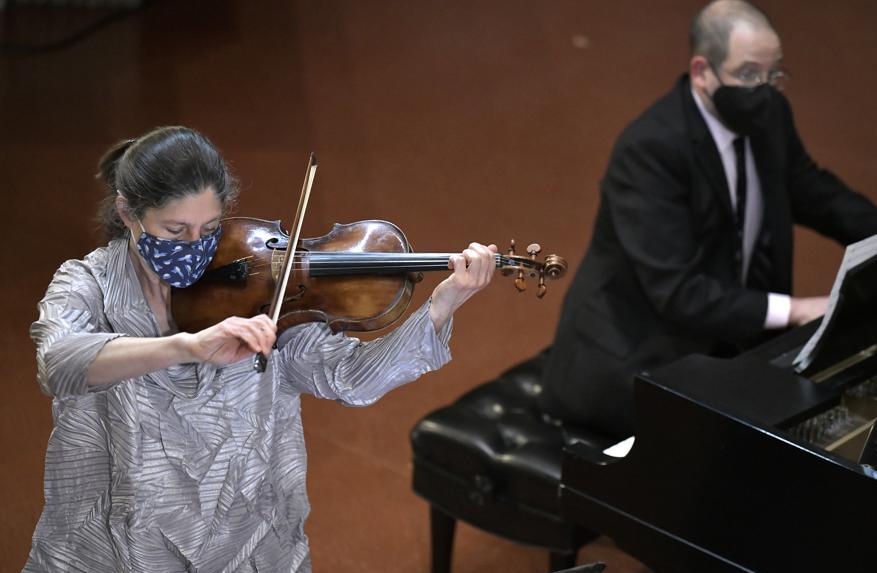
Long-running local chamber music outfit Winsor Music demonstrated the meaning of “better late than never’’ on Thursday evening, as co-artistic directors Gabriela Diaz and Rane Moore welcomed a live audience to First Church in Boston for a program that had originally been intended for spring 2020. The program juxtaposed 19th-century fare from Robert and Clara Schumann with selections by modern master of miniatures György Kurtág: a surprising combination, but a deeply satisfying one.
That this unique combination worked so well was in part thanks to featured performer Kim Kashkashian, a New England Conservatory faculty member and veteran performer who has released multiple award-winning recordings of Kurtág’s music. Before embarking on a set of five selections for solo viola from “Signs, Games, and Messages,’’ the performer shared several candid anecdotes from her time working with the now-nonagenarian composer. Kashkashian relayed the unpublished subtitle to the elegy “Tamar Blum,’’ which was written for a friend who had lost her husband — “Do not be sad: I wait for you on the other side.’’ Performing “Tamar Blum,’’ Kashkashian rendered solemn yet sweet double stops that flowed note to note, the rhythm only interrupted when a single pitch erupted in a buzzing, anguished cry. “Chromatic argument,’’ another standout, had been explained to Kashkashian as a depiction of “two very stupid people’’ who can’t agree: with the viola’s lowest and highest pitches firing off squirrely lines in parallel, it wasn’t hard to imagine the composer transcribing a lovers’ quarrel, or his own memory of one.
Winsor Music founder and oboist Peggy Pearson, pianist Donald Berman, and Moore (a clarinetist) also contributed to portions of the program: Moore and Pearson with two short but arresting duets for the primal sonorities of bass clarinet and English horn, and then the trio of Kashkashian, Berman, and Moore for “Hommage a R. Schumann.’’ No written program notes were provided, but Moore translated and decrypted movement titles for the audience from the mic, pointing out references to Robert Schumann’s musical alter egos Florestan, Eusebius, and Raro.
Listening to Kurtág’s miniatures can feel like gazing into a bag of exquisitely crafted marbles. Contained within each small structure waits an entire world, and Winsor’s performers and Kashkashian knew just how to hold them up to the light. When a sudden downpour hit during the spacious final movement of the Schumann homage, it seemed as much a part of the piece as Moore’s muted bass drum thud that ended the concert’s first half: the only moment the large drum that sat on stage all night was used.
Preceding the Kurtág selections was Pearson’s arrangement of Clara Schumann’s “3 Romances,’’ pieces that have received increased attention in the past several years as interest has grown in women composers of centuries past. The pieces were originally for violin and piano, with a solo written for the virtuoso violinist Joseph Joachim. Pearson’s arrangement put her own instrument, the oboe, in the front seat, and she delivered the melodies with all the agile eloquence that Emmanuel Music listeners have known her to give many a Bach cantata, while pianist Berman provided a solid foundation.
The back half of the concert was given to Schumann’s Piano Quartet, with Diaz (violin) and Rafael Popper-Keizer (cello) joining Berman and Kashkashian. Initially I thought I was having trouble hearing Kashkashian, and wondered if the special guest’s part might be suffering from middle-child syndrome, but then I realized that the violist and cellist had matched their warm, burnished timbres so well that it was sometimes necessary to lean forward to see whose bow was moving in which patterns. Some cohesion between the piano and the strings was lost during the faster sections in the second movement Scherzo, but the quartet covered those tracks in the third movement, laying down one of those lowercase-r romantic melodies at which Schumann excelled and setting it aglow.
Winsor Music’s season continues with two performances of a program featuring guest pianist Simone Dinnerstein and composer Milan Yousufi. (May 13-14).
A.Z. Madonna can be reached at az.madonna@globe.com. Follow her on Twitter @knitandlisten.