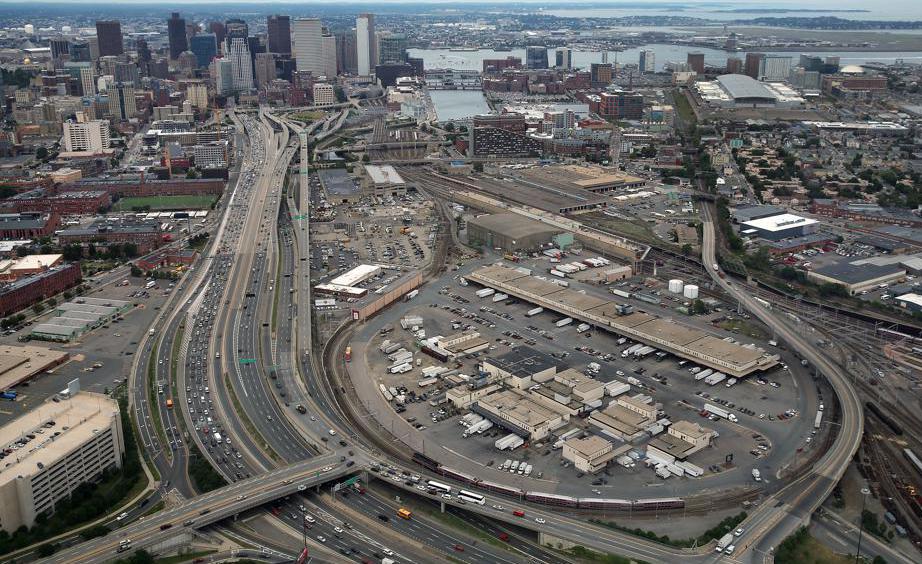


The MBTA has completed a $255 million purchase of the 24-acre Widett Circle industrial area, with plans to turn what was once a busy meatpacking district into a railyard.
T officials say Widett will provide a crucial relief valve to South Station, which sits about a mile to the north, by creating room for a nearby layover space to store and work on trains used along nine commuter rail lines. Widett, which is sandwiched between the Southeast Expressway and a set of railroad tracks, is considered essential if the T wants to increase commuter rail frequency south or west of the city, and it’s an important component of plans to add more tracks to South Station itself.
Currently, the T’s yard in Readville, on the southern outskirts of Boston, is the closet layover facility to South Station. That requires many trains that are not in service to be piloted back and forth along the Fairmount line, particularly in the middle of the day when fewer trains are running. This system of moving trains to Readville when they are not in use burns extra fuel, takes up additional crew time, and can cause congestion on the Fairmount route.
Widett Circle, a nondescript assemblage of industrial buildings, served as home to a variety of food distributors and processors for roughly five decades. It popped onto the city’s radar about eight years ago, when it was proposed as the possible home for an Olympic stadium as part of Boston’s ill-fated bid to host the 2024 Summer Olympics. The hope at the time was that the site could be redeveloped after the Games, and when Boston’s Olympic dreams were dashed in 2015, developers still held out hope for Widett’s potential as prime open real estate in the crowded city.
Eventually, developer Able Co. and its financial backers acquired a nearly 20-acre food distribution complex at Widett, known as the New Boston Food Market, and a separate 5-acre cold storage warehouse site next door. Able had quietly circulated plans for a sprawling mixed-use development there, and at one point a massive Amazon distribution center was being considered for part of the site. The T, which already had a small parcel in the area, remained in the mix through these discussions, in part because the layover options at Widett are considered crucial to any South Station expansion.
The ambitious mixed-use vision never came to fruition. Able became more interested in selling the 24 acres to the T last year, and struck a deal with the transit agency in the fall. Meanwhile, the food processors decamped for other sites.
State officials expect it could take another three years to build out the railyard, and it’s possible that the site could also eventually accommodate other state or city uses, such as some of Boston’s nearby public works operations on Frontage Road in the shadow of the Southeast Expressway. Meanwhile, plans to expand South Station remain in flux, in part because of funding issues and the need to move the US Postal Service from its property next door.
However, the dreams of building more of a neighborhood in this industrial area have not died.
City officials have long considered redeveloping the next-door Frontage Road yard, which is closer to downtown and public transit; figuring out where to move the things that the yard holds now has been one of the obstacles. Widett has been viewed as one option for those.
In 2018, when she was on the City Council, now-Mayor Michelle Wu sparred with then-mayor Martin J. Walsh over the public works property’s fate. She thought Walsh was moving too quickly to redevelop the Frontage Road yard and wanted more input from the public about what should go there. The city yard had long been floated as a possible site for a standalone New England Revolution soccer stadium.
But Wu told the Globe last week that she’s still interested in thoughtful additional development in this area, with a goal of improving climate resiliency, and raised the prospect of “land swaps’’ involving other publicly owned sites.
Arthur Jemison, Wu’s planning chief and director of the Boston Planning and Development Agency, said he’s in frequent communication with the MBTA about parcels in the area, including an MBTA bus depot on nearby Albany Street and the Frontage Road yard. There’s a chance to rethink the way the area is configured, and potentially consolidate uses, Jemison said.
“When we and the MBTA sit down together and figure out how to allow trains and public works and buses to be there, we may be able to find efficiencies and economies of space that give us the chance to potentially have more housing there,’’ Jemison said.
Jon Chesto can be reached at jon.chesto@globe.com.
Catherine Carlock can be reached at catherine.carlock@globe.com.