

When the King asked me to form a government, it was the first time for both of us. But I quickly realised that while I was new to the international stage, he was the world’s most experienced diplomat.
President Zelensky was a rare, if not unique, example of a world leader that I had met but the King had not.
With all that experience, I was not surprised to see the elegance with which His Majesty, on his trip to Washington last week, got JD Vance — a man who had described stopping aid to Ukraine as one of his proudest achievements in office — applauding the royal call for western solidarity with Kyiv.
The monarch’s message was necessary. Russia has been a short-term beneficiary of the US-Iran war. Its oil revenues are up about $150 million (£110 million) a day thanks to the Strait of Hormuz price spike and the US decision to suspend sanctions on Russian oil during this conflict. Moscow also benefits whenever Nato is divided, as it undoubtedly is now.
But Ukraine is resilient on the battlefield. In March, Russia made no overall gains on the front line for the first time in two and a half years. It is now losing as many men in a month as it did in the whole Afghan war, and its casualties in the past few months have been the worst of the conflict.
Ukraine’s strength on the battlefield is not just down to its soldiers’ bravery but also its ingenuity. Ukrainian drones have made it almost impossible for Russia to mass the forces it needs to advance.
Kyiv now has a strong claim to having the world’s most advanced defence tech industry: in 2025, it produced more drones than all the Nato countries combined. The Iran conflict confirmed that the nature of warfare has changed, and Ukraine is the western-aligned nation that knows best how to fight in this new way. This is why so many Gulf states have rushed to sign defence deals with Kyiv.
I have even heard a senior figure in the US military establishment observe that they would find it easier to reopen the Strait of Hormuz using new technologies that the Ukrainians used to drive the Russian fleet out of the Black Sea. This defence tech prowess makes the country a valuable partner.
Ukraine is not a charity case but a nation that can help others to combat threats from the axis of authoritarian states — Iran, Russia, China and North Korea — who share battlefield technologies. The Shahed drones that menace the Gulf are Iranian-produced, but they benefit from a design tweak the Russians made after Iran supplied them to Moscow.
Defence tech will become a valuable export industry for Ukraine. This is important because while the country can ensure its survival on the battlefield, its long-term success will require a sound economic base.
Volodymyr Zelensky has been a heroic wartime leader, but he is seized of the need for Ukraine to win the peace when it comes. When I saw him in February, he was explicit about the need to start planning for that moment even while Ukraine continues to fight.
At the invitation of Zelensky and the former Canadian finance minister Chrystia Freeland, I serve on the International Advisory Council for the Economic Renewal of Ukraine. On the one hand, the task is daunting: the cost of rebuilding Ukraine over the next ten years will be more than three times the country’s gross domestic product (GDP).
But on the other, few countries have more potential. Ukraine combines an educated and entrepreneurial population with significant natural resources. It is one of the most techliterate nations in Europe; its e- government platform is used by more than 20 million Ukrainians and, since the invasion, now provides an entirely digital way for couples to get married.
Ukraine also has 41 million hectares of agricultural land, a third of which is highly fertile black soil. Yet, despite this, its yields for most crops are below the European average. An exception is the sunflower seed, which is why Ukraine is the world’s leading sunflower oil exporter. If the country — which before the war was the world’s third-largest exporter of barley and maize, and fifthlargest of wheat — could bring its agricultural productivity up to the European average, then it really could become the bread basket of the world.
One of the West’s most pressing problems is dependence on China for critical minerals. Ukraine can help with this. It is the second-largest producer of gallium, essential for electronic warfare systems, and has deposits of 21 of the 30 most critical raw materials.
There is a similar story on how Ukraine can help Europe achieve greater energy security. It has the potential to create almost as much renewable energy as the EU’s entire generating capacity.
So how is this potential to be realised? It will require international investment.
This will depend on confidence in the rule of law: a clean judicial system and an investor-state dispute-resolution mechanism will be vital. Kyiv knows this and must demonstrate progress.
Delivering on these reforms is vital to Ukraine’s effort to become a member of the European Union. This goal has grown in importance given US opposition to Ukraine joining Nato.
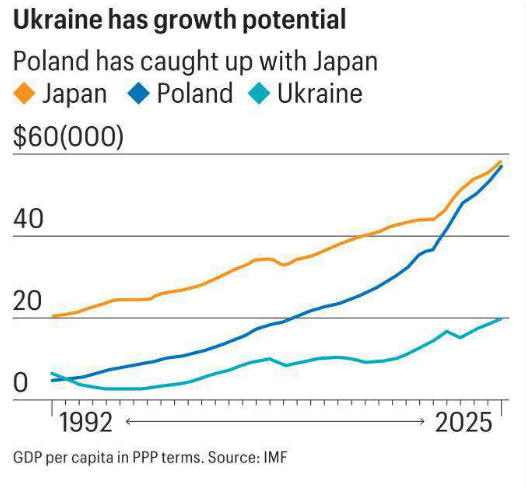
Many EU members will look at Ukraine, and its agricultural prospects, and be wary of admitting it into the single market. But the opportunity is immense. In 1992, Poland was poorer than Ukraine in per capita terms; today, Poles are as rich as the Japanese.
If Ukraine can come close to replicating that success, it will make itself, the EU and the entire West more secure — and ensure the ultimate defeat of Russian revanchism.
The Sunday Times supports the Richmond Project (richmondproject.org) and the work it undertakes. Rishi Sunak has donated the fee for this column to it