

Imagine you are a small Cretaceous critter who has just escaped from the jaws of a Tyrannosaurus rex to live another day. Now imagine being told that, every time you encounter the beast again, it will have grown bigger.
And bigger. And bigger.
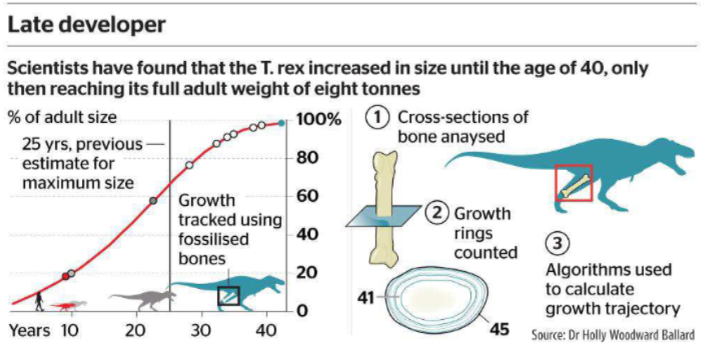
Scientists have found that the T. rex kept on increasing in size until the age of 40, only finally reaching its full adult weight of eight tonnes after four decades of constant growth. It was previously thought that the predator stopped growing at about 25 years old.
Scientists at Oklahoma State University and Intellectual Ventures have been counting annual growth rings — the dinosaur equivalent of tree rings — found inside the leg bones of T. rex fossils to understand how old they were when they died and how quickly they reached their adult weight.
Their analysis identified growth rings in 17 fossils. They applied polarised light to slices of bone to show up spots where two rings may have appeared to be one single ring before.
The study, published in PeerJ, suggests that two of the 17 specimens, known as Janey and Petey, may not belong to T. rex, but come from a smallerbodied species called Nanotyrannus.
A recent study focused on a pair of dinosaurs, including a triceratops, that were buried in silt during a duel 67 million years ago and fossilised together.
It was previously thought the predator in the duel was a juvenile T. rex, but analysis found that it was a grown adult from a smaller species.
The latest study cannot prove that Janey and Petey belong to this smaller species, but their growth patterns are “statistically incompatible with the others”, raising the possibility that they are not T. rex.