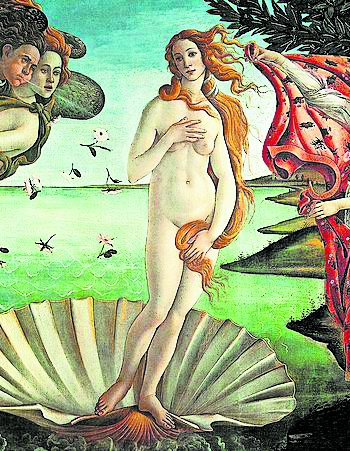


The woman thought to have served as Botticelli’s muse for his masterpiece The Birth of Venus died aged 23 and never saw the work she inspired.
Simonetta Vespucci, deemed one of the great beauties of medieval Italy, collapsed during a ball and died days later as the result of a haemorrhage linked to a benign tumour on her pituitary gland, new analysis suggests.
Researchers have gathered fresh evidence to support their theory that an initial diagnosis of tuberculosis, offered by a physician after her collapse at the ball in April 1476, was incorrect.
Portraits inspired by Vespucci show changes in the shape of her face between the ages of 16 and 23, scientists found. They also analysed a painting showing her lactating, despite never having been pregnant, noting that a tumour on the pituitary gland can stimulate the production of breast milk.
Letters between her father-in-law, Piero Vespucci, and Lorenzo de’ Medici, de facto ruler of the Florentine republic and a great admirer of Vespucci, show that in her final days she “suffered from copious epistaxis [nosebleeds], rhinorrhea [runny nose], debilitating headaches and confusion”, and “appeared to hallucinate at times ... with vomiting spells and high fever”.
A physician to the family believed it to be tuberculosis. “After a long dispute, they agreed to administer some medicine against consumption, which unfortunately had no effect,” said the study, published in the journal Endocrinology, Diabetes & Metabolism.
Her symptoms actually point to pituitary tumour apoplexy, a sudden haemorrhaging or blockage of blood flow around or into a tumour called a pituitary adenoma on the gland at the base of the brain. It is likely to have grown “undisturbed over the course of several years”, eventually causing damage to the blood vessels supplying the gland.
Vigorous dancing may have contributed to her death, according to the researchers from Queen Mary, University of London, Campus Bio-Medico University in Rome and the University of California, San Francisco.
“The genre of the alte danze entailed quick movements and jumps,” the study said. “Considering that she collapsed during a ball, the mechanical trauma of repeated jumps endured by anatomical structures already compromised by an expanding mass [of the tumour] may have hastened the onset of haemorrhage.”