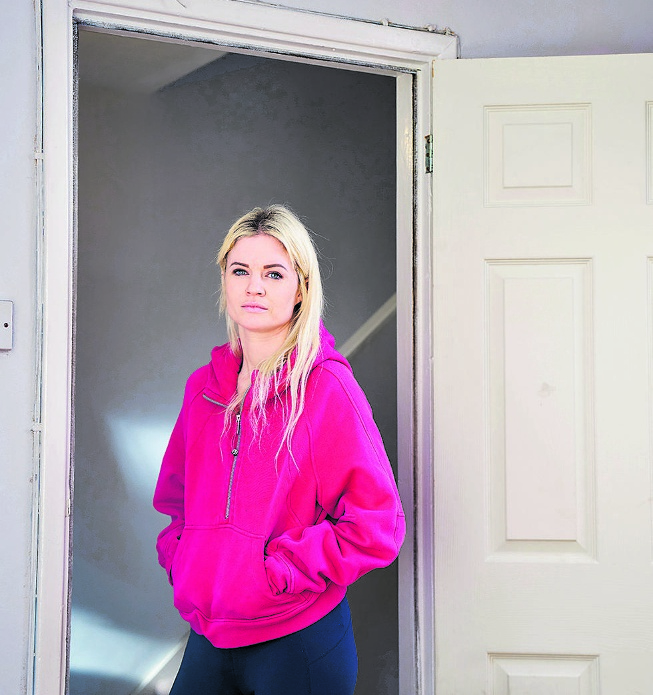


When Becky Farrow bought her home in Devon in 2011, she was “over the moon”. She and her husband had worked hard to save for it, and they had two children who needed the room to grow. By 2018, Farrow had decided to renovate her house, which was built in 1935.
“Trying to do the best for our kids, we decorated their rooms first,” she says. “I had it in my head that it was good practice to sand off old paint before adding a fresh layer.”
As the year went by, Farrow and her mother’s health went downhill. “I developed psychiatric symptoms, then ME [chronic fatigue syndrome]. My mother had kidney issues and high blood pressure.”
The most marked deterioration, however, was in Farrow’s son. “He changed.
He went from being a really happy, balanced child with no developmental issues to a very sick one.” He went off his food, regressed so sharply that he would speak only in baby talk, and developed obsessive tendencies. At the age of seven, he became suicidal.
Farrow “got nowhere” with the NHS but a test of her son’s hair revealed high levels of lead. “I was like, ‘What?’” she recalls. She tested the paint that she was removing, “and all of it was lead paint. The doors, the skirting, the ceilings, my son’s door, everything.”
Farrow, who asked that her last name be changed, realised her children had been breathing dust from the sanded paint for months.
They might well have eaten it: lead paint tastes slightly sweet and there were flecks of it around. Her son seemed particularly affected, possibly because he had been opening and closing his sanded door, then putting his fingers in his mouth.
“The guilt nearly finished me off,” Farrow says. “I knew that an action I’d taken had potentially poisoned them.”
People have been using lead for thousands of years: it is easy to mine, is malleable and resistant to corrosion.
The Romans plumbed their cities with it (the word “plumber” is derived from plumbum, Latin for lead).
Artists such as Rembrandt rejoiced in the lead in their paints. In the 1920s, a chemist at General Motors found that adding a lead compound to petrol made car engines run more smoothly.
Today we know that lead is terrible for human health.
Exposure can trigger heart attacks, lower IQ and cause developmental delays and behavioural problems. There is no level of lead exposure known to be without harmful effects. Many scientists are convinced by the lead-crime hypothesis, which argues that crime soared in the 20th century because of the introduction of leaded petrol, then began to fall after it was phased out.
In the new podcast Untold: Toxic Legacy, Laura Hughes, a Financial Times reporter, examines the failure of the authorities in the UK to tackle lead poisoning. In the US for instance, children are screened for lead. Here they are not, and testing of food for lead is scant.
Much of the lead that is damaging health today is in our homes: ours is the oldest housing stock in the world and up to nine million houses are thought to still have lead water pipes. There are also 6,000 or so former lead mines across the country.
Mark Macklin, an authority on environmental metal pollution who is a professor at the University of Aberystwyth, says the problem is not only mines but fine-grained mine waste that has flowed downstream and into rivers and floodplains.
“The last big mine around here closed around the end of World War I,” he says when we meet at his home. “There was no regulation then. The waste from the mine was dumped into the river and it washed downstream.”
Land contaminated by historical lead mining is still much in use. Families are living in houses on it. Farmers are rearing animals on it. One 2023 study found that eggs being sold by two small farms downstream from a Welsh mine contained such high levels of lead that if a child ate one or two of their eggs a day, they could become “cognitively impaired”.
Macklin has mapped the parts of the UK that are likely to be contaminated, and says climate change is adding to the problem. As floods become more frequent and severe, he says, lead that has long lain dormant in floodplains is on the move.
He finds it frustrating how seriously lead is taken in some countries whereas here the buck keeps being passed.
That is partly, he says, because responsibility is spread between different bodies. In Wales, for instance, the former mines are managed by Natural Resources Wales but it falls to councils to test floodplains.
Macklin lives in a newbuild on top of a hill, where he knows his land is in no danger of contamination. But in 2012, many of the valleys in Ceredigion were flooded. He knew instantly it would mean more lead being released into gardens and farms.
Last year he and a scientist friend asked residents if they wanted their soil tested. He is due to present the results this month. Many samples, he says with a grimace, made him think: “Oh shit.”
Macklin’s contamination maps are used worldwide but local authorities in Britain do not seem interested. There are signs, however, that the apathy might be shifting.
Last week, letters went to 150,000 homes in Leeds, inviting parents of children aged one to six to participate in a screening programme which involves a finger-prick blood test.
The scheme could be introduced nationwide. Jane Entwistle, the professor leading the project, says any child with high lead levels will be treated urgently.
Intervention doesn’t always occur, however. Jess Draper, a counsellor who asked for her last name to be changed, had “no idea” lead posed a threat when she and her children moved to a 1940s house in Bath.
The property was in a dire state so she set about sanding the walls and banisters, then she saw someone asking for some lead test strips on social media and decided to test her home. “It kept coming out positive,” she says.
Her youngest child, two at the time, was particularly vulnerable. But when she contacted the social housing provider, “they were baffled.
They didn’t know what to do”. Eventually they sent a surveyor who sampled six parts of the house, all of which tested positive for lead.
Draper believes her son has been affected by the exposure but she can’t know for sure because her GP won’t test him unless he shows signs of severe poisoning. “But he’s not growing well. And his behaviour — I don’t want to label it ADHD, but he gets really angry really quickly.”
Draper wants GPs to offer lead testing to children who could be at risk (if they live in an old house, for instance), and believes properties should be routinely tested.
“We need to make lead the new asbestos,” she says.