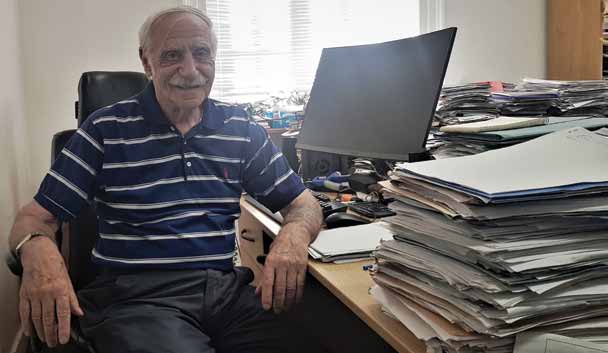


‘That self-confidence was given to me by my grandmother Anna. She was convinced I was the reincarnation of my grandfather. She treated me as if I was infallible. She brought me up and from a very early age I was given all this self-confidence.’
How does one talk to a politician and not talk about politics? How does one talk to Sir Joe Bossano and leave politics to one side? This is what I intended when I invited him to join me at Alice’s Table. It would be my longest session yet. Truth be told, politics was touched upon but the intellect of this man, who I have known since my early days on Radio Gibraltar, took us into areas of conversation I had never imagined that sunny afternoon.
Start any conversation on any subject, and rest assured he will have an opinion, and he will be informed. The problem was how to condense it all.
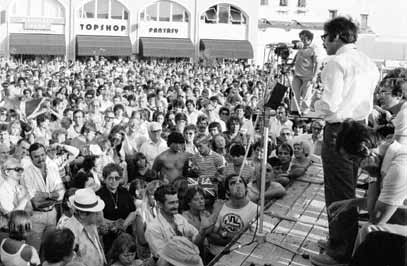
50 years ago, this week, Sir Joe Bossano – often referred to as the Father of the House - became a Parliamentarian for the first time. This makes him the longest serving Member of the Gibraltar Parliament. He first became a Member of the House of Assembly when he was elected into Opposition 23 June, 1972, with the IWBP led by the late Sir Robert Peliza.
Forming the Gibraltar Democratic Movement, GDM, in 1975 he remained in the House when the Party won four seats in 1976. A year later he gave birth to the Gibraltar Socialist Labour Party, GSLP, and remained on the Opposition benches until 1988 when he first became Chief Minister of Gibraltar.
My first interview with him was on Radio Gibraltar. It was a Friday, 6.30pm, on a live programme called News Round Up from Studio 2 at Wellington Front. He was then Branch Officer of the TGWU and I was a young 18-year-old radio announcer. Joe came into the studio with his large brown briefcase which he carried everywhere. Funny things one remembers. How many times have I interviewed him over the years? Impossible to say. But I was there when he sat on the Opposition benches as Leader of the Opposition, when as leader of the GSLP he won the election of 1988, on the night he lost the election in 1996 (by then I was producing all the election programmes on GBC), and the time he was back on the Government benches in the new Millennium.
Joe created the Integration Movement in 1964 when Sir Joshua Hassan and Peter Isola first went before the United Nations. As a young man he wrote a letter published in the Financial Times. With talk of Close Association, he argued both leaders did not have a mandate for this. He presented the options available which he insisted had not been put to the Gibraltarian electorate. This was the start of the long road he would embark on and which would one day see him at the top of the political ladder in Gibraltar and a Knight of the Realm.
Somehow my first question (about him) takes us to Gibraltar being prosperous over centuries – “its importance is out of proportion with its size. Its value being its strategic geographical position particularly for England, and later the UK throughout history.”
He continues to the commercial core of Gibraltar’s background in buying and selling beyond its shores in a great variety of areas – “it is the one thing we need to maintain to be a successful economic unit.”
On asking that first question, I already knew it would lead us everywhere except to the man himself. But how did we get to the lesson in the theory of relativity, the laws of quantum physics and quantum entanglement? I let him finish. His brain always active. Totally focused on the present, and the present subject.
I then insist we keep to the questions asked. He looks at me with a cheeky grin on his face as if he had misbehaved.
We both laugh as we realise just how difficult this is going to be. I manage to steer him back to his early days but politics pops up again.
“I did not get involved in politics to run Gibraltar. I was in the union, and the AACR, and went on to create the pro-integration movement as a pressure group.
There was a debate on integration both for and against within the AACR, at the premises next to the old Chronicle offices in Governor’s Parade,” he offers.
The ACCR soon cut its ties with the unions, and the prointegration investigation group, with just five people, held its first meeting in the Petite Bar in Main Street. Joe became its first Secretary. But let’s start at the beginning.
An only child, he was born at the outbreak of WWII in 1939. Baby Joe, his mother Theresa and grandmother Anna, like most Gibraltarians, were evacuated to Tangier, London and finally Northern Ireland. His memory of wartime London is of a bomb landing in the hotel next door.
“I was walking along the corridor and the blast blew all the glass from the windows. I was four. I did not yet reach the window but I remember the glass flying around me. It was an interesting experience seeing glass splinters above my head and falling to the ground.”
His young inquisitive mind was keen to learn how this could have happened. Gathering knowledge has been a common thread throughout his life. And when he argues he knows his facts. There’s a hint of pride in his voice when he tells me how even as a boy he was blessed with great selfconfidence.
“That self-confidence was given to me by my grandmother Anna. She was convinced I was the reincarnation of my grandfather. She treated me as if I were infallible. She brought me up and from a very early age I was given all this self-confidence,” he says.
His grandfather Jose died just before the outbreak of war. Active in the union, in 1920 he had been a member of the Central Committee of the General Workers’ Union before it united with the Transport and became the TGWU. His father, a member of the Gibraltar Confederation of Labour, was affiliated to the AACR. In 1949 the 10-year-old boy returned in the repatriation. He entered the three-tier education system; Grammar School, Technical and Commercial College. Where you studied then was determined by how well you did in your 11 Plus. He came second that year and was sent to the Grammar School. He did not want to go.
“All my friends were in ‘La Escalera del Monte’. I was the youngest but the leader of my gang. The others had not made it into the Grammar School. My going there did not go down well,” he points out.
His father Oscar was a Nursing Orderly in the hospital. In addition to his duties, he assisted in all post mortems. He had learnt to read and write in his fifties.
The family lived in the Patio Vaca (at the top of Devil’s Gap). They never ventured far.
“People hardly went outside the area they lived in. This produced a sense of intimacy, closeness and membership, which we have lost in our civilisation with people now moving from one area of the planet to another, and thinking nothing of it,” he says.
In those days – 1940s, 50s and 60s – the post-war world was one of rationing. Life was hard. There were no luxuries.
“In most households nobody had enough money to stretch for a full week. They ran out of money before the next pay packet. Most people bought on the tick. What you bought was jotted down in the shop books.
We went to Carter’s (Carta) at the top of Prince Edward’s Road. We settled our account at the end of each week. People lived almost on a subsistence diet from week to week. They borrowed from their neighbours when they had to. The purchasing power of the people who lived where I lived was very limited,” he asserts.
He recalls his mother reading to, and writing for all the neighbours who could not read or write. He was influenced by this. It taught him the importance of helping others. Five families lived in the patio and shared the toilet and fresh water pump. His mother cooked with charcoal before the Belling Cookers were introduced. With limited resources people rented them from the City Council.
“I never felt a sense of impoverishment. My memories of childhood are very happy and one of a full life,” he emphasises.
But things changed when he went to Grammar School.
The pupils there wore smart looking blazers which had been bought from an expensive shop in town. Unable to afford this his father bought him a cheaper version which was not red but purplish. Instead of avoiding him looking different it highlighted it. And yet, he insists, this never gave him a sense of inferiority because his grandmother had always protected him against it.
The school introduced him to Dennis Matthews (SDGG) who would become a life-long friend.
“I was always very commercial and even went into competition with the school. I bought chocolate biscuits wholesale and set up a rival tuck shop,” he smiles.
“You see I had an analytical mind from a young age. Logic is something my DNA provided me with. I can focus on something and quickly see the logic and sequence which has always made learning for me more accessible, especially science,” he adds.
To this day he believes he should have studied science. Maybe been a scientist. As a boy he read a lot.
He collected stamps. He never played football. He never liked sports. Even now he never listens to music.
“It is sound,” he states. “If you like it, you call it music. If you don’t, you call it noise. I am not good at judging distances, colours or sounds. I remember being taken by the Christian Brothers to a violin concert with a distinguished violinist. I thought he looked so strange. To me he sounded hilarious.”
On leaving school aged 16 he became a messenger in Barclays, and managed the office of the construction firm ‘Sodi y Flores’.
At 18 following his military service, he left for London with Lionel Alman. Not knowing anyone he asked the Methodist Church if they could give him an address. He spent his first night at the Salvation Army in Whitechapel. His first job in London was retrieving oil in an engineering company that made screws.
“All the metal removed to create the screw was very sharp. My job was to get the metal debris with gloves and place it in the dryer which then made the oil reusable,” he explains. He earned £5 a week, compared to the £2 he had earned in Gibraltar. He was also a road sweeper. He then filled big barrels with paraffin to make oil paints.
“A boring job. I had to put the tap on and wait. I took books to read. Unfortunately, when I got very interested in the book, I lost my sense of time until I felt something cold on my knees. The 25 - gallon tank had emptied into a five - gallon recipient,” again he laughs at the memory.
When his friend Lionel joined the Merchant Navy, he took the same path. At 21 he signed a four-year contract. The Seamen’s Union then had 65,000 members.
Signing with the Shipping Federation you could be sent anywhere in the UK. But they guaranteed your wages. The salary was £7 a week. He first sailed on the P & O ship, Orion, working a 30 - day month.
The experience saw him sail around the globe and work as a deckhand, a grease monkey in the engine room and a junior cook. He furthered his education through the College of the Sea undertaking his A Levels through correspondence at sea.
The Merchant Navy would see him take his first steps in Union matters. Joe would form part of the campaign to democratise and gain recognition for the union.
“At the time they were not allowed to have shop stewards. The old laws from the late 1800s Shipping Act did not allow them to take industrial action on leaving a UK port – if you did it would be treated as mutiny and you could be put in iron by the Ship’s Master. We started a campaign of industrial action. I then became active in the union.
I made many contacts. We won what we were fighting for. Walker who had led on this became head of the union and Sam McCluskey his deputy.”
On completing his four years he returned to the UK with his uncle Jose who was a member of the Communist Party. Joe joined the Labour Party and helped his uncle deliver the newspaper, The Daily Worker.
“My uncle greatly influenced me. He became like my father in London. He had three children and I became his fourth child.”
Back on the Rock he then formed the Integration Movement. It was 1963 and he got a job as a trainee in Public Health and was one of three Gibraltarians sent to study in the UK. One of them, Pepin Delgado, would head the Environment Department years later. Joe failed his practical in Public Health. There was no doubt he could write on the subject but handling fish and meat was not for him. It was then he moved to study Economics and met his first wife. His degree was at the London School of Economics. He soon became interested in sociology and was introduced to socio-linguistics.
Another degree in Italian at the University of Birmingham saw him live in Sicily for a year studying the Sicilian dialect at Palermo University.
“I wanted to do one of the Romance languages. I was interested in bilingualism and the inter-play between society and language in terms of identity, like Llanito. My own theory involved demonstrating that bilinguals do not switch language but have three languages; English, Spanish and a hybrid which has got its own rules. My research was never completed because I got involved with the unions and politics.”
It was the sense of identity, he adds, which made him interested in linguistics.
“I see it not just as a way of communicating but one of expressing who we are. When people go to London and stay as a group in a part of the city, what is it that keeps them together? In your own pack the sounds that you make are what differentiate you from the other packs. That is what language does to us.”
I ask him, if he is saddened by the fact that we are losing our bilingualism? “As humans we are losing a lot of skills. Bilingualism is part of that process. We are so clever that we have learnt to invent machines that will do things for us. Today hardly anybody does calculations in their head or by hand, they use a calculator. The fact that you do not use your brain to do this means you will lose your ability to do so. The same with language. Languages are living things. They are in constant change. Language and culture are intimately linked.”
I then ask him, what Llanito means to him? “To me Llanito is who I am,” he promptly responds begging the question that if Llanito is lost, what will this mean for future generations of Gibraltarians? “It will mean the weakening of their sense of identity,” he says categorically.
“I think this has to be placed in context. There is a lot more happening to them, which is also happening everywhere else. Today the concept of distance and isolation is gone. Globalisation has made the world a global village so what you now have are communities which are not just linguistic communities but linguistic in a particular speciality. So, communities into hard rock music, for example, will communicate with hard rock fans everywhere in the world, and they will talk about hard rock and nothing else.”
It was IWBP leader, the late Sir Robert Peliza, who called on Joe to return to Gibraltar in 1972 to stand for election.
“With talk of a lease Bob felt it was a crucial moment in Gibraltar’s history. He told me he needed me. With the border closure we had lost half the workforce so people were encouraged to take on extra jobs to ensure the public services were maintained. This was part of the campaign that Bob started and his critics called it the twojob society but in fact it proved to be the fighting spirit to keep Gibraltar going because they were not going to let Franco get away with it.”
Joe had come home with his young family. He had no job and they lived with his mother in a one-bedroom flat. Although he was elected into Opposition no one would employ him. He was having a hard time.
As a Member of the House of Assembly he received £370 a year. He had to find another job.
He worked for a construction company building Varyl Begg Estate earning £35 a week – from a labourer he moved into the office. Sometime later Jose Netto offered him a job in the TGWU.
Although this meant a pay cut of £10 a week, he took it. The rest is history as he went on to become the Branch Officer of the TGWU, and one of the leaders in the fight for parity.
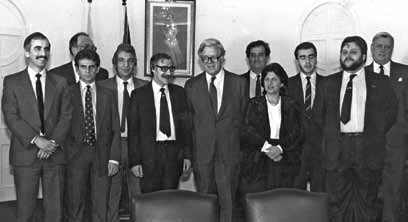
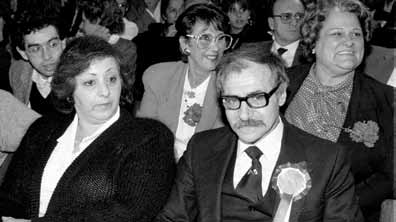
When in 1975 the IWBP was dissolved he formed the GDM and later the GSLP. The party gained seven seats in 1984 and won the 1988 election.. He was now Chief Minister of Gibraltar. He had reached the top of the ladder.
When in 1996 he lost the election, he returned to the Opposition benches.
Then in 2011 he was back in Government, with Fabian Picardo now as Chief Minister, and to date continues to serve as Minister for Economic Development with the GSLP/ Liberals.
Now, for more than 50 years Gibraltar politics has filled his days. At 83, you can still find him in the office every Saturday and Sunday – it’s seven days a week for him.
In the early eighties he separated from his first wife.
They had four children. In 1988 he married his present wife, Rose. He enjoys cooking – Italian and Chinese –his favourites. He believes he makes a mean pizza with mushrooms, olives, oregano and anchovies. On television he enjoys documentaries. At the time we met he was reading a paper called ‘The Inevitability of Life – the decay of life’. Nothing trivial works for him but he is a Trekkie, and like many of us enjoys watching Star Trek… to boldly go where no man has gone before.
“Thinking is my hobby. It is the most exciting thing I can do. Thinking abstract thoughts,” he adds. Today, his thoughts also take him to the fight to save the planet from self-destruction.
With the ability to absorb things instantly he carries loads of information in his head, especially figures.
When he concentrates on a subject, he forgets the world outside of his own space. He is responsive to everyone who needs help, especially when he sees the solution and knows there is an injustice. He then makes it his cause too.
“I come from a background where I need very little to survive. I don’t want more. I have no use for money because there is nothing that I want to buy.”
Much of what he does, he says, is spontaneous – what he does in the moment is important but then five minutes later his head will be somewhere else.
When I present him with the question, who is Sir Joe Bossano? Pausing for a brief moment in our over three hours of conversation. He looks directly at me, and says: “I am never what I am doing. I am always that little boy that a lady called Anna Tosso, my grandmother, told me nothing was impossible for him. That I could do it all and I believed her.”