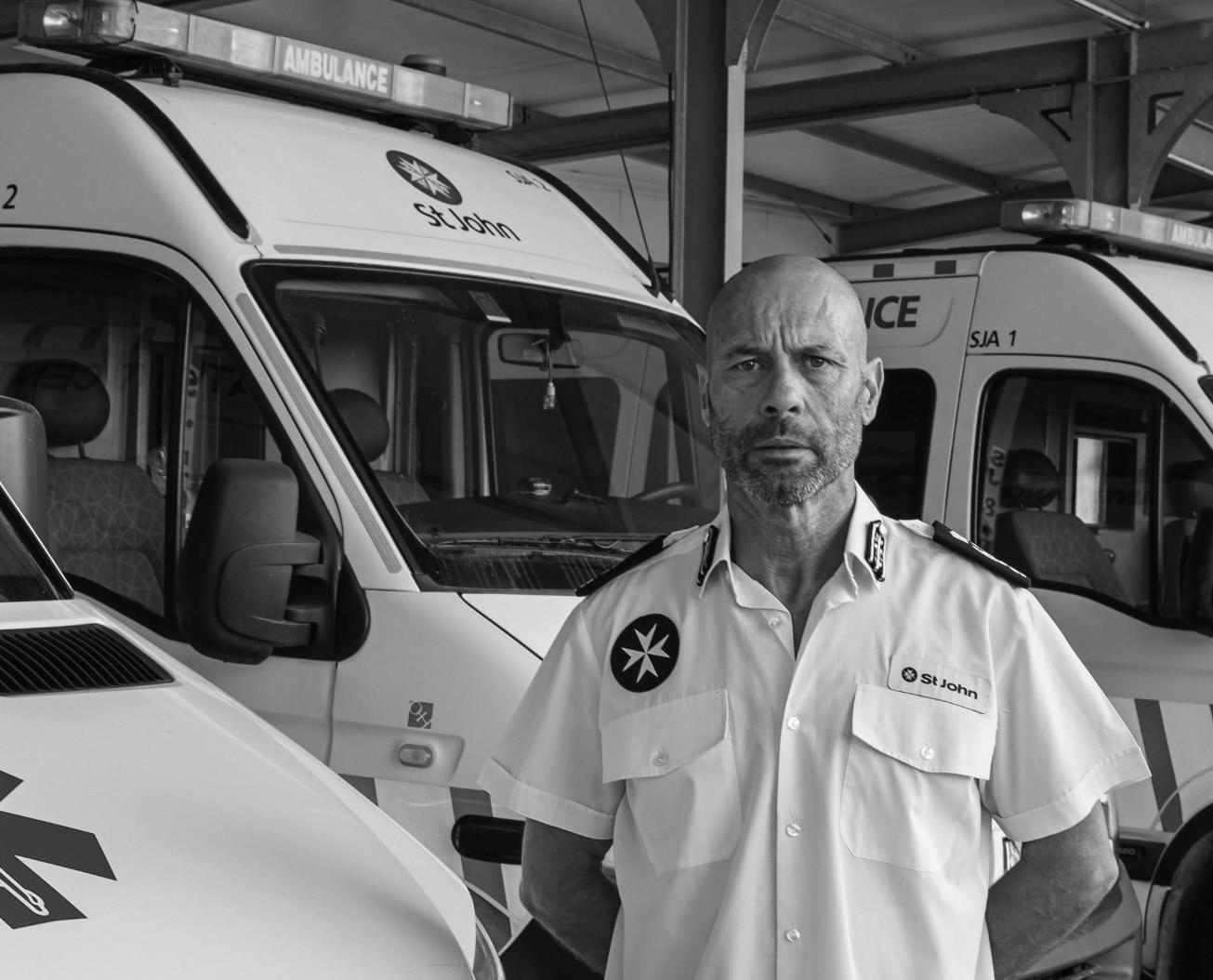


The new chief executive of St John Gibraltar, Sigurd Haveland, is exploring ways of developing the service and expanding resources in order to work “hand in hand” with the Gibraltar Health Authority and Civil Contingency.
Since taking up the role, Mr Haveland has been working on a strategy that will help improve the pre-hospital service while working around the challenges faced in Gibraltar, which has a “finite pool” of resources.
Mr Haveland brings with him a wealth of experience after working with the GHA’s ambulance service for over 15 years, starting as a paramedic and working his way up to the post of Acting Chief Ambulance Officer.
After leaving the GHA, Mr Haveland took up the role at the charity service on a part-time basis while continuing his work at the University of Gibraltar as a lecturer.
His return to St John Ambulance has been hailed as a “coup” by St John trustee, Matthew Turnock.
“Having worked with the GHA and Civil Contingencies, I now feel I am in a position to see things from both sides and hopefully come up with a functional model so that the GHA finds as much resilience as it can,” Mr Haveland said.
“Gibraltar is basically an island so the resources have to be found within.”
“With that in mind, the strategic plan for St John Ambulance is to build resilience internally and externally, and for that we have adopted a view that we need to work on our clinical capabilities.”
Volunteers at the St John Ambulance are now training to work alongside other emergency services in Gibraltar, including the Gibraltar Fire and Rescue Service, to “increase the capacity” for services as the first person on the scene, Mr Haveland said.
Mr Haveland said the charity is also looking at enhancing its outreach instructors within other services such as the Royal Gibraltar Police and Customs.
Under his leadership, Mr Haveland is hoping to increase the number of instructors, build on the topics covered, and look at how the charity can look at “training and developing” volunteers beyond first-aid capabilities.
“We are in very close communications with St John Ambulance in the UK and St John International and we are looking at cherry-picking some of the modules that we can use to improve clinical capabilities for public events for example,” Mr Haveland said.
“It is very robust at the moment and we can always find areas of improvement.”
“When it comes to public events, St John covers them excellently but what we are looking at is improving the service on offer.”
St John Ambulance has a range of volunteers including ‘badgers’, cadets and ambulance drivers, and these badgers can be as young as nurseryage children knowing how to call for help, Mr Haveland said.
He is looking towards further developing the roles for cadets as well.
At present there are some 60 volunteers, but among them there are 25 to 30 active volunteers.
Volunteers for St John Ambulance proved to be “invaluable during Covid”, Mr Haveland said, having seen the work they did while he was Acting Chief Ambulance Officer with the GHA.
During the pandemic, volunteers provided patient transfers across the ERS facilities in Gibraltar.
“I could see the good work that the volunteers were doing with the most vulnerable in our community,” Mr Haveland said.
“It was a very humbling experience as we were working to capacity and St John were not only supporting the GHA, but also Civil Contingency.”
Mr Haveland’s eventual goal is to offer the GHA with an auxiliary ambulance service with non-health professionals at a technician level.
When it comes to the work St John does, Mr Haveland said the team looks at three strands, including business continuity for the GHA, responding to critical or major incidents, or a “slow-burner” such as the surge during the Covid-19 pandemic.
When it came to coronavirus, the charity worked with the Civil Contingency department on tabletop and live incidents.
The arrival of Brexit and a change of policy at the frontier has meant patient transfers to Spain have dropped from some 130 patients a month to just three or four a month.
Those still needing medical services across the border are taken by Spanish-registered ambulances which are privately run, but Mr Haveland hopes to see a change in this policy going forward.
This has had an impact on money coming into the organisation which has affected its long-term plans as a charitable organisation.
Mr Turnock said St John needs to revamp its fleet of ambulances, with costs estimated at £175,000 to change two ambulances.
At present it has six to nine vehicles available at any one time, but the priority is to change the vehicles needed for long-distance transfers, such as those to Spain.
“We would like to ask the community to help us to help the community,” Mr Turnock said.
“Even if someone has a driving licence for more than three
years, they can maybe give a couple of hours a week to join St John.”
“Even if someone doesn’t want to get involved in the medical side of things, we also need support on the administration side.”
Mr Haveland added that retired personnel from Gibraltar’s emergency services can also sign up and bring a “very important skill with their understanding of how emergency services operate in Gibraltar”.
“We are looking at that pool of people together with our younger ones and looking to start a mentorship programme and see how it will work out,” Mr Haveland said.
“We are a small community and our goal at St John is to become a centre of excellence when it comes to vocational training.”
“Hopefully, with the framework we have today, I am looking forward to receiving that award from the UK next year.”
“And I hope that gives us further credibility that the work we are doing is the right one for the community.”
“There’s a St John of the past, the St John of today and the St John going ahead, and the one going ahead is one that gives confidence internally and externally, and sending out feelers that St John belongs to the community but it is also a community effort.”