Cain tests positive
2 weeks later, fallout from rally continues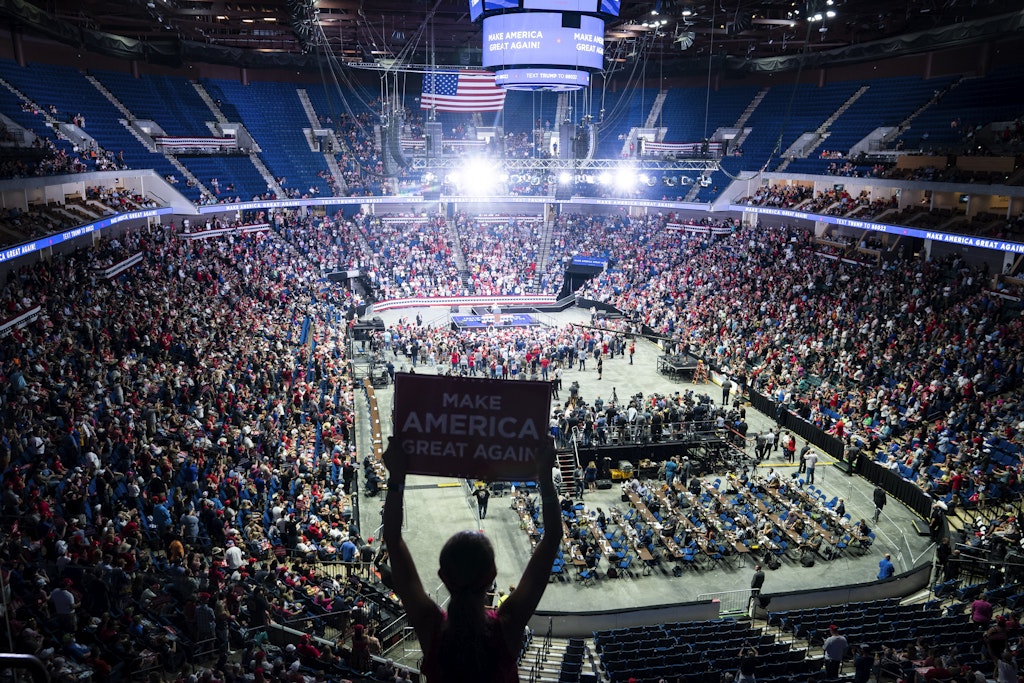


It was just hours before President Donald Trump was set to take the stage for his rally in Tulsa last month when the news broke: Six staff at the site had just tested positive for the coronavirus.
The president, who was en route from Washington, was livid that the news was public, according to people familiar with his reaction.
Health care workers were quizzed about whether they had leaked the information about the positive cases to the news media — and then were given a different list of people to test, according to two people with direct knowledge of the events.
The flurry inside the tent was part of a cascade of events triggered by Trump’s insistence on holding the June 20 rally inside the Tulsa arena, despite the adamant warnings of health officials about the rising risks of the novel coronavirus in Oklahoma.
Tim Murtaugh, a campaign spokesman, said the Trump campaign “performed more tests than originally anticipated” in Tulsa, adding that the event was in compliance with Oklahoma state guidelines and that campaign employees “wore masks during the rally in accordance with [Centers for Disease Control and Prevention] guidelines.”
On Sunday, a second round of testing was provided in Virginia for campaign staff, according to people familiar with the event. Murtaugh, who initially declined to discuss the additional tests, later acknowledged that the campaign had arranged for the procedure for those who had returned from Tulsa and anyone else who wanted one and contracted a testing firm in Virginia to handle the volume.
More infected
In the past two weeks, the campaign has contended with waves of fallout from the rally.
Two more advance staffers tested positive after returning to Washington. And dozens of Secret Service agents on the trip were ordered to self-quarantine at home because two of the staff who tested positive in Tulsa were Secret Service employees.
Videos and photos then emerged showing that before the rally, workers removed thousands of “Do Not Sit Here, Please!” stickers from seats in the arena that were intended to mark recommended distances between rallygoers.
In Tulsa, where many rally attendees did not wear masks, coronavirus cases climbed in the days immediately following the event, according to local health officials, who have said it is still unknown whether the gathering contributed to the problem.
Back in Washington, some top campaign officials, including campaign manager Brad Parscale, self-quarantined at home, while other employees went to hotels, according to campaign advisers.
Campaign aides had hoped the rally would be a needed return to normal — urged on by the president who wanted to go back on the trail.
But some advisers now see the rally as ill-advised, an event that created a cascade of problems that have challenged the campaign and its staff.
Michael Glassner, the longtime architect of Trump’s rallies, had been reassigned in the campaign to handle lawsuits, campaign officials said Wednesday, confirming a report in Axios.
‘Ill advised’
Several Tulsa residents and business leaders had warned that the rally in their city would inevitably lead to the spread of the virus in their community and possible deaths. A group of them went to court trying to block the Trump campaign from hosting the rally. They expressed concern about the number of spectators — and people in Trump’s entourage — who would probably not wear masks.
The Los Angeles company that managed the BOK Center acknowledged that the gathering created substantial risks.
“We certainly agree that the CDC and other relevant medical experts believe that this type of event is ill advised,” Joseph Farris, an attorney for the company that manages the BOK Center, said during a court hearing before the rally. “No question about it. And we don’t argue that the CDC ... classifies events like this as presenting the highest possible risk.”
Back at the campaign’s headquarters in Alexandria, many staff were not wearing masks and some feared that could increase the possible spread after the return of those who were in Tulsa, according to people familiar with their concerns.
Asked whether staff wear masks in the office, Murtaugh said the campaign follows CDC guidelines.
Meanwhile, Tulsa County saw record-setting spikes of coronavirus cases in the days after the Trump rally — with the discovery of roughly 200 to 250 new cases each day.
In all, the county charted 902 new cases of the virus in the week after the rally, an increase of 15 percent over the week that led up the president’s visit. This week, new cases have fallen slightly, with an average of 93 positive cases per day so far.
Herman Cain, a 2012 GOP presidential candidate, is being treated for the coronavirus at an Atlanta-area hospital, according to a statement on his Twitter account Thursday.
CONDITION: It’s not clear when or where Cain was infected, but he was hospitalized less than two weeks after attending President Donald Trump’s campaign rally in Tulsa. He did not meet with Trump there, according to the campaign. Cain, 74, was hospitalized after developing “serious” symptoms but is “awake and alert,” according to the statement.
COMMENT: “I realize people will speculate about the Tulsa rally, but Herman did a lot of traveling the past week, including to Arizona where cases are spiking,” Dan Calabrese, who has been editor of HermanCain.com, wrote on the website. “I don’t think there’s any way to trace this to the one specific contact that caused him to be infected. We’ll never know.”
COLLEAGUE CONTACT: Cain took part in a Trump campaign livestream before the rally with campaign senior adviser Katrina Pierson and Texas state Rep. James White.
The Associated Press