


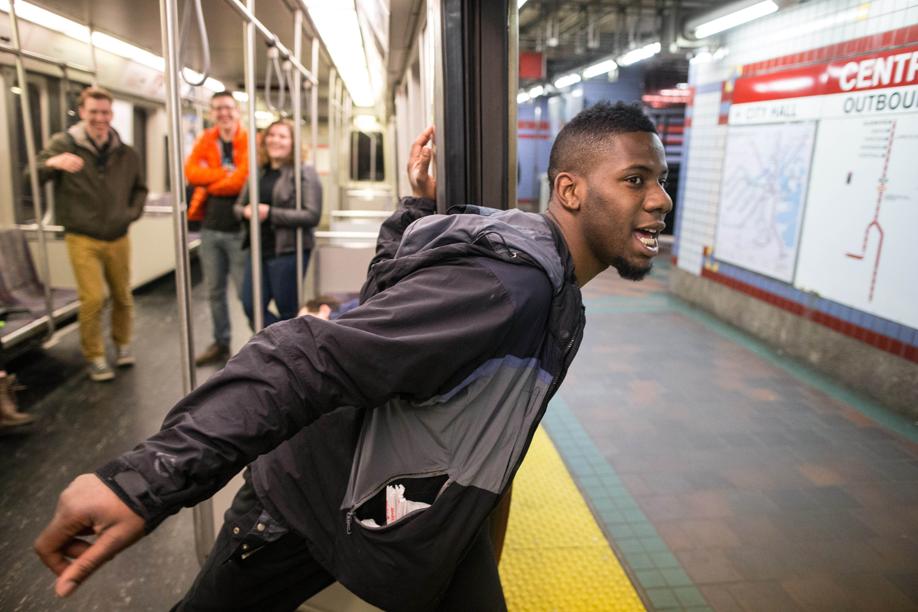
J. Sanders leaned his upper body out of the Red Line train berthed at Park Street Station early Saturday morning and belted out an advisory to fellow passengers who may have still been lingering on the station platform.
“Last train forever!’’ he yelled, his hands placed on either side of the train car’s door frame to keep his balance. “Last. Train. Forever!’’
Sanders’s unsolicited announcement — which he repeated at other stops — was perhaps the final call for the Massachusetts Bay Transportation Authority’s late-night train service. The program came to a halt just after 2 a.m. as the last trains rolled out of major downtown transit hubs in the city.
“I’d prefer it to stay open,’’ Sanders said, now standing back inside the train car. “But they’ve got to do what they’ve got to do.’’
The cancellation of the late-night service, which first launched in 2014 under Governor Deval Patrick, comes after months of hints from MBTA officials about how much the extended hours had cost the agency.
A slight decline in late-night ridership, lack of corporate partnerships, and conflict with the T’s overnight maintenance schedules also led to its demise.
But even with a low rider head count and a relatively quiet atmosphere at Park Street Station in the early hours Saturday, many passengers who rely on late-night service to get in and out of Boston balked at the T’s decision, calling it a giant step backward for a city that is meant to be forward-thinking and “world class.’’
Cassie Anderson, 26, said that when she moved to the area in February, she was excited by the prospect of hopping on a Green Line trolley during weekend excursions and not having to rely on expensive cab rides or Uber trips to get home.
“It turns out that’s over now,’’ she said. “This is something that I so looked forward to as a part of my experience in a city, and I feel like that has been taken away from me, right as I got here.’’
Anderson said convenience wasn’t the only reason she favored the T’s late-night service over other modes of transportation. She said the trains offered a safer alternative when traveling alone.
Lauren Porter, who was waiting alongside Anderson for a Green Line trolley to arrive, agreed. “I would much prefer taking the train because it’s much safer,’’ she said. “Having more people and numbers is better for me.’’
While safety remained a priority for some passengers who frequented the after-hours trains while the service was available, other riders said the cancellation would hit them where it hurts — their wallets.
Clif Sims, 34, who works as a supervisor of concessions at TD Garden, said he’ll have to dig a bit deeper into his pockets for rides home to Quincy after his weekend shifts are over.
“This is my way home,’’ he said, while waiting for an outbound Red Line train. “Now it’s either pay meters or garages, or pay for Uber. It will suck.’’
The T plans to revert to its normal weekend operating hours now that the special service has ended. The last trains will depart downtown stations at 12:30 a.m. The last buses will also now depart around that time.
But for many, that’s not enough.
Shauntay Morgan, 27, said early Saturday mornings were the only days she could save money after leaving her job at 1 a.m., because she could rely on the T’s cheap ticket prices. Without the late-night service, she’ll begin taking taxis instead.
“I use this every weekend,’’ she said. “I am extremely bummed. They should keep it.’’
Back on the last Red Line train out of Park Street, where Sanders had kept riders aware of the final train’s departure, a group of friends from Somerville returning home from a Boston bar reflected on the final trip. Nearby, a man slept, stretched out on the T seat with his head resting on a backpack.
The group had come together two years earlier to help kick off the introduction of late-night service, so bidding it farewell only seemed right.
The group was slightly dismayed, but not enough to let it keep their spirits down.
“I’ll still keep partying. I’m not going to call it just because the trains aren’t running,’’ said Alexis Lloyd. “But having a train to go back [home] on makes it so much more doable.’’
Nicole Dungca of the Globe staff contributed to this report. Steve Annear can be reached at steve.annear@globe.com. Follow him on Twitter @steveannear.

