



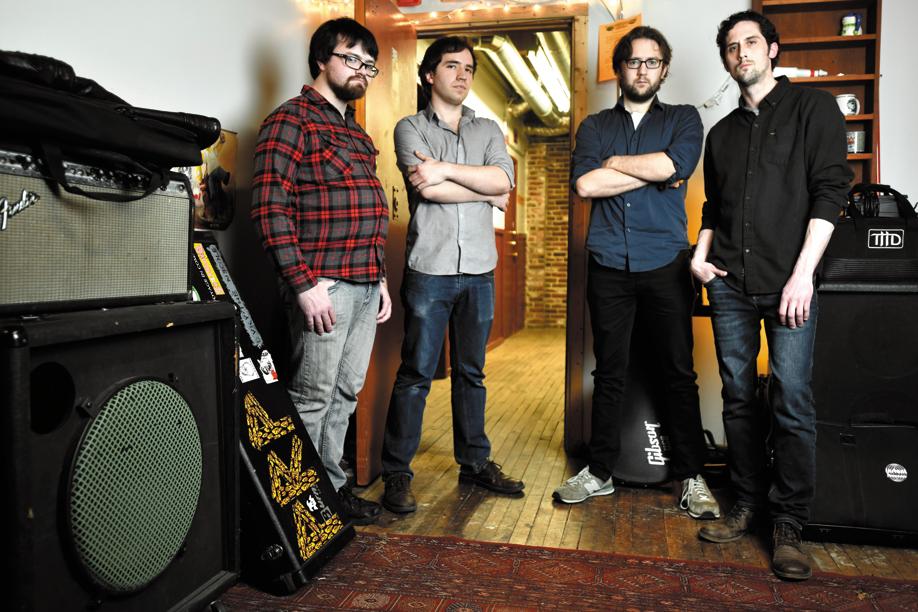
CAMBRIDGE — For more than a decade, Brookline Street’s EMF building has thrummed with music, but its status as a creative font for Central Square is up in the air with the eviction of scores of musicians on the horizon.
The future of the unassuming brick structure located a few blocks from Massachusetts Avenue is at the heart of a broad and pitched debate about affordable creative space in a city that prides itself on its arts and music scene.
Nowadays, the building’s maze of rehearsal rooms is filled with music-making. A guitar noodles from behind a closed door, a muffled bass line emerges from somewhere down the hall.
Despite a recent and temporary reprieve from eviction for the musicians who use the building, those sounds may still be silenced.
The roughly 200 musicians who utilize the building initially had until the end of the month to get out, according to eviction notices sent to the tenants.
But on Friday, they were granted a reprieve until May 31, while Cambridge officials continue talks with the owner, John DiGiovanni, a well-known Harvard Square property manager, about the building’s future.
“Although the future of the EMF building has not been decided, we have all agreed to continue conversations,’’ Mayor Marc McGovern said in a statement.
DiGiovanni declined to comment on the ongoing talks.
EMF — short for Electrical Motor Frequency — once was used to store and sell electrical supplies. It now has about 60 rehearsal spaces and three recording studios.
For those who view EMF as their creative home, the prospective exodus is devastating.
“It’s a huge loss,’’ said Melissa Nilles, a 27-year-old therapist who has rented space at EMF for more than three years. “It’s an entire community of vibrant artist and musicians and it’s going to be taken away. There isn’t anywhere for anyone to practice in Cambridge.’’
Nilles, who sings and plays keyboard in the alternative rock outfit Miele, said she was unsure where the band would move to next; she said she is considering practicing in a church.
DiGiovanni, who bought the property for $4 million in 2016, said he plans a “wholesale renovation,’’ and has no plans to demolish it.
“We knew going in that this building was going to need upgrades and repairs,’’ DiGiovanni said in an interview late last month. “We came to the conclusion that there’s no way to do this in a piecemeal fashion.’’
EMF is DiGiovanni’s latest real estate venture in Cambridge, where he serves as president of the Harvard Square Business Association.
His company, Trinity Property Management, owns and manages several well-known commercial buildings in the city, including ones that house the music venue The Sinclair and the Harvard Square Newbury Comics.
And while he has not yet hammered out a plan for the building’s future, “some work space is likely,’’ he said.
Some of EMF’s musicians, meanwhile, are bracing to be uprooted.
Anna Rae, a 35-year-old singer and bassist in the pop rock band Hemway, said EMF is its own creative ecosystem; it has been the place where you could find someone to do your album art, print your band’s T-shirts, or take professional photos. Now, Rae’s band is on long waiting lists for rehearsal space at three other buildings in the area.
Musicians at EMF, Rae said, fill the schedules of nearby venues like The Middle East and Cantab Lounge, and people who practice at EMF frequent local businesses in the square.
“I’m enraged because it’s really gross to be yanked around by people who have a lot of means,’’ said Rae.
For his part, DiGiovianni disagrees with the assertion that he is draining a creative and economic lifeforce from the square.
“I think musicians and artists of all types are important to the city of Cambridge, and that’s a much bigger question than one building,’’ he said.
He added that zoning “to encourage music and artists space would be appropriate and I’d support it.’’
The outrage over EMF’s possible closure has caught the attention of City Hall.
The City Council has asked the city manager to explore buying the building from DiGiovianni. Additionally, the City Council has broached the possibility of finding other spaces for the EMF artists who are being evicted, while a council committee is studying the idea of having an artists overlay zoning district in Central Square that would reward developers who build and maintain artistic spaces.
Ruby Rose Fox, a 34-year-old singer, has rented space in the building since 2011. She remains hopeful the EMF building will continue to be used as creative space, but as of now, she is moving to a rehearsal space in Boston. Leaving EMF is emotional for her.
“I literally cried for an entire day,’’ she said.
Andy Constantine, a guitarist in the rock band Instant Shawarma, thought EMF’s potential closure could mean bands will play less in Cambridge.
The rent for the room Constantine’s band practiced in at EMF was $550 per month, and that cost was split among three bands, he said. The band paid a little more than $180 a month at EMF and will pay $250 for less space at their new rehearsal room in Brighton.
Standing in an EMF rehearsal room, he said they used to roll their equipment down the bicycle lane of Brookline Street to play gigs at The Middle East, located just a few blocks away.
“Those days are over,’’ he said.
Danny McDonald can be reached at daniel.mcdonald@globe.com. Follow him on Twitter @Danny__McDonald.

