


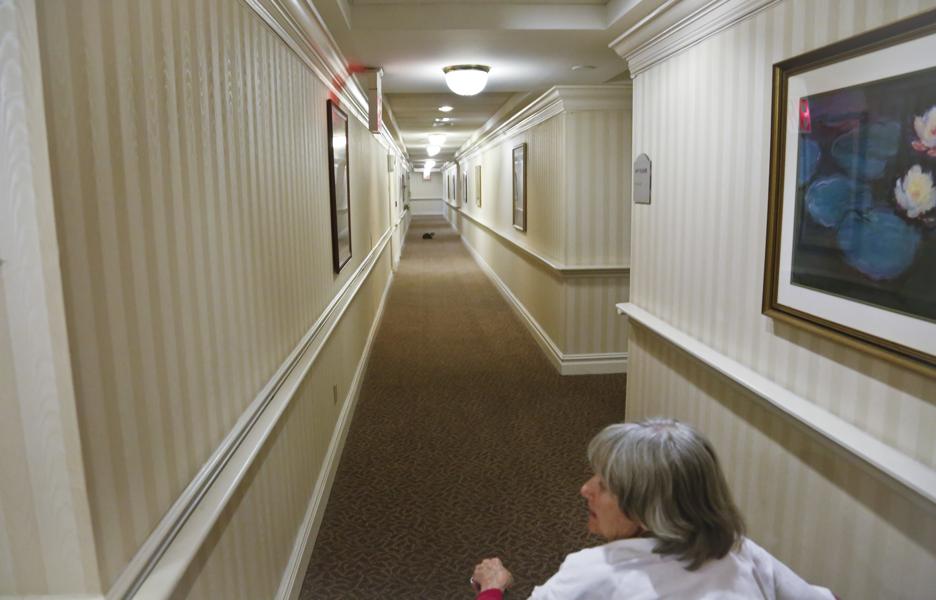
NEW YORK — The stately dining room at this once-bustling old-age home has been emptied, its floors ripped up. The tiny general store’s shelves are barren, and the exercise room has gone silent.
No one is leafing through the books of the library or digging into a treat in the ice cream parlor or painting at an easel in the art room.
All that remains are five women, ages 91 to 101, in the fight of their long lives.
Two years after the sale of Prospect Park Residence was announced, nearly all of the assisted-living facility’s 125 residents have long since heeded management’s orders to leave. Those who have left included Holocaust survivors, a Tuskegee airman, and a floor full of people with advanced dementia.
But five holdouts have refused, challenging the handling of the $76.5 million sale and sparking a web of litigation. Their fight highlights the rights of the elderly and the difficulty of transition in life’s twilight.
‘‘I think we have that right to do what we want to do,’’ said 93-year-old Annemarie Mogil, a retired social worker who has remained in her eighth-floor apartment at the home. ‘‘I’ve earned my rest. I worked hard. I deserve my peace.’’
As the building in the trendy Park Slope neighborhood of Brooklyn emptied, a small band of tenants decided to put up a fight. Local politicians came to their side and the Legal Aid Society filed suit on their behalf. As the months ticked by, they said management purposely worsened conditions in hopes of persuading them to leave.
The holdouts said they were being bathed less frequently, saw housekeeping scaled back, and central air conditioning cut off in favor of less-effective window units. They said hot water was tampered with.
Those moves, opponents of the sale say, were orchestrated by building owner Haysha Deitsch even as he raised fees on the holdouts. He denied it, and in a countersuit against the families of the remaining residents, he called for $50 million in damages for their interference in the sale, ‘‘slanderous’’ allegations and resulting ‘‘mental anguish.’’
Deitsch said he followed the law, that residents always got outstanding care, and he never cut back services. Closing was not an easy choice, he said, but costs became untenable.
He portrayed the remaining residents as unable to make decisions on their own, and represented by individuals with questionable motivations.
‘‘The representatives of those who remain are not negotiating in good faith. They repeatedly have changed their positions and moved the goal post,’’ Deitsch wrote. ‘‘Those representing the remaining residents are acting out of greed and malice and appear unwilling to offer any compromise or reasonable position.’’
Deitsch said residents’ complaints should really be with the Legislature and state regulators. New York City Councilman Brad Lander also sees lax state oversight, though he isn’t letting Deitsch off the hook.
‘‘He is evil. He is acting in a way that I think is sociopathic. But the state health department has essentially taken the side of the sociopath,’’ Lander said.
Erin Silk, a spokeswoman for the state Department of Health, said she could not comment on active litigation. In court filings, the department defended the secrecy of closure plans, saying it ‘‘avoids chaos’’ of word trickling out. Prospect Park Residence filed a plan that, after some revisions, ‘‘was plainly consistent with the regulations,’’ the department said.
A Brooklyn state court judge ruled the initial closure plan inadequate and intervened on specific complaints, including the resumption of central air conditioning and consistent hot water. Families of the holdouts are fighting a new closure plan, saying appropriate new homes still have not been found for the remaining five. They say the options offered have been prohibitively expensive or excessively far or have other problems.
‘‘All of this is an effort to protect my mother from having to go into a storage facility,’’ said Deborah Pollack, whose 98-year-old mother, Lillian Guide, remains at Prospect Park Residence.
As hearings drag on, emptiness abounds in the building on coveted Prospect Park West.
Mogil spends much of her day down the hall with her friend Alice Singer. They speak of the difficulty in moving to the home to begin with, but of growing to love its location and simple pleasures. They watch bikers, skaters, and runners in the park below, witness the changing of seasons, hear the sounds of city life. It keeps them feeling alive.
Singer, a retired bacteriologist with mild dementia, knows she might be seen as stubborn, but sees no good alternative.
‘‘When I grow up,’’ the 91-year-old says with a straight face, ‘‘I’ll find out if stubbornness is good or bad.’’

