


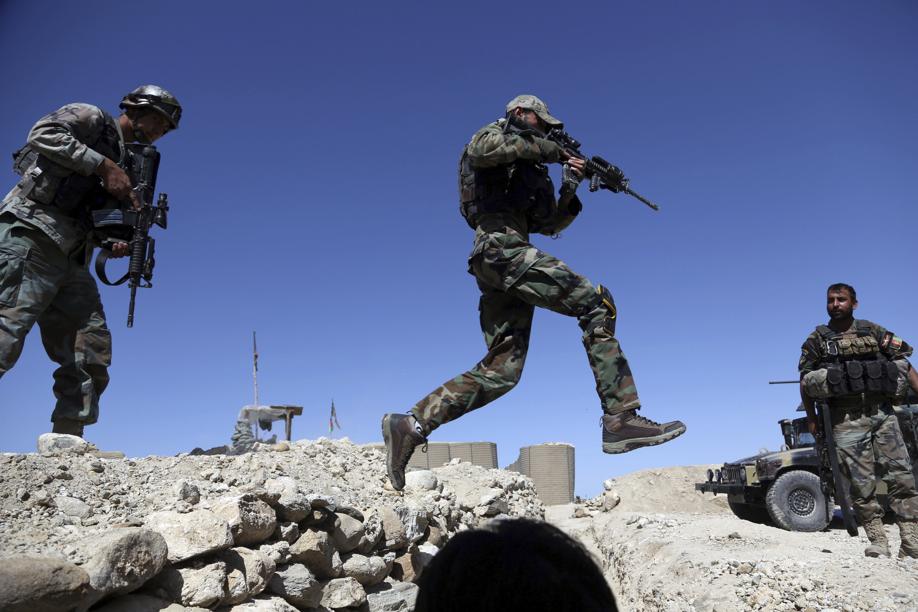
On Thursday, the United States dropped the ‘‘mother of all bombs’’ on a network of Islamic State caves and tunnels in Afghanistan. The military argued that its massive use of force was necessary to destroy the underground terror hideout. (Though it’s not clear that the MOAB was the right tool to accomplish that goal.)
Tunnels are not just the purview of the Islamic State’s small Afghanistan force. Like other guerrilla groups, the Islamic State has created tunnel systems under many of the cities and villages that they occupy. These pathways are essential to their strategy, enabling them to move stealthily, strike quickly, and then escape capture.
It’s hard to know how many tunnels exist, or where. But anecdotal reports suggest that the network is extensive. After Mosul was liberated in 2015, for example, Iraqi troops and the Kurdish peshmerga found that the road into the city had been honeycombed with tunnels, many booby-trapped. Mosul, too, had an extensive under-layer of pathways. As an Iraqi intelligence officer told my colleague last year, ‘‘they’re everywhere.’’ The same was true under Fallujah.
Iraqi forces say the tunnels have made an already difficult offensive harder, allowing Islamic State fighters to appear seemingly out of nowhere. This infrastructure allowed Islamic State fighters to creep quickly into position, then ambush advance troops from concealed locations.
Rukmini Callimachi, who covers the Islamic State for The New York Times, explains the strategic advantage on NPR:
‘‘In all of the areas that I have visited, ISIS dug a complicated network of tunnels. And so what they’re able to do is they retreat inside the tunnels. And then from there, they’re able to send a drone up into the air. So they’re completely protected and unseen from our surveillance. And yet, they’re able to see. So what they suspect is happening is that the drone is sent out to collect information to identify the location of where the enemy troops are. And then from there, they’re able to pinpoint that place and then start aiming mortars at it as well as aiming munitions from the drone itself.’’
‘‘It’s like we are fighting two wars in two cities,’’ Colonel Falah Al-Obaidi of the Iraqi counterterror forces told The Washington Post. ‘‘There’s the war on the streets and there is a whole city underground where they are hiding. Now it’s hard to consider an area liberated, because though we control the surface, ISIS will appear from under the ground, like rats.’’
The network of tunnels illuminates something else: that it will be nearly impossible to bomb the Islamic State into submission.
‘‘It’s absolutely impossible,’’ Callimachi told NPR’s Terry Gross. ‘‘Unless you’re willing to court, you know, a real human catastrophe, you can’t just bomb this place indiscriminately.’’

