


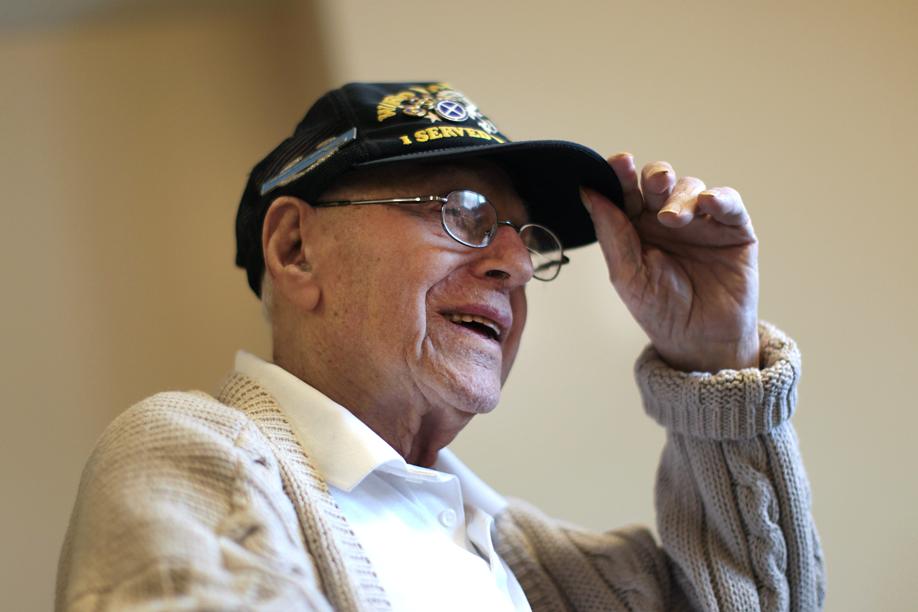
DEDHAM — When Francis DeNapoli landed on Omaha Beach, he never thought he’d make it home.
But two children, five grandchildren, five great-grandchildren, and more than 70 years later, he is approaching his 100th birthday.
Surrounded by family members, including Ann, 97, his wife of 73 years, DeNapoli sat with a reporter at the Golden LivingCenter to do something his family says they’ve almost never seen him do: reflect on his wartime experiences.
One of an estimated 16,000 World War II veterans still alive in Massachusetts, a number that’s fast dwindling, and the winner of a Purple Heart for injuries suffered on the battlefield, DeNapoli has rarely spoken of a brief chapter in his life that clearly left an indelible impression.
Born Crescenzio DeNapoli to Italian immigrants who’d settled in Roslindale, the fourth of seven children, he was a driving a truck for a local company before he was drafted, a job he promptly returned to upon his discharge, relieved to put the war behind him.
“The war affected him physically, yes,’’ said Ann, “but not mentally.’’
To say that DeNapoli was a newlywed when Uncle Sam came knocking in 1942 would be an understatement: His draft notice actually conscripted him to serve days before he and Ann Columbo planned to wed. The couple hastily held the ceremony a week earlier. His two older brothers were also drafted for the fight against the Axis powers, which included fascist Italy; his younger sister enlisted. All survived the war, but have since died.
Appointed an Army rifleman and heavy equipment operator, DeNapoli underwent two years of training at five stateside locations. But nothing prepared him for what awaited when the Queen Mary brought him to Europe in 1944.
Some 160,000 troops had crossed the English Channel on June 6, 1944, D-Day, but more than three times as many would follow, including Private First Class DeNapoli. He landed on Omaha Beach on July 4, he said, adding that doing so was itself a life-threatening experience. Infantry had to jump onto boarding vessels, DeNapoli said. If they timed their leaps wrong, they could be crushed between boats.
What he found onshore was horrifying. DeNapoli said he’d never seen a dead person before, but thousands awaited him on the beach. Soldiers walked around corpses, he said, constantly alert to danger.
“Machine guns were firing over our heads,’’ DeNapoli said. “As soon as you pop your head up, they gave you the works.’’
DeNapoli leaned forward to look a reporter in the eye for the first time.
“War is hell, believe me,’’ he said. “It’s hell.’’
More than 125,000 US troops died on the beaches of Normandy, the British D-Day Museumestimates. DeNapoli survived, but when his division reached a small town in northern France — he couldn’t recall the name — his luck changed. At first, he didn’t know he was injured. But when he looked down, he realized he’d been struck by bomb shrapnel in his left buttock and leg.
“The soldier that picked me up said, ‘Can you walk?’ ’’ DeNapoli said. “I said, ‘Are you kiddin’ me?’’’
He was loaded into a jeep and driven to a hospital in Paris, he said, then scheduled for further treatment in England. But bad weather kept delaying the flight. He spent almost a month in a tent, he recalled, before “they finally said, ‘OK, boys, get ready for England.’’’
He was ready for more than that — for going home. In late May 1945, after he’d been awarded a Purple Heart in his hospital bed and two weeks after the Allies declared victory in Europe, he got his wish. Soon after arriving at Otis Air National Guard Base in Buzzards Bay, he said, he was handed $9 and told to find his way home. When he got to Roslindale, he met his 7-month-old son Dennis for the first time.
“I got home in my Army clothes and threw them away,’’ DeNapoli said. “That was the first thing I did.’’
He readjusted to civilian life without hesitation, he said, and went back to work at Alco Trucking, as he’d been promised before the war. In 1960, he was hired by the Boston Department of Public Works as a street sweeper, Ann DeNapoli said.
He made $44 a week to start at the DPW, she said, adding that he served as a plow operator, street sweeper, time keeper, inspector, and supervisor for the West Roxbury public works yard before retiring at age 70 in 1986.
To supplement his retirement income, which wasn’t much, Ann said, DeNapoli refurbished and sold wooden chairs.
Twice, she said, he accidentally severed the same finger while refurbishing a chair. Twice, he had it reattached. His family put an end to the chair business.
Now they plan to celebrate his life a week or so before his Feb. 18 birthday.
Bret Hauff can be reached at bret.hauff@globe.com. Follow him @b_hauff.

