


The Lynnfield High girls’ tennis team wasted little time building a huge lead against visiting North Reading Tuesday afternoon in the Division 3 North semifinals.
Lynnfield claimed the competition’s first three matches, sealing its third straight sectional finals berth. The win was hardly surprising: A sign attached to the fencing around the courts listed the team’s five state championship teams, underlined by “Coached by Craig Stone.’’
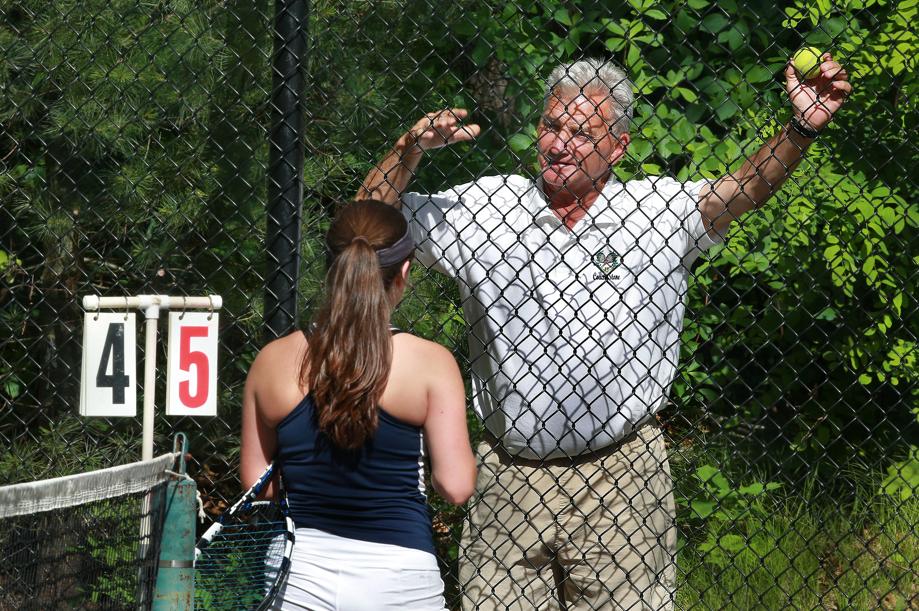
The man himself walked the perimeter of the courts, weaving in and out of the wooded area surrounding them.
Three games into the contest’s No. 1 singles matchup, he paused briefly to speak with junior Sarah Mezini. The two exchanged whispers before Mezini returned to the court to take her serve. Stone continued his cycle, moving on to the No. 2 singles match.
“There’s two types of coaching during matches,’’ Stone said following his team’s 4-1 victory. “Psychological and technique.
“Sometimes players get distracted or psych themselves out, and sometimes they just need to be reminded of how to attack their opponent,’’ he said. “Often, at this point in their playing careers, they know the fix. They just need someone to say it to them sometimes.’’
At this point in his career, after 36 years of coaching tennis at Lynnfield, Stone certainly knows how to get the best of his players. Tack on his 41 years and counting at the helm of the school’s co-op wrestling team with North Reading, and the 66-year old Stone has built a remarkable record of success.
His achievements over decades of MIAA competition — between tennis and wrestling, 15 sectional titles, five state championships, and a combined 1,078 wins — put him on an exclusive list of coaches who have become staples of their programs. When Stone started as a physical education teacher at Lynnfield’s Summer Street elementary school in 1972, the high school didn’t have wrestling or girls’ tennis programs. When those were created in 1975 and 1980 respectively, he signed on.
“For wrestling,’’ Stone said with a laugh, “I was the only one to apply.’’
Suzanne Ontso did much the same thing at Winchester High. She helped pioneer girls’ lacrosse at the school when she signed on as coach in 1994. At the time, it was one of only 12 such lacrosse teams statewide and the first created in more than a decade.
In 23 years, Onsto’s teams have garnered nine North sectional titles and, in 2008, a state championship.
You won’t hear her talk about that track record too much. In her eyes, there are far higher achievements.
“On average, ‘’ she said, “50 percent of my girls go on to play in college for at least one year, whether it’s at a club or college level.
“It’s always so great for them to come back and check in on occasion. Plus I try my best to go see them play.’’
Reading boys’ tennis coach Bruce Appleby got his start in the 60s. Jump forward 53 years, and the 77-year-old still loves every day of it.
“It’s such a great community to coach in,’’ Appleby said. “The administration and the families of these players are always supportive.’’
In coaching, a love like Appleby possesses for the game is crucial, and sustained success sure helps.
But ask Appleby about his achievements as a coach, and he’ll start listing former players.
“Mark Erelli went on to win a state title at Bates,’’ he started. “He’s a folk singer now. John Lyons was my first real No. 1 singles player and now he works at Wilson’’ as the sporting good firm’s tennis global product director. “Jamie Cerretari went undefeated until the state finals his freshman year. Now he’s a professional.’’
For most of the longtime coaches, it seems, true joy comes not in winning, but in nurturing young men and women.
“You’re more than a coach,’’ said Leo DiRocco, Tewksbury High softball coach since 1990 who began in 1960 as the freshman football coach at Dracut High.
“You’re a parent first,’’ said DiRocco. “You get to understand the various aspects of their lives from home to the field, and you go from there, because it’s all about them.’’
When a coach values his or her players to such a degree, the players take notice.
“Doc’s always stressing the importance of us being a family,’’ said junior Adrianna Favreau, a pitcher for the squad.
“He knows what to say when we’re upset or nervous. He cares about us and the game itself so much, and you can tell in the way he gives speeches or regularly interacts with us.’’
If handling young athletes properly hasn’t changed much, the coaches say, the athletes have.
“The kids have an awful lot more skill when I get them,’’ Appleby said. “To make a good high school team, they’re playing the sport like three seasons out of four. It’s the only way to be really competitive.’’
Said Stone: “Being a [physical education] teacher, I’m a big advocate of cross-sport training. It’s become so highly competitive. I see these younger kids sometimes and think, ‘how do you even find the time for this?’
“If players can reflect back upon their Lynnfield careers and feel good about being a part of it all,’’ Stone said, “I’ll feel more than successful.’’
Ethan Schroeder can be reached at ethan.schroeder@globe.com.

