


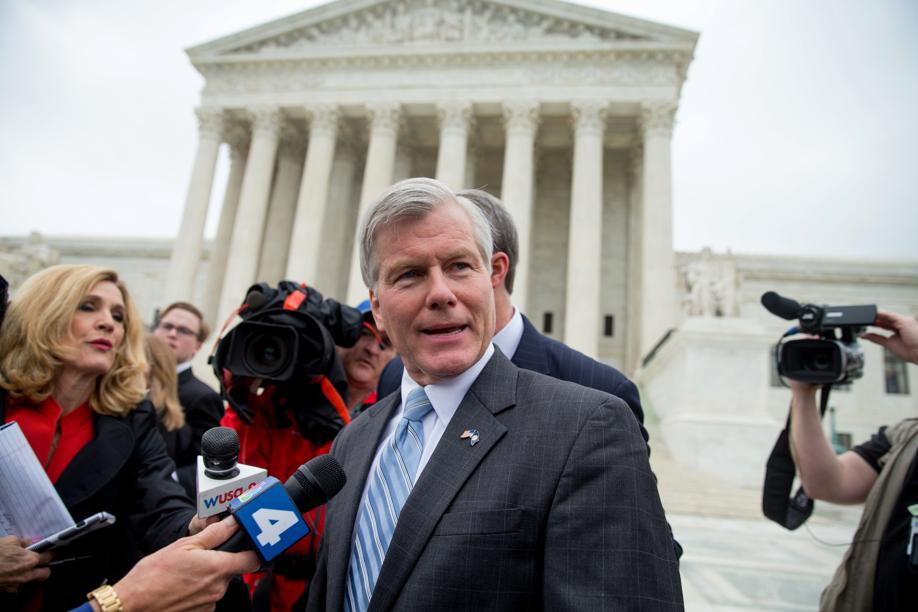
Though the US Supreme Court ruled unanimously Monday for former Virginia governor Robert McDonnell, it’s still not standard practice for a public official to accept more than $175,000 from a businessman who’s trying to get the government on his side. The threat of federal prosecution is still a good reason for public officials not to accept money or favors to promote nefarious private agendas behind the scenes.
That’s a relief, because the McDonnell verdict could have done far more to legitimize influence-peddling than it did.
While FBI agents catch the occasional state senator stuffing cash in her clothes, most political intrigue involves more subtlety on everyone’s part. McDonnell and his wife were convicted on federal corruption charges in 2014 after accepting more than $175,000 in gifts, trips, loans, and other favors from Jonnie Williams, who wanted to get his company’s tobacco-based nutritional supplement approved as a drug by the FDA. McDonnell urged subordinates to look into the supplement, nudged state university researchers to conduct studies on it, and arranged meetings on Williams’s behalf.
Yet in an 8-0 decision, the Supreme Court found that the trial judge’s instructions to the jury were too broad, and that the “official acts’’ that the government had portrayed as part of a quid pro quo were too commonplace and unspecific to be clearly illegal.
Some anticorruption advocates were despondent. Law professor and congressional candidate Zephyr Teachout fretted that the ruling “has enshrined bribery in our politics.’’
Don’t be so sure. Even as the Court overturned McDonnell’s conviction, Chief Justice John Roberts’s opinion also spelled out a different way of prosecuting him. Under existing precedents, a public official doesn’t even have to perform a specific act to trigger legal suspicion — “it is enough that the official agree to do so,’’ Roberts writes. The deal doesn’t have to be in writing; a jury could conclude that “an agreement was reached if the evidence shows that the public official received a thing of value knowing that it was given with the expectation that the official would perform an ‘official act’ in return.’’
In other words, the feds should have made it clearer to jurors what Williams expected for his $175,000 and how McDonnell encouraged that expectation. “If you put it before a jury that way, one of the practical things it does for the government is put the focus back on the money,’’ Boston College law professor George Brown said in an interview Monday.
The McDonnell verdict was widely anticipated in Massachusetts, where some civil libertarians argue that recent corruption cases, including the conviction of former probation commissioner John O’Brien, have criminalized politics-as-usual.
For his part, McDonnell also argued that the federal laws under which he was convicted were unconstitutionally vague. Some legal experts supporting him argued that Citizens United, the 2010 decision that concluded that unlimited campaign expenditures are a form of free speech, offers greater protection to “ingratiation and access’’ in politics.
The high court conspicuously avoided those conclusions. It left open the option of retrying McDonnell, and the justices haven’t ruled — at least not yet — that it’s OK for politicians to take big personal gifts in exchange for official favors. That kind of corruption, thankfully, is still illegal.
Dante Ramos can be reached at dante.ramos@globe.com. Follow him on Facebook: facebook.com/danteramos or on Twitter: @danteramos.

