


SALT LAKE CITY — Donald Trump has vowed to turn blue states red in November, but as he continues to rattle Republicans with his combative style and provocative proposals, voters in some of the country’s most conservative strongholds are considering a radical idea: supporting Hillary Clinton.
The dilemma posed by this year’s choice of candidates is perhaps most apparent here in Utah, the mountain state that has not backed a Democrat for president since Lyndon B. Johnson in 1964. More than 50 years later, a large Mormon population with a strong distaste for Trump has left the state up for grabs, and with a substantial Mormon presence spilling into places such as Arizona, Idaho, and Nevada, what would normally be a Republican safe zone could be surprisingly competitive.
With the Clinton campaign looking to put Republican-leaning states in play, the decision for many Mormon voters in Utah has become agonizing as they digest Trump’s stances toward Muslims in light of their own history as an oft-maligned religion, and as his “America First’’ message repels well-educated Mormons who travel the world on missions and who welcome refugees.
“People who normally vote Republican are in a terrible state of ambivalence right now,’’ said Tim Chambless, a political scientist at the University of Utah. “They are so undecided. They want to vote, but they aren’t sure how to vote.’’
The first signs of Trump’s troubles in Utah date to early March, when Mitt Romney, the 2012 Republican presidential nominee and a Mormon who is beloved in the state, gave a speech here warning that Americans were being duped by Trump. Later that month, Trump was throttled by Texas Senator Ted Cruz in the state’s caucuses, winning a paltry 14 percent of the vote. In June, two polls showed Trump and Clinton deadlocked in Utah, making it increasingly plausible that its six electoral votes are really in play.
With three months until the election, the Clinton campaign is now considering a possible upset in Utah, Libertarian candidate Gary Johnson is aggressively wooing disenchanted Republicans, and on Monday word came that Evan McMullin, a Mormon who is a former CIA official opposed to Trump, was also entering the race.
Voters such as Angie Melton, who has never voted for a Democrat, are feeling deeply torn.
“I’m upset by this turn of events,’’ Melton, 41, said as she sat in the shade with her family next to the towering Salt Lake Temple, the center of Mormonism. “I’ve always voted Republican, but my thought has been that she would be less damaging in terms of world politics,’’ she said, referring to Clinton.
“It doesn’t mean that I agree with much of anything she says or her as a person,’’ Melton added, “but I would rather that she win.’’
Such hand-wringing is common as trepidations about Trump grow by the day. On both substance and style, he evokes an antipathy among many Mormons that is rooted in culture, religion, and history. For a religious group that was driven to Utah during the 19th century in the face of persecution, Trump’s calls for religious tests and a ban on Muslim migration echo a painful past, leaving some wondering if they will be next.
“The issue of religious liberty is an important one in the state, and the notion of a religious test for immigration raises deep concerns,’’ said Chris Karpowitz, a codirector of Brigham Young University’s Center for the Study of Elections and Democracy. “Mormons are sensitive to issues like this because of their own history.’’
Joseph Smith founded the Church of Jesus Christ of Latter-day Saints in upstate New York in 1830. Converts, however, were often targeted as heretics for practicing polygamy, believing in scriptures exclusive to Mormonism, and claiming that their faith was the true restoration of Christianity.
Most Mormons were Democrats in the 19th century, Karpowitz notes, because of Republican opposition to polygamy, but they started to move to the right in the 20th century. By the time the 2012 presidential election came around, with Romney as the candidate, 90 percent of Utah’s Mormons voted Republican.
That number is expected to drop significantly this year with Trump atop the ticket. His shifting positions on social issues, his hard-line views on immigration and his flashy lifestyle clash with Mormon sensibilities that prize humility and charity.
And there is his stance against taking in refugees from abroad.
“His rhetoric and the church’s rhetoric on refugees could not be more different,’’ said J. Quin Monson, a coauthor of “Seeking the Promised Land: Mormons and American Politics.’’
Democrats are taking Utah seriously. While they realize that their improved chances in the state are not because their nominee has suddenly surged in popularity, the party would be happy to break its losing streak.
“This is the first time since the mid-1960s that a Democratic presidential candidate could win in Utah,’’ said Peter Corroon, the party’s chairman in the state. “Unfortunately, it’s not because of the Democrat, it’s because of the Republican.’’
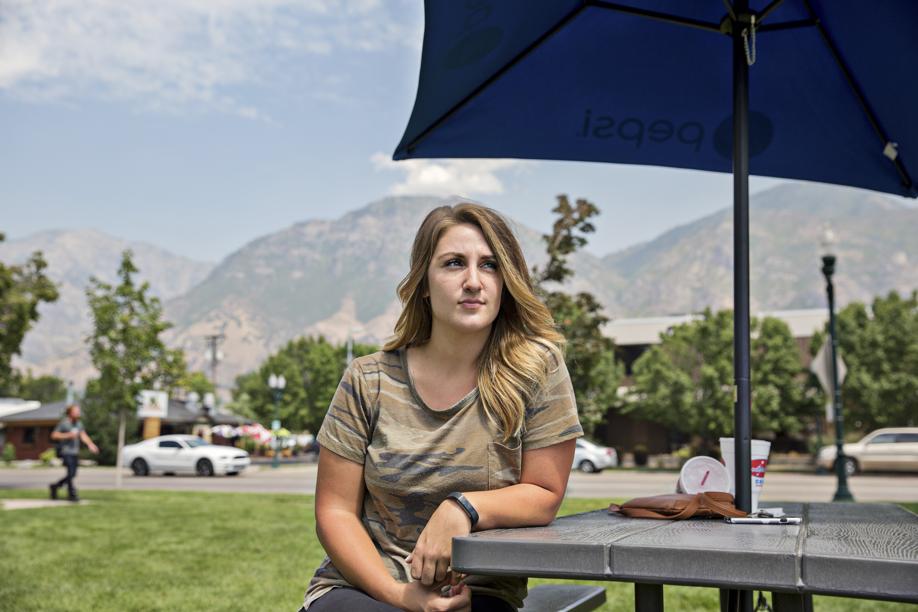
Young Republican Mormons such as Mary Weidman give Democrats hope. Sitting outside a soda shop in Provo, Weidman explained that after supporting Romney four years ago, she would vote for Clinton in November.
“I think it’s the lesser of two evils,’’ Weidman, 27, said, expressing dismay over how Trump talks about women. “When you think of a leader, he lacks every trait.’’
Despite such sentiments, it is risky to count Republicans out. While the Trump campaign had no comment about its strategy, the state Republican Party said that Trump’s team is up and running in Utah. Longtime conservatives who say they are thinking about voting for Clinton could have second thoughts on Election Day.
“Republicans at this point are a little unhappy with Trump, but they’re going to vote for him,’’ said James Evans, the chairman of the state party.
That appeared to be the case for Nathan Alder, a 21-year-old Republican Mormon who goes to Utah Valley University in Orem. With his skateboard in one hand and his dog by his side, he said that when it came down to it, he would most likely hold his nose and vote for Trump.
“I don’t like Trump, but I probably will vote for him,’’ Alder said, explaining that his worries about Clinton’s liberal views narrowly outweighed his fears about Trump’s temperament. “I am pretty torn. I’m not going to lie.’’

