


The first ever fashion exhibit at the State House, “Fashion on the Hill,’’ was no ordinary show: The designers were Burlington High School students, and the materials were garbage bags and bubble wrap.
The Great Hall of Flags was converted into a runway, with tables lining the walls presenting other work done by students in the Burlington High art department.
“Last year when I saw the fashion program, I didn’t know what to expect, and I was blown away by the creativity and preparation done by the high school students,’’ state Representative Kenneth Gordon, who hosted the event, told the audience. “Take note of what we can do in our public schools.’’
The designers walked the runway, modeling dresses they designed themselves. They included Athanasia Michaelidis, Nicole Smith, Taylor LeRoux, Samantha Marchese, and Amanda Wagreich (class of 2016); Emily Sateriale, Juliana Cameli, Kellsee Lynch, Kailee Heffler, Melanie Sunnerberg, and Zoe Desantis (2017); and Daniella Lombardo, Daviana Alford, Emily Hopkins, Joel Hagan, Laura Prendergast, Sara Cannalonga, and Shamie Kasozi (2018).
The students showed off their designs for graphic T-shirts, skirts, and dresses. There also were several more unique parts of the show, such as costume design, where the outfits were inspired by fictional characters such as Disney’s Maleficent. The designers “upcycled’’ men’s shirts to make them into trendy shirts and accessories for women. Hopkins’s “Maasai’’ sock design was featured, a winner of the national Noble Stitch competition.
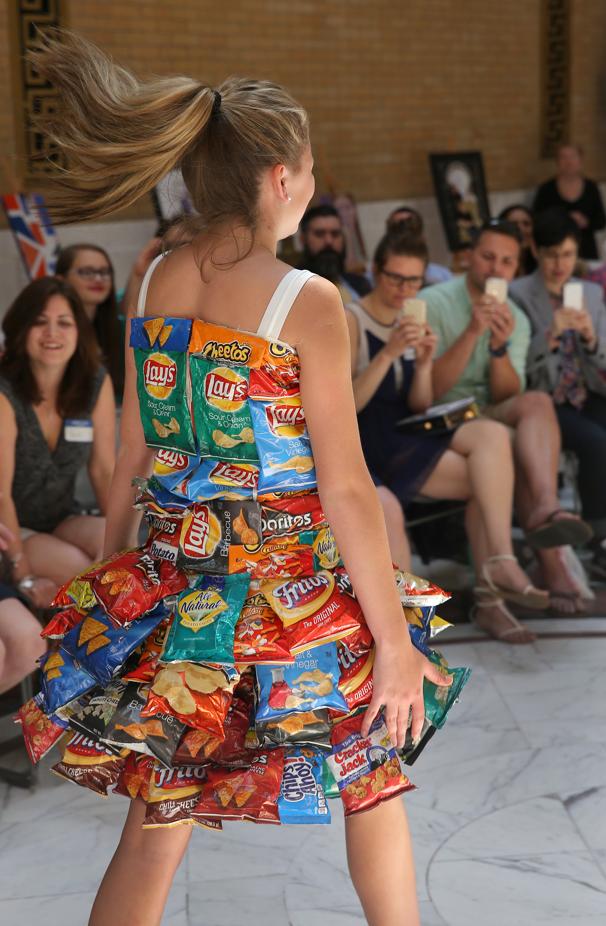
The recycled dresses were constructed of popsicle sticks, paint swatches, and other unconventional materials.
Another notable project was the “adapted garment’’ section, created by Wagreich, Marchese, LeRoux, and Sunnerberg. Four young children in wheelchairs modeled their new jackets. The frog and monkey prints opened in the front and attached with Velcro to the hood, making it easier to wear.
“We usually make clothes for ourselves, never mind children or handicapped children,’’ said Sunnerberg. “It was an awesome opportunity, a true blessing.’’
Sunnerberg, who is attending Boston’s School of Fashion Design’s Fashion Academy this summer, said the adaptable garment project inspired her to start her own brand making adaptable clothing, the Purple Peach Company.
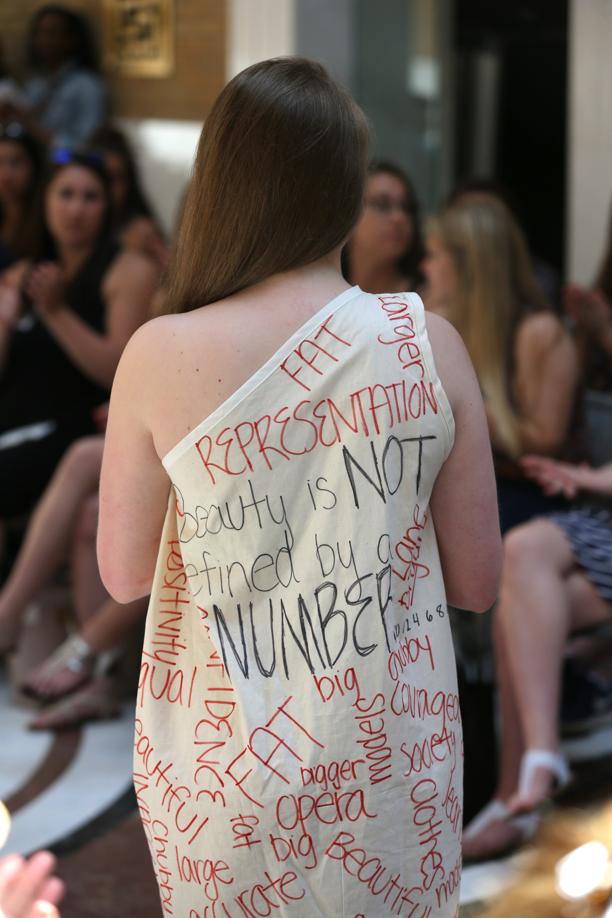
Sunnerberg had more to share, bringing out three models wearing clothes she designed for a social experiment. She had asked people the first thing they thought of when they heard the words “beautiful,’’ “sexy,’’ and “plus-sized,’’ and then wrote those words on corresponding dresses made of formless muslin.
“The hardest for people was ‘beautiful,’?’’ Sunnerberg said. “It should be easy. People should say, ‘Oh, me,’ or, ‘My wife,’ or, ‘My daughter,’ or, ‘My brother.’ I was most surprised by the ‘plus-sized’ one. People said terrible things like, ‘Disgusting,’ ‘Fat,’ ‘Disgraceful.’?’’
On the back of the dresses were positive phrases, such as “Beauty is not defined by a number.’’
“I wanted to show how the fashion industry affects society today,’’ Sunnerberg said.
Christina Bagni can be reached at christina.bagni@globe.com.

