


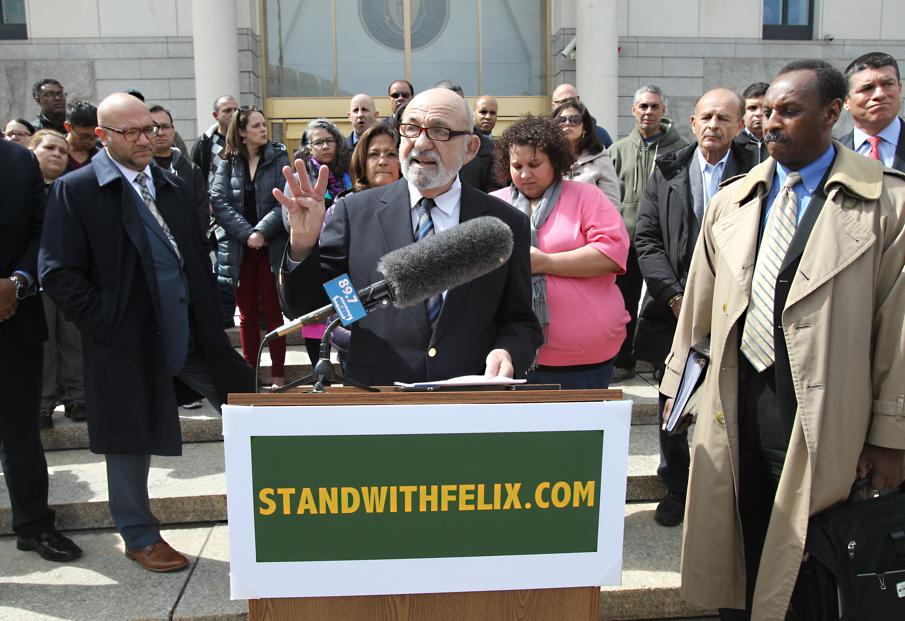
The Department of Justice is conducting a civil inquiry into whether the Register’s Office of the Suffolk County Probate and Family Court “engaged in a pattern or practice of discrimination,’’ court officials said Thursday, as they said that suspended register Felix D. Arroyo could return.
Arroyo, suspended in February amid questions about his job performance, will have the option to return to the position in early October.
Paula M. Carey, chief justice of the Trial Court, and Court Administrator Jon Williams wrote this week that Arroyo can resume his job Oct. 2, eight months after he was put on paid administrative leave.
“The Trial Court has worked with register Arroyo on his plan of return to address shared desirable organizational, hiring, and training goals, including our agreement to the addition of a new position of assistant register,’’ Carey wrote.
Arroyo promptly accused the court of imposing restrictions on his authority as an elected official and did not commit to returning as court register.
“At first glance, we are deeply troubled by the Trial Court’s proposal,’’ said Patrick Kearney, a spokesman for Arroyo. “Their insistence on imposing conditions that aren’t provided for in the statutes are consistent with the institutional racism that register Arroyo and his staff of color experienced on a regular basis.’’
Arroyo, who is Latino, has asserted he was the target of a racially motivated attack by white courthouse employees, who objected to his efforts to hire a more diverse staff. A court system investigation, which The Boston Globe detailed in March, found pervasive accusations of racial hostility and sexual harassment at the Probate Court.
Meanwhile, the Department of Justice has requested documents pertaining to the Suffolk Probate and Family Court Registry dating back to 2014, said a spokeswoman for the Trial Court, Jennifer Donahue.
Arroyo, a former Boston city councilor who is paid close to $140,000 a year, was suspended two years into his six-year term. Three weeks later, court officials said they had discovered serious deficiencies’’ in the operations at the Suffolk Probate and Family Court “sufficient to threaten the court’s ability to serve the public and the bar.’’
Their findings included scores of misplaced files, hundreds of dollars in unprocessed checks, and a lack of consideration for the public.
The registry, which has 33 employees, handles filings that include divorces, wills, child custody cases, and other family issues.
In her memo, Carey said the court has been working with Arroyo since May on a plan to return him to the office. It included hiring a new assistant register and other new managers to assist with office responsibilities.
Temporary leadership was brought in to “reorganize the delivery of services on an interim basis to address serious deficiencies,’’ wrote Carey, who said the system has worked with Arroyo to develop “shared desirable organizational, hiring, and training goals.’’
A recent internal audit showed significant improvement since late 2016 in addressing financial management and file integrity, Carey said. Arroyo will receive “specific professional development in areas that will aid in his successful return,’’ she wrote.
But Kearney said court officials were seeking to limit applicants to a key position to insiders, a move he panned as “consistent with the cronyism that register Arroyo had to confront during his tenure.’’
“Not only are these jobs already posted, but they will be closed before register Arroyo returns to his duly elected position,’’ Kearney said. “Furthermore, it will necessarily limit the number of women and people of color who can apply, because of the Trial Court’s well-documented lack of diversity.’’
Donahue said two management positions were posted this week “to expedite the hiring process and allow register Arroyo to conduct interviews with a pool of candidates in September, prior to his October return.’’
Jamie Sabino, a family law attorney at the Massachusetts Law Reform Institute, said Suffolk Probate and Family Court serves a population that needs it to run smoothly. Any dysfunction within the court “adds stress to already stressed families,’’ she said. “They’re relying on the professionalism and expertise of the court. The court needs to be able to operate.’’
Arroyo’s son, Felix G. Arroyo Jr., Boston’s chief of human services, was placed on paid administrative leave from his $130,000-a-year job last month pending an internal investigation. Mayor Martin J. Walsh’s administration has not provided details about that investigation, saying only that there is an internal inquiry into Arroyo. The city’s law department is looking into the matter, officials confirmed.
Jan Ransom can be reached at jan.ransom@globe.com.

