


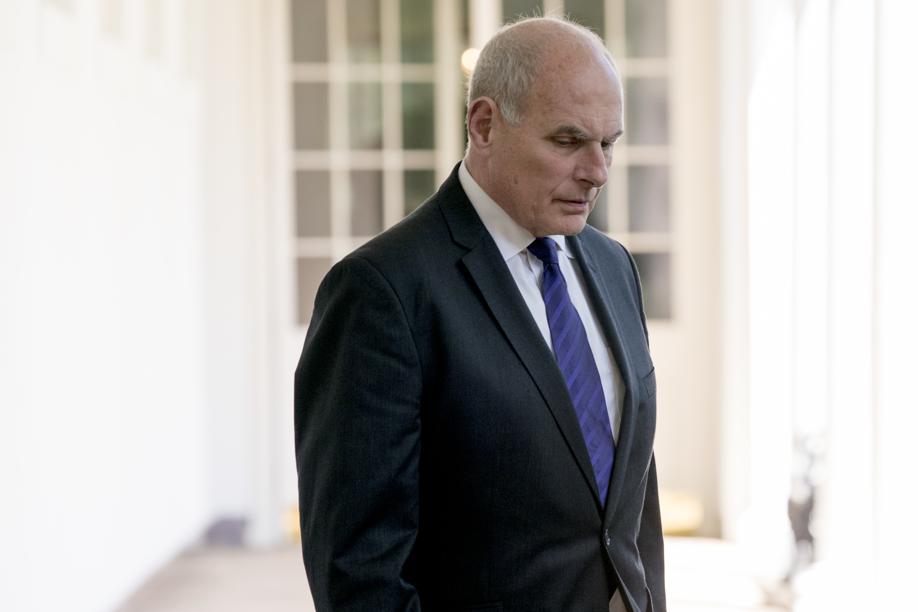
WASHINGTON — White House Chief of Staff John F. Kelly, who came to that job after helping to establish President Trump’s immigration policies at the Department of Homeland Security, gave an interview to NPR last week in which he said it is important to block people trying to cross the border illegally.
‘‘Let me step back and tell you that the vast majority of the people that move illegally into United States are not bad people,’’ he said. ‘‘They’re not criminals. They’re not MS-13. Some of them are not.’’
‘‘But they’re also not people that would easily assimilate into the United States, into our modern society,’’ the Boston native said. ‘‘They’re overwhelmingly rural people in the countries they come from — fourth-, fifth-, sixth-grade educations are kind of the norm.
“They don’t speak English,’’ he continued. “They don’t integrate well. They don’t have skills. They’re not bad people. They’re coming here for a reason, and I sympathize with the reason. But the laws are the laws.’’
Kelly argued that three main factors put immigrants at a disadvantage in the United States: lack of education, lack of familiarity with English, and coming from rural areas.
Ironically, those traits probably apply to several of Kelly’s own ancestors.
Genealogical researcher Monica Pattangall researched Kelly’s family tree earlier this year. She said seven of Kelly’s eight great-grandparents were immigrants. Four emigrated from Italy, three from Ireland.
His great-grandfather John Edward Kelly was born in Maine, the son of parents who emigrated from Canada. His great-grandmother Mary Connelly came to the United States after the Irish famine from near Clifden, Ireland, in County Galway.
His great-grandfather Joseph (Giuseppe) Pedalino came from near Avellino, Italy. Researcher Jennifer Mendelsohn, with whom Pattangall shared her research, found Pedalino’s naturalization papers, which indicate that he came from Quadrelle province in the Italian foothills.
John Edward Kelly worked as a blacksmith, making iron bands for barrels. Based in Maine, he worked in the shipping industry as had his father before him, Pattangall said.
Perhaps because of the decline in the shipping industry, John’s son John Leo Kelly moved to Massachusetts and went to work as a railroad brakeman. His father-in-law, Coleman Curran, also worked for the railroad.
The two sides of chief of staff John F. Kelly’s family met in Boston. Kelly’s father worked as a mail carrier in Brighton. On his mother’s side, Kelly’s great-grandfathers worked as a wagon driver and fruit peddler, according to Mendelsohn.
From a US Census record, Mendelsohn learned that John DeMarco, the fruit peddler, still didn’t fully speak English after more than a decade in the country. His wife Crescenza — Kelly’s great-grandmother — lived in the United States for more than 30 years without learning the language.
Kelly’s interview suggests he thinks such comparisons are not useful. Today’s illegal immigrants, he said, cannot assimilate ‘‘into our modern society.’’
At the time that Kelly’s Italian ancestors were living in Boston, there was a large population of both Italian and Irish immigrants. The houses near Kelly’s ancestors were populated with people who had mostly emigrated from Italy and Ireland.
In the 19th century, residents of these neighborhoods didn’t have to speak English to communicate — much as there are communities today where the primary language is Chinese or Spanish.
Education is more important now than it was then, but there is work to be done by people with less than a high school education. Many immigrants come from Mexico and work as farm laborers.
They may not end up as Marine Corps generals or White House chiefs of staff, but then neither did Giuseppe Pedalino. It took Pedalino’s family three more generations before it attained that level of prominence.

