


Football knows best.
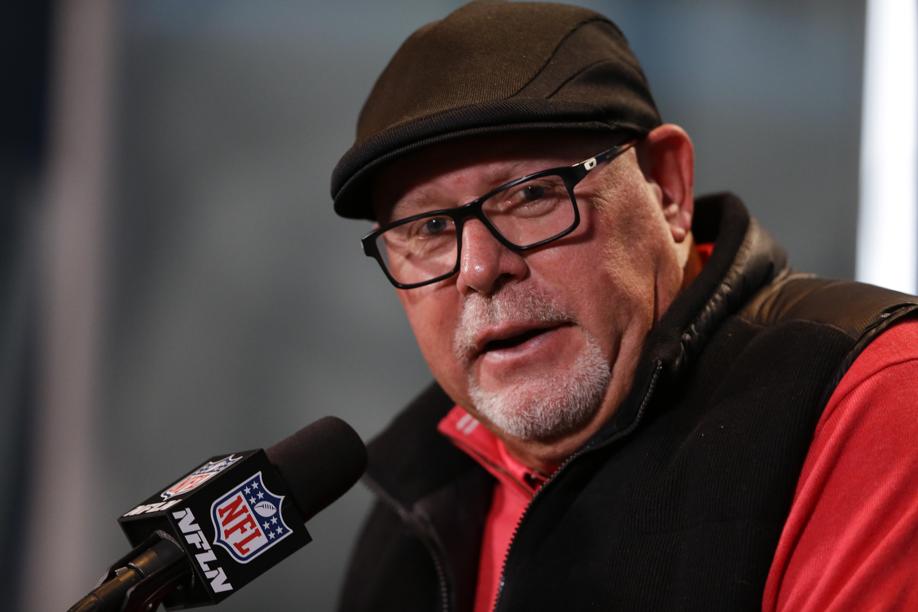
That’s what Arizona Cardinals coach Bruce Arians believes. Defending a sport that some feel is under siege due to concussion concerns, Arians told The MMQB website last week at the NFL owners meetings that football “teaches more values than any other game,’’ and that “people that say, ‘I won’t let my son play it’ are fools.’’
There is a brain under Arians’s trademark Kangol cap. He should have used it before he uttered such misguided, macho, atavistic drivel. Arians obviously wanted to extol the virtues of a great sport. Fine. Football is rightly king in this country, but we’re learning that playing it can come with some sobering inherent risks. It’s not for everyone.
The message should be increased education and safety, not brow-beating, strong-arming, and brainwashing people into allowing their children to play.
Football ideologues such as Arians and Cowboys owner Jerry Jones, who termed the idea of a link between football and degenerative brain disorders absurd, sound like people denying Darwinism.
They’re dismissive, defensive attitudes do more to hurt the game than help it. They contribute to what — after a New York Times story alleged the NFL’s initial concussion study was flawed and misleading — looks like a systematic effort by the NFL establishment to diminish the danger of playing football.
Studies have found that football has the highest incidence of concussions among high school athletes.
Earlier this month, the NFL’s senior vice president for health and safety policy, Jeff Miller, acknowledged there is a link between football and degenerative brain disorders like chronic traumatic encephalopathy (CTE), a monumental admission of the health and safety risk associated with the game.
The NFL is still trying to get final court approval for a $1 billion settlement in a concussion lawsuit brought on behalf of more than 5,000 former players.
“We have this fear of concussions that is real. But not all of those statistics can prove anything,’’ Arians told MMQB. “You can find all the statistics you want, if you want to crucify something. Our game is great. People that say, ‘I won’t let my son play it,’ are fools because there are DNA tests now that I can give you that will tell you your child’s chance of having a concussion or should they play a contact sport of any kind. It’s only 400 bucks, so go get one.’’
Arians seems like a modern, enlightened man. Last year, he hired the NFL’s first female coaching intern, Jen Welter. But the views of the 2014 NFL Coach of the Year are startlingly insensitive to the parents of high school football players who died playing the game. There were at least 11 such deaths in 2015.
Football shouldn’t become extinct or fade into sporting irrelevance. It should not be faced with an existential crisis.
However, parents who don’t want their children to play the game for safety reasons should not be disparaged or demonized. The same goes for parents who sanction their child’s participation.
It’s a choice, one that is hopefully being made with the most accurate information possible.
Removing the concerns regarding concussions and repeated subconcussive hits from the equation, someone who steers their athletically gifted child away from a pigskin path is hardly a fool.
Football players risk the most and get paid the least. The NFL is a league where players’ joints, muscles, ligaments, and long-term health are mortgaged every Sunday.
Players are treated like disposable razors. The athletic actuarial tables are not in a football player’s favor.
Their contracts aren’t fully guaranteed. Teams can renege on the terms if you become too expensive, too old, or too much of an independent thinker.
From a financial standpoint you should encourage your kid to be the NFL commissioner. Roger Goodell makes more per year than any pro football player, and he doesn’t subject his body to any collisions.
Among the “fools’’ that Arians referenced are some pretty notable names.
President Barack Obama said in 2014 that if he had a son he wouldn’t let him play football. LeBron James, who was an All-State player in Ohio in high school, said he doesn’t let his sons play football.
Perhaps more telling is the hesitation from former NFL players.
Former NFL linebacker Bart Scott said he won’t let his son play. Four-time Super Bowl-winning quarterback Terry Bradshaw and three-time Super Bowl champion Troy Aikman have both expressed the idea they would advise against children playing.
Retired linebacker Scott Fujita penned a New York Times Op-Ed in 2013, detailing his own ambivalence and uncertainty about whether he would let a hypothetical son play.
In that piece, Fujita debunks one of Arians’s claims — that football imbues character and life skills that can’t be learned elsewhere.
“When you have things that happen in your life that aren’t going to be good, if you play football, you know how to handle them. It doesn’t necessarily equate in track and other things,’’ Arians said.
Fujita wrote: “Certainly there are lessons to be learned from playing football, about toughness, battling through adversity, and teamwork. But I don’t think football is the only way to teach those. I have numerous friends who never played football but who have battled through failed bar exams, medical residencies, and struggling businesses, and who are just as successful as I am. In truth, they are probably a lot more well adjusted, well balanced, and better positioned to navigate life’s speed bumps than I’ll ever be.’’
Sorry, Captain Kangol. The idea that football alone can build resiliency, discipline, and mental toughness is well . . . foolish. While the game does inculcate those traits, it’s absurd to proclaim it as the only avenue to acquire vital life skills.
As long as football proselytizers such as Arians are espousing their tough-guy tripe and tropes, it’s difficult to trust that the game will become safer or more enlightened.
While rules, equipment, and tackling techniques are all evolving to make football safer, dangerous attitudes have to change as well.
Christopher L. Gasper is a Globe columnist. He can be reached at cgasper@globe.com. Follow him on Twitter @cgasper.

