


NEW YORK — By seizing the Republican presidential nomination for Donald Trump on Tuesday night, he and his millions of supporters completed what had seemed unimaginable: a hostile takeover of one of America’s two major political parties.
Just as stunning was how quickly the party tried to reject them. Its two living former presidents spurned Trump, and a number of sitting governors and senators expressed opposition or ambivalence toward him.
He also drew a forceful rebuke from the single most powerful and popular rival left on the Republican landscape: the House speaker, Paul Ryan of Wisconsin.
But Trump now feels so empowered that he does not think he needs the political support of the party establishment to defeat the likely Democratic nominee, Hillary Clinton.
Rarely if ever has a party seemed to come apart so visibly. Rarely, too, has the nation been so on edge about its politics.
Many Americans still cannot believe that the bombastic Trump, best known as a reality television star, will be on the ballot in November. Plenty are also anxious about what he would do in office.
But for leading Republicans, the dismay is deeper and darker. They fear their party is on the cusp of an epochal split — a historic cleaving between the familiar form of conservatism forged in the 1960s and popularized in the 1980s and a rekindled, atavistic nationalism, with roots as old as the republic, that has not flared up so intensely since the original America First movement before Pearl Harbor.
Some even point to France and other European countries, where far-right parties like the National Front have gained power because of the sort of resentments that are frequently given voice at rallies for Trump.
Yet if keeping the peace means embracing Trump and his most divisive ideas and utterances, a growing number are loath to do it.
The ties between Republican elites — elected officials, donors, and Washington insiders — and voters have actually been fraying for years.
Traditional power brokers long preached limited-government conservatism and wanted to pursue an immigration overhaul, entitlement cuts, free trade, and a hawkish foreign policy, and nominees like John McCain and Mitt Romney largely embraced that agenda. Republican leaders also vilified President Obama and Democrats, stoking anger with rank-and-file conservatives.
Many Republican voters trudged along with those earlier nominees, but never became truly animated until Trump offered them his brand of angry populism: a blend of protectionism at home and a smaller US footprint abroad.
And he was able to exploit their resentments and frustrations because those same Republican leaders had been nurturing those feelings for years with attacks on Obama, Democrats, illegal immigrants, and others.
Trump, with his steadfast promises to deport immigrants who are in the country illegally and to build a wall with Mexico, may have done irreversible damage to his general election prospects.
But he quickly earned the trust that so many of those voters had lost in other fixtures of America — not just in its leaders, but in institutions like Congress, the Federal Reserve, and the big-money campaign finance system that Trump has repudiated, as well as in corporations, the Roman Catholic Church, and the news media.
And he has amplified his independent, outsider message in real time, using social media and cable news interviews — and his own celebrity and highly attuned ear for what resonates — to rally voters to his side, using communication strategies similar to those deployed in the Arab Spring uprising or in the attempts by liberals and students to foment a similar revolution in Iran.
Trump is an unlikely spokesman for the grievances of financially struggling, alienated Americans: A high-living Manhattan billionaire who erects skyscrapers for the wealthy and can easily get politicians on the phone.
But as a shrewd business tactician, he understood the Republican Party’s customers better than its leaders did and sensed that his brand of populist, pugilistic, antiestablishment politics would meet their needs.
After seething at Washington for so long, many of these voters now see Trump as a kind of savior.
Even if he does not detail his policies, even if his language strikes them as harsh sometimes, his supporters thrill more to his plain-spoken slogans like “Make America Great Again’’ than to what they see as the cautious and poll-tested policy speeches of Ryan and other Washington Republicans.
Trump said in an interview Saturday that he is confident that his appeal will be broad and deep enough among voters of all stripes that he could win battleground states like Michigan, Ohio, and Pennsylvania without the support of leaders like Ryan.
Although he plans to meet with Ryan and House Republican leaders Thursday, Trump said he would not materially change his policies or style to win their endorsements.
“Everything is subject to negotiation, but I can’t and won’t be changing much, because the voters support me because of what I’m saying and how I’m saying it,’’ Trump said. “The establishment didn’t do anything to make me the nominee, so its support won’t really make much difference in me winning in November.’’
Trump will, though, be somewhat dependent on the party’s fund-raising muscle since he has indicated he will not fully self-finance his general election campaign.
One reason Trump takes a skeptical view of establishment support is that he does not believe much in the power of the Republican elite.
He is the party’s presumptive nominee, after all, because the political forces that once might have halted his rise have been enfeebled.
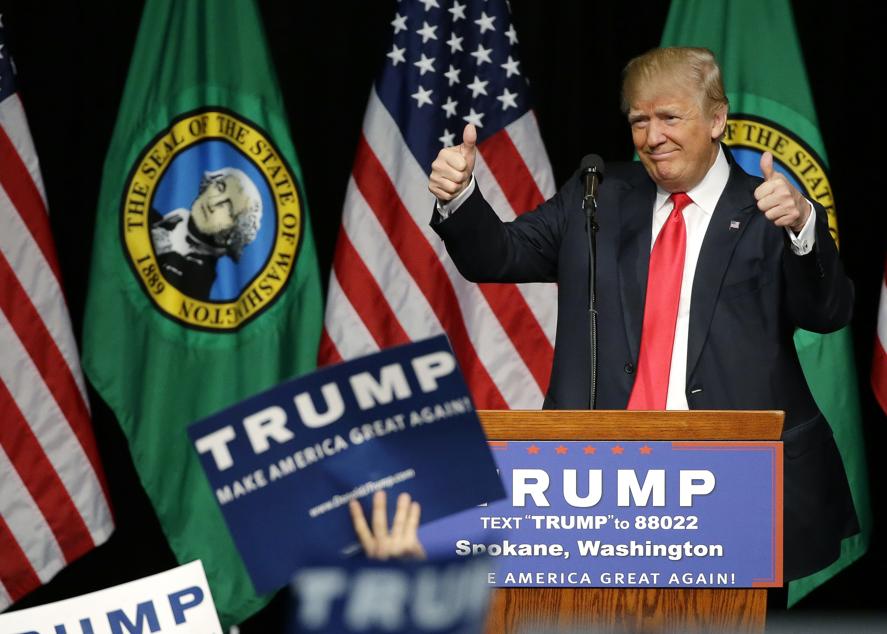
In Spokane, Wash., on Saturday, Trump again raised former President Bill Clinton’s marital infidelities, a preview of how he is likely to respond to attacks from Clinton and her allies about his treatment of women.
Trump repeatedly assailed the woman he has dubbed ‘‘Crooked Hillary.’’
‘‘She’s married to a man who was the worst abuser of women in the history of politics,’’ he added.

