


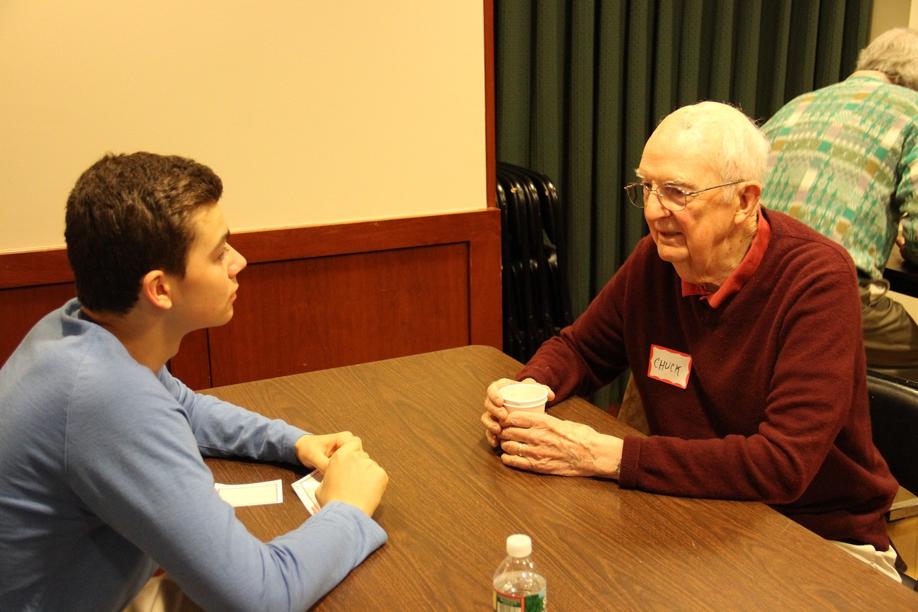
It had been years since Chuck Wade had thought about the small but pivotal role he played in World War II. Wade was a paperboy, delivering news from the battlefront at a time when people couldn’t turn to television, much less the Internet.
That is among the memories that have returned to him since he became involved with Sages & Seekers, a program that connects older adults and high school students.
Wade recalls that one customer, who was married to a German, asked the news dealer to withhold delivery any day that there were reports of bombing raids on his wife’s hometown. He didn’t want her to worry about her family.
That slice of history isn’t likely to be found in any textbook. But through Sages & Seekers, volunteers like Wade serve as living texts.
The private Rivers School in Weston first tried the program in 2010 and found it so rewarding that this year all 93 of its sophomores take part during their English classes.
“It’s an opportunity for the sage to reflect and become the storyteller, and for the seeker to learn about somebody’s life really intensely and intimately,’’ said Mac Caplan, a Rivers English teacher and coordinator of the school’s program.
Founded in 2008 by Elly Katz, then of Natick, Sages & Seekers has spread to schools across the country. Katz, who now lives in California, left her career as a graphic artist to devote herself to combating ageism.
She persuaded Wade to join the program shortly after his wife died three years ago.
“This is the focus of my life right now,’’ said Wade, who is taking his fourth turn as a sage this spring at Rivers. He also recruits seniors and raises money for the nonprofit.
Students meet with the seniors weekly over the course of two months. The first session serves as an ice-breaker. The sages bring in mementos, including letters and photographs, and meet with each student in brief sessions. This approach serves to match sages and seekers. Over the subsequent five weeks, seekers meet one-on-one with their sages.
“A number of sages really open up,’’ Caplan said, recalling how when he took on the role of seeker, a sage confided after several sessions that his life only began to become comprehensible to him after he was diagnosed at age 65 with Asperger’s syndrome.
The sages are recruited through area councils on aging and seniors’ groups. They come from a wide variety of backgrounds, from professors and doctors to homemakers and nurses. They range in age from late 60s to one participant this year who is 99.
The program culminates with a group session where students read aloud “tribute’’ papers to their sages.
The three- to four-page essays aren’t biographies, but rather are portraits that capture pivotal moments in the sage’s life.
“The students want to write about the challenges sages went through that resonate with their own lives,’’ Caplan said. “The sages want to talk about their relationships, their struggles, their successes beyond the professional.’’
The program also gives seniors a sense that they matter. “They live in a world that oftentimes neglects them or pushes them to the margins,’’ Caplan said. “This is an experience where they feel valued and their stories are valued.’’
While Wade said he has been able to forge close bonds with his seekers, the relationships haven’t lasted beyond the program. But that doesn’t bother him, he said. “It’s more important that they become better friends with their grandfather than with me.’’
For more information, visit sagesandseekers.org.
Steve Maas can be reached at stevenmaas@comcast.net.

