


BROCKTON — Connie Jonet-Branco used to drive her daughter two evenings a week to Norwood, three towns away, for Portuguese class so she could learn the family’s native tongue.
Starting in September, families won’t have to leave the city for their children to become fluent in the language that’s spoken in Cape Verde, Brazil, Mozambique, Angola, Guinea-Bissau, East Timor, Equatorial Guinea, São Tomé, Príncipe, and of course Portugal — as well as in many Brockton households.
Brockton’s public school district is launching a Portuguese immersion-style program in which classes will be conducted equally in Portuguese and English – an approach school officials say is aimed at celebrating the city’s cultural diversity and at improving academic performance.
The district is part of a small cadre of public school systems in the state with immersion programs — including Cambridge, Holliston, Maynard, Millis, and Milton; only Cambridge also offers a Portuguese immersion program.
“What I’m particularly proud about is we are seeing the linguistic diversity of our community as an asset, as a strength on which to build,’’ said Kellie Jones, who helped develop the Portuguese program as the district’s director of bilingual education. “We want to take this Gateway City label and embrace it.’’
The state identifies Brockton as a Gateway City because of its size — with a population of roughly 94,000 — and the relatively low average income and educational background of its residents.
Jones was referring to the more traditional definition of a city that is home to many immigrants, a designation that aptly fits Brockton, where the US Census Bureau says a quarter of the residents are foreign-born and more than a third speak a language other than English at home.
Brockton’s 17,100 public school students collectively speak more than 30 languages – with Cape Verdean, Haitian, Spanish, and Portuguese the most common, in that order, Jones said. Others include Albanian, Armenian, Chinese, Korean, Laotian, Polish, Punjabi, Russian, Yoruba, and Zulu, she said.
Jones said 3,365 of the students are not proficient in English.
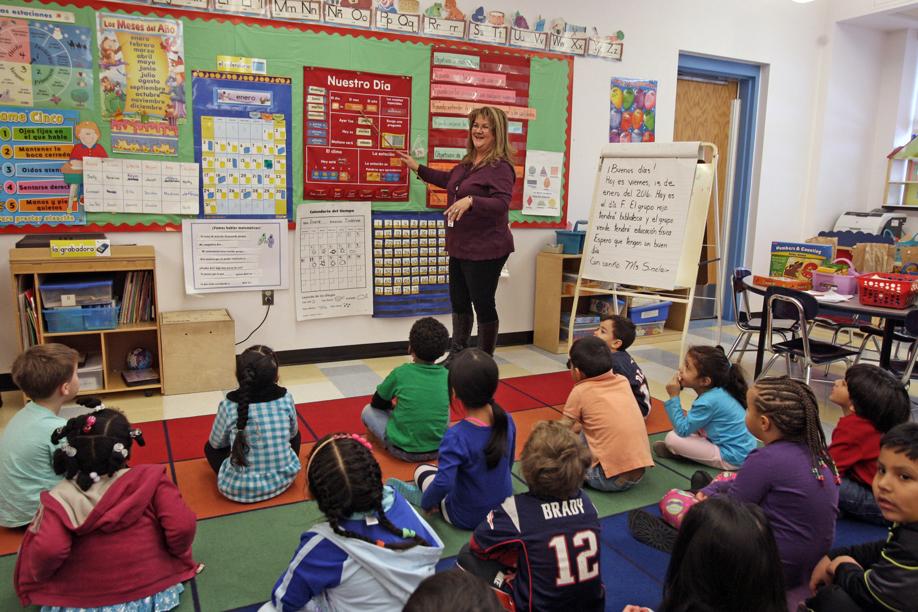
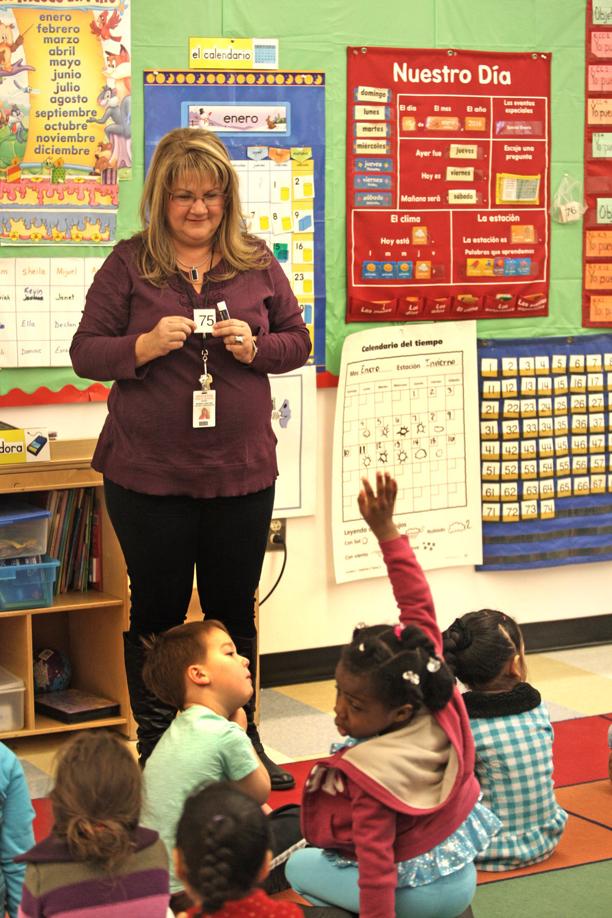
The city’s schools have numerous programs to help students learn English, and Brockton was the first district in the state, in 1972, to offer bilingual education. Among the programs currently offered is a popular Spanish two-way immersion, which has equal numbers of Spanish- and English-speaking students, about 400 in all, learning in both languages in 12 elementary school classes. The program averages about 100 students on a waiting list, Jones said.
The Portuguese immersion program will be different from traditional bilingual education, though, because students don’t need to be English learners to participate, Jones said. And while the goal of bilingual education is for students to learn English, the goal in immersion is for students to become fluent in both English and the foreign language, she said.
“It’s such a great model because the students learn another language in a very natural way,’’ said Catherine Ritz, president of the Massachusetts Foreign Language Association. “They’re learning the language through content, instead of direct instruction, so they’re exposed to it the way you’re exposed to your first language.’’
And starting young is key to developing any language skills in later life, Ritz said.
The new Brockton program will start with two kindergarten classes – 50 students in all, who will be chosen by lottery in the spring. Parents will sign a contract agreeing to keep their children in the program through fifth grade.
The Raymond School, which freed up classroom space when it switched this school year from a kindergarten through eighth grade to a kindergarten through fifth grade format, will host the program.
Plans call for expanding the Portuguese program after September, adding two French kindergarten immersion classes in 2017 and eventually creating an International School.
The idea grew out of a district initiative started in 2012 to find ways to improve student achievement, an effort undertaken by a combination of school union, administration, and School Committee representatives. Brockton trails the state in most student academic assessments.
Jones said the group quickly decided to focus on students whose native language wasn’t English. From there, the idea moved to fostering bilingualism for all students through an immersion program, she said.
“The research is clear that those who participate in dual language programs have greater executive functioning, better memory skills, and more cognitive flexibility,’’ Jones said. They also tend to do better on standardized tests in both languages, she said.
Studies even found health benefits, with people who are bilingual recovering more quickly from strokes and developing Alzheimer’s disease later in life, she said.
People who are bilingual also have “enhanced employment opportunities,’’ she said.
The group next surveyed the community, getting responses from 2,201 parents or guardians, 399 teachers or staff, and 188 others; Jones said an overwhelming 1,502 parents said they would enroll their children in a dual language program, and another 550 said they might.
The survey also asked parents to rank their interest in French, Portuguese, or Spanish programs. On a scale of one to five, Portuguese had the highest favorable rating with 4.37.
“It’s the obvious choice,’’ said Monica Taveres of the Cape Verdean Association of Brockton. “There’s a large growth in the city of Cape Verdeans, Brazilians, Angolans. So a Portuguese program makes sense.’’
Lucia Alvarado, who works as a translator and does outreach for the Brockton schools, said the program also is a source of pride for the Portuguese-speaking community. “They can say, we have this,’’ she said.
Jones also pointed out that Portuguese is the seventh-most used language in the world — some sources place it as high as fifth — and has been identified by the federal government as a “critical language’’ for the economic well-being and security of the country.
Brockton is modeling its program after one developed by the Utah Department of Education, which has made dual language education a priority, Jones said. More than 100 schools in Utah have immersion classes in Chinese, French, German, Portuguese, and Spanish.
Brockton educators also visited existing immersion schools in Massachusetts and Rhode Island, including the two decades-old French program in Milton.
Brockton received help developing its program from Bridgewater State University and the Massachusetts Educators of English Language Learners, and the state provided a $73,000 planning grant. Local businesses, including HarborOne Bank, have pledged support as well.
The district is inviting parents to learn about the new program at forums on Feb. 10 and March 2, and will hold a lottery for the spaces in May.
Alberto Alves, who moved here as a teenager from Cape Verde and works for the Cape Verdean Association in Brockton, said he may enter his 5-year-old son, A.J., in the lottery.
“I think it’s an awesome initiative and a great opportunity for families and kids,’’ he said.
Claudia Fernandes, a recent Brockton resident with roots in Brazil and Portugal, said she wishes her two children were young enough to take advantage of the program.
“Students who become proficient in other languages have a higher rate of success in the global environment in which we live and work,’’ she said through a translator. They “develop a greater understanding, tolerance, appreciation, and respect for other languages and cultures. It also gives them self-esteem, and an appreciation and respect for their language and culture.’’
Johanna Seltz can be reached at seltzjohanna@gmail.com.

