


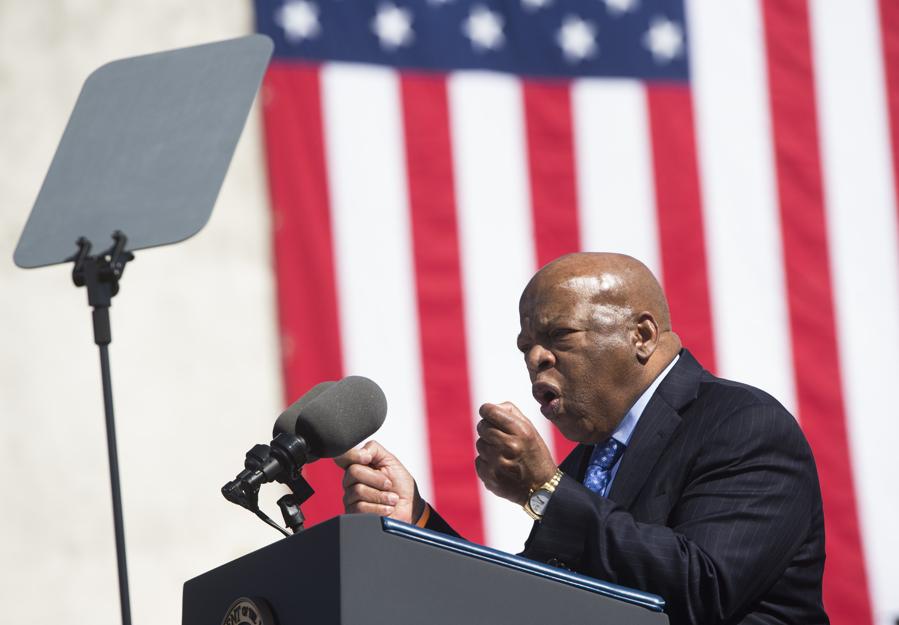
Representative John Lewis, a son of sharecroppers and an apostle of nonviolence who was bloodied at Selma and across the Jim Crow South in the historic struggle for racial equality and who then carried a mantle of moral authority into Congress, died on Friday. He was 80.
His death was confirmed by a senior Democratic official.
He announced on Dec. 29 that he had Stage 4 pancreatic cancer and vowed to fight it with the same passion with which he had battled racial injustice. “I have been in some kind of fight — for freedom, equality, basic human rights — for nearly my entire life,’’ he said.
On the front lines of the bloody campaign to end Jim Crow laws, with blows to his body and a fractured skull to prove it, Mr. Lewis was a valiant stalwart of the civil rights movement and the last surviving speaker at the historic March on Washington for Jobs and Freedom in 1963.
More than a half-century later, after the killing in May of George Floyd, a Black man in police custody in Minneapolis, Mr. Lewis welcomed the resulting global demonstrations against systemic racism and the police killings of Black people. He saw those demonstrations, the largest protest movement in American history, as a continuation of his life’s work, though his illness had left him to watch from the sideline.
“It was very moving, very moving to see hundreds of thousands of people from all over America and around the world take to the streets — to speak up, to speak out, to get into what I call ‘good trouble,’’’ Mr. Lewis told “CBS This Morning’’ in June.
“This feels and looks so different,’’ he said of the Black Lives Matter movement that drove the anti-racism demonstrations, which dwarfed the civil rights protests of the 1960s. “It is so much more massive and all inclusive.’’
And this time, he said, “there will be no turning back.’’
Mr. Lewis’s personal history paralleled that of the civil rights movement. He was among the original 13 Freedom Riders, the Black and white activists who challenged segregated interstate travel in the South in 1961. He was a founder and early leader of the Student Nonviolent Coordinating Committee, which coordinated lunch-counter sit-ins. He helped organize the March on Washington, where the main speaker on the steps of the Lincoln Memorial was the Rev. Dr. Martin Luther King Jr.
Mr. Lewis led demonstrations against racially segregated restrooms, hotels, restaurants, public parks and swimming pools, and he rose up against other indignities of second-class citizenship. At nearly every turn, he was beaten, spat upon or burned with cigarettes. He was tormented by shrieking white mobs and absorbed body blows from law enforcement.
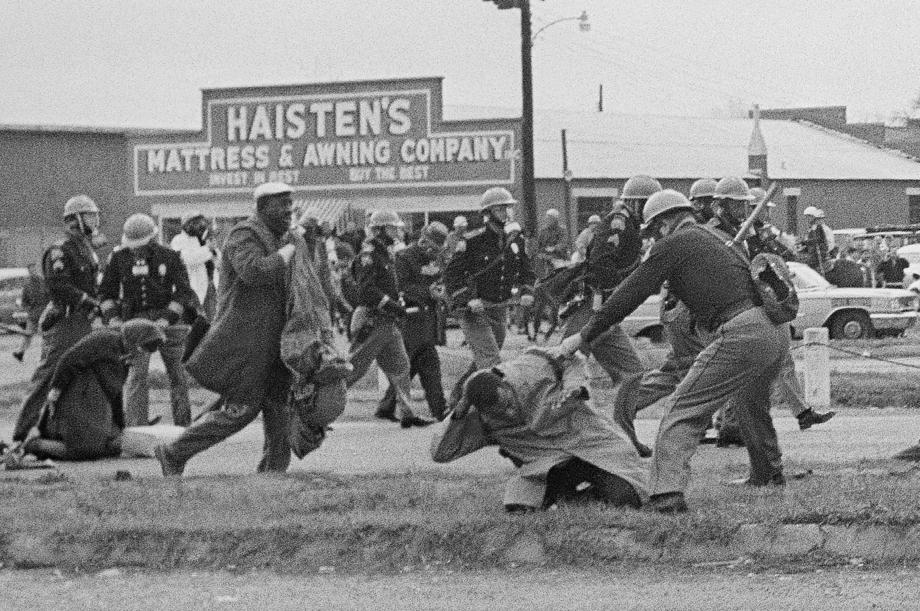
On March 7, 1965, he led one of the most famous marches in American history. In the vanguard of 600 people demanding the voting rights they had been denied, Mr. Lewis marched partway across the Edmund Pettus Bridge in Selma, Ala., into a waiting phalanx of state troopers in riot gear.
Ordered to disperse, the protesters silently stood their ground. The troopers responded with tear gas and bullwhips and rubber tubing wrapped in barbed wire. In the melee, known as Bloody Sunday, a trooper cracked Mr. Lewis’s skull with a billy club, knocking him to the ground, then hit him again when he tried to get up.
Televised images of the beatings of Mr. Lewis and scores of others outraged the nation and galvanized support for the Voting Rights Act, which President Lyndon B. Johnson presented to a joint session of Congress eight days later and signed into law on Aug. 6. A milestone in the struggle for civil rights, the law struck down the literacy tests that Black people had been compelled to take before they could register to vote and replaced segregationist voting registrars with federal registrars to ensure that they were no longer denied the ballot.
Once registered, millions of African-Americans began transforming politics across the South. They gave Jimmy Carter, a son of Georgia, his margin of victory in the 1976 presidential election. (A popular poster proclaimed, “Hands that once picked cotton now can pick a President.’’) And their voting power opened the door for Black people, including Mr. Lewis, to run for public office. Elected in 1986, he became the second African-American in Congress from Georgia since Reconstruction.
While Mr. Lewis represented Atlanta, his natural constituency was disadvantaged people everywhere. Known less for sponsoring major legislation than for his relentless pursuit of justice, he was called by his colleagues “the conscience of the Congress.’’
When the House voted in December 2019 to impeach President Trump, Mr. Lewis’s words rose above the rest.
“When you see something that is not right, not just, not fair, you have a moral obligation to say something,’’ he said on the House floor. “To do something. Our children and their children will ask us, ‘What did you do? What did you say?’ For some, this vote may be hard. But we have a mission and a mandate to be on the right side of history.’’
His words resonated as well after he saw the video of a Minneapolis police officer kneeling on Floyd’s neck for more than eight minutes as he gasped for air.
“It was so painful, it made me cry,’’ Mr. Lewis told “CBS This Morning.’’ “People now understand what the struggle was all about,’’ he said. “It’s another step down a very, very long road toward freedom, justice for all humankind.’’
As a younger man his words could be more militant. History remembers the March on Washington for Dr. King’s “I Have a Dream’’ speech, but Mr. Lewis startled and energized the crowd with his own fiery passion.
“By the force of our demands, our determination, and our numbers,’’ he told the cheering throng that August day, “we shall splinter the desegregated South into a thousand pieces and put them back together in the image of God and democracy. We must say: ‘Wake up, America. Wake up!’ For we cannot stop, and we will not be patient.’’
His original text was more blunt. “We will march through the South, through the heart of Dixie, the way Sherman did,’’ he had written. President John F. Kennedy’s civil rights bill was “too little, too late,’’ he had written, demanding, “Which side is the federal government on?’’
But Dr. King and other elders — Mr. Lewis was just 23 — worried that those first-draft passages would offend the Kennedy administration, which they felt they could not alienate in their drive for federal action on civil rights. They told him to tone down the speech.
Still, the crowd, estimated at more than 200,000, roared with approval at his every utterance.
An earnest man who lacked the silver tongue of other civil rights orators, Mr. Lewis could be pugnacious, tenacious and single-minded, and he led with a force that commanded attention.
He gained a reputation for having an almost mystical faith in his own survivability. One civil rights activist who knew him well told The New York Times in 1976: “Some leaders, even the toughest, would occasionally finesse a situation where they knew they were going to get beaten or jailed. John never did that. He always went full force into the fray.’’
Mr. Lewis was arrested 40 times from 1960 to 1966.He was beaten senseless repeatedly by Southern policemen and freelance hoodlums. During the Freedom Rides in 1961, he was left unconscious in a pool of his own blood outside the Greyhound Bus Terminal in Montgomery, Ala., after he and others were attacked by hundreds of white people.
He spent countless days and nights in county jails and 31 days in Mississippi’s notoriously brutal Parchman Penitentiary.
Once he was in Congress, Mr. Lewis voted with the most liberal Democrats, though he also showed an independent streak. In his quest to build what Dr. King called “the beloved community’’ — a world without poverty, racism or war (Mr. Lewis adopted the phrase) — he routinely voted against military spending. He opposed the Persian Gulf war of 1991 and the North American Free Trade Agreement, which was signed in 1992. He refused to take part in the 1995 “Million Man March’’ in Washington, saying that statements made by the organizer, Louis Farrakhan, leader of the Nation of Islam, were “divisive and bigoted.’’
In 2017 he boycotted Donald Trump’s inauguration, questioning the legitimacy of his presidency because of evidence that Russia had meddled in the 2016 election on Mr. Trump’s behalf.
Mr. Lewis was presented the Presidential Medal of Freedom, the nation’s highest civilian honor, by President Obama in 2011
In bestowing the honor in a White House ceremony, Mr. Obama said: “Generations from now, when parents teach their children what is meant by courage, the story of John Lewis will come to mind — an American who knew that change could not wait for some other person or some other time; whose life is a lesson in the fierce urgency of now.’’
Mr. Lewis was a popular speaker at college commencements and always offered the same advice — that the graduates get into “good trouble,’’ as he had done against his parents’ wishes.
He put it this way on Twitter in 2018:
“Do not get lost in a sea of despair. Be hopeful, be optimistic. Our struggle is not the struggle of a day, a week, a month, or a year, it is the struggle of a lifetime. Never, ever be afraid to make some noise and get in good trouble, necessary trouble.’’

