


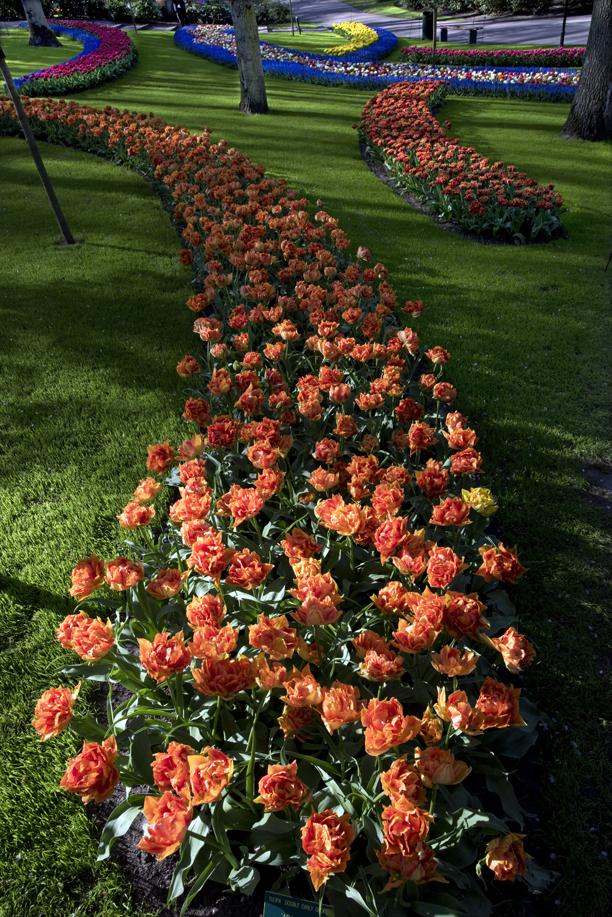
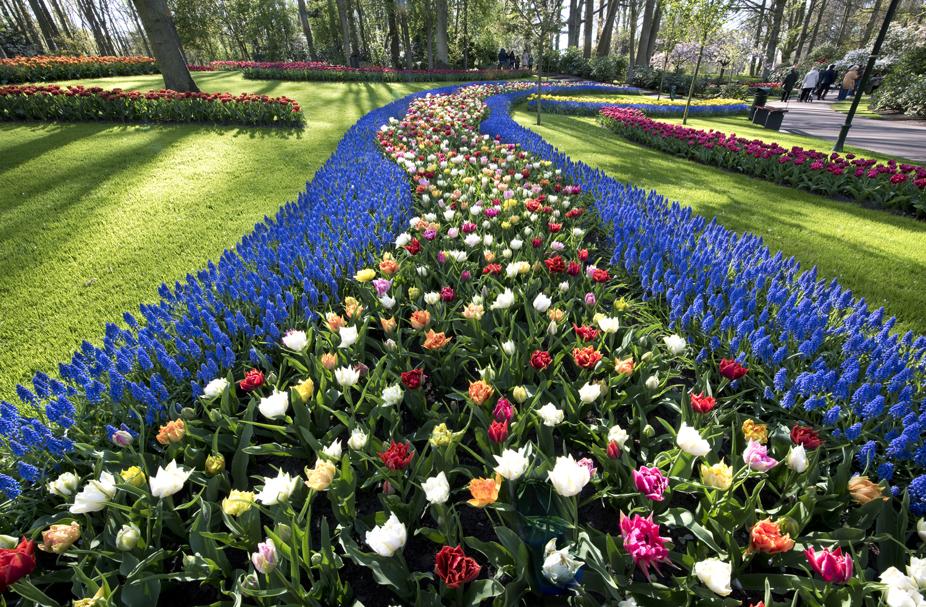
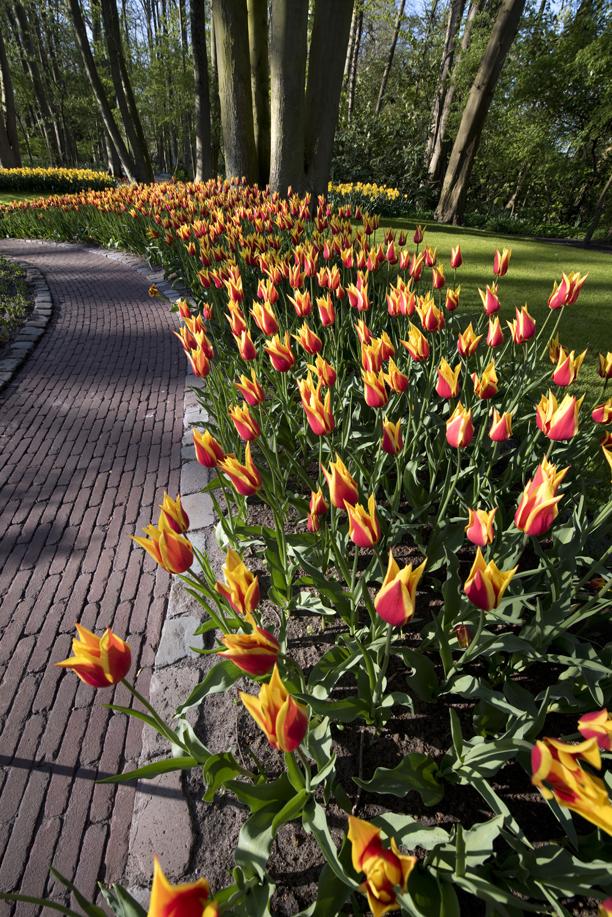
LISSE, The Netherlands — The flower formations swirl in vast galaxies at the Keukenhof gardens, as if to accentuate not just the beauty of the tulip, but its travel through centuries of the human imagination. To walk here is to stroll back to ancient Asia, the flowing literature of the Ottoman Empire, riotous remnants of the Holy Roman Empire, and Holland’s version of the American Gold Rush.
In formation after formation, thousands of flowers seemingly curl out of infinity from deep shade of trees and explode and expand into the sunlight, threatening to engulf you until they all end at your toes. That makes it even more impressive to remember that the bulb likely originated as a stubbier plant to withstand the rugged slopes and harsh weather of the barely-accessible Tien Shan mountains of central Asia. Much of that area today has been nominated as a UNESCO World Heritage site, partially because of their endemic tulips “of fairytale beauty.’’
Admired by Turkish nomads as a harbinger of spring, the fairytale flower had its earliest known cultivation in Persia around 1050, according to Mike Dash’s engaging book, “Tulipomania.’’ In poetry and mythology going back to the likes of Omar Khayyam, beautiful women had “tulip-tinted’’ cheeks and red tulips metaphorically sprang from the blood of kings and star-crossed lovers. The cupped crowns of tulips also held the wine of life in the wilderness. One poem praised the “charming’’ tulip as “tender as a pheasant’’ and as “soothing to the sorrowful heart as moonlight in a cloudless night.’’
Keukenhof soothes any sorrow and inspires unbridled joy. The name harkens back to the “kitchen gardens’’ that fed 15th-century royalty. In 1950, a group of tulip bulb exporters threw the kitchen sink at the kitchen gardens. They created what they hoped would be an annual exhibition of the variety of bulbs in Holland.
Today, teams of whimsical gardeners shape the gardens into fantastical woods. In doing so, they struck gold as sure as the bulb traders of the early 1600s who made the tulip one of Holland’s biggest exports during the century that the nation dominated Western trade.
“Every day I go to work, it’s like a party,’’ receptionist Debbie van Zonneveld told me. “Everyone is so happy, from little children to the older people.’’
The stars of the party are 7?million bulbs that spring to life from late March through mid May, each a Monet dot on an 80-acre canvas. Last year, the park received a record 1.2?million visitors. But with its size, Keukenhof does not feel overrun as you meander from tulip curves to steep rock formations aflame with orange tulips. Rows of colors come in rectangles, triangles, and ovals. One rainbow of red, yellow, orange, purple, and white tulips, and hyacinths snaked in subtle curves the length of a football field.
In the center of Keukenhof, the land rises in mounds from a canal and small pond, so surrounding you in tulips, hyacinths, and daffodils that you keep spinning to take it all in.
It’s all so beautiful, the biggest problem with visitors is trying to keep them out of the flower beds. “Years ago, people were content with taking pictures of just the flowers, and photographing them from the borders,’’ said Annemarie Gerards-Adriaansens, public relations director. “But today, everyone wants their picture taken with flowers right in front and right behind. With everyone having cellphones, people take pictures of themselves in the flowers to send immediately to their family and friends to show where they are.’’
She said Keukenhof has accommodated the digital era and the desire to be intimate with the tulips by cutting paths through some tulip beds.
The ways to imbibe the tulips are endless. When you are tired of walking, you can take a whisper boat around the surrounding bulb fields. If you have energy to burn, there is a bicycle rental where you can cycle into the fields. I did both. As much as I’ve seen tulip fields in magazines and calendars, the scale of the quarter-mile-long stretches of orange, red, purple and yellow flowers, on one of the flattest and lowest nations on earth, is as breathtaking as any mountain.
And yet, to fully appreciate the tulip, one has to sigh, pack the camera, and leave Keukenhof to head 12 miles south to the city of Leiden. The university bearing the city’s name hosts one of the oldest and most important formal botanical gardens in the world. In 1593, Carolus Clusius, one of the fathers of modern botany, arrived to turn the garden into a center for flower study. He did so with renown, with the aid of tulip bulbs and seeds he collected in other parts of Europe, especially in Vienna when he worked briefly for Holy Roman Emperor Maximilian II.
The first known tulip to flower in Europe, according to “Tulipomania,’’ was in 1559 in Bavaria. Then in 1562 a ship arrived in Antwerp with tulip bulbs among a shipment of fabrics. The merchant who received the shipment thought the bulbs were onions, and according to Dash, “roasted and ate them for his supper, seasoned with oil and vinegar.’’
Fortunately there were leftovers, which the merchant planted. Three decades later, Clusius took the tulip to a level that rocked Europe. Hybrids sprung up from different varieties planted close together. Viruses caused other colorations considered beautiful. The proliferation of varieties became so well known that poachers stole many of his bulbs.
They became a major symbol of luxury, particularly to French royalty. Speculation on bulbs reached Wall Street heights and one mere bulb could command many pigs, oxen, and sheep and tons upon tons of wheat, rye, butter, cheese, wine, and beer, according to Dash.
The price of tulips may have since returned to earth levels where you can buy them at Home Depot, but their beauty and history are still priceless at Leiden University. Actually, the star of the show on our visit here was the daffodil, which obliterated some of the grounds in sheets of bobbing yellow and white. Not far behind was a huge and mesmerizing collection of plant specimens from around the world, both outdoors and in glasshouses. Many are being conserved as they are endangered in their native habitats. Others are being studied for DNA and compositions that could lead to new uses for humans.
It was in Leiden that Carolus Clusius, as recounted in “Tulipomania,’’ realized what a beautiful monster he created in the tulip. He wrote to a friend, “So many ask for them, that if I were to satisfy every demand, I would be completely robbed of my treasures, and others would be rich.’’
In the end, Clusius was not robbed of his place in the history of tulips, and his treasure is now shared with everyone. That is the best ending possible for this fairytale of a flower.
Derrick Z. Jackson can be reached at jackson@globe.com.

