


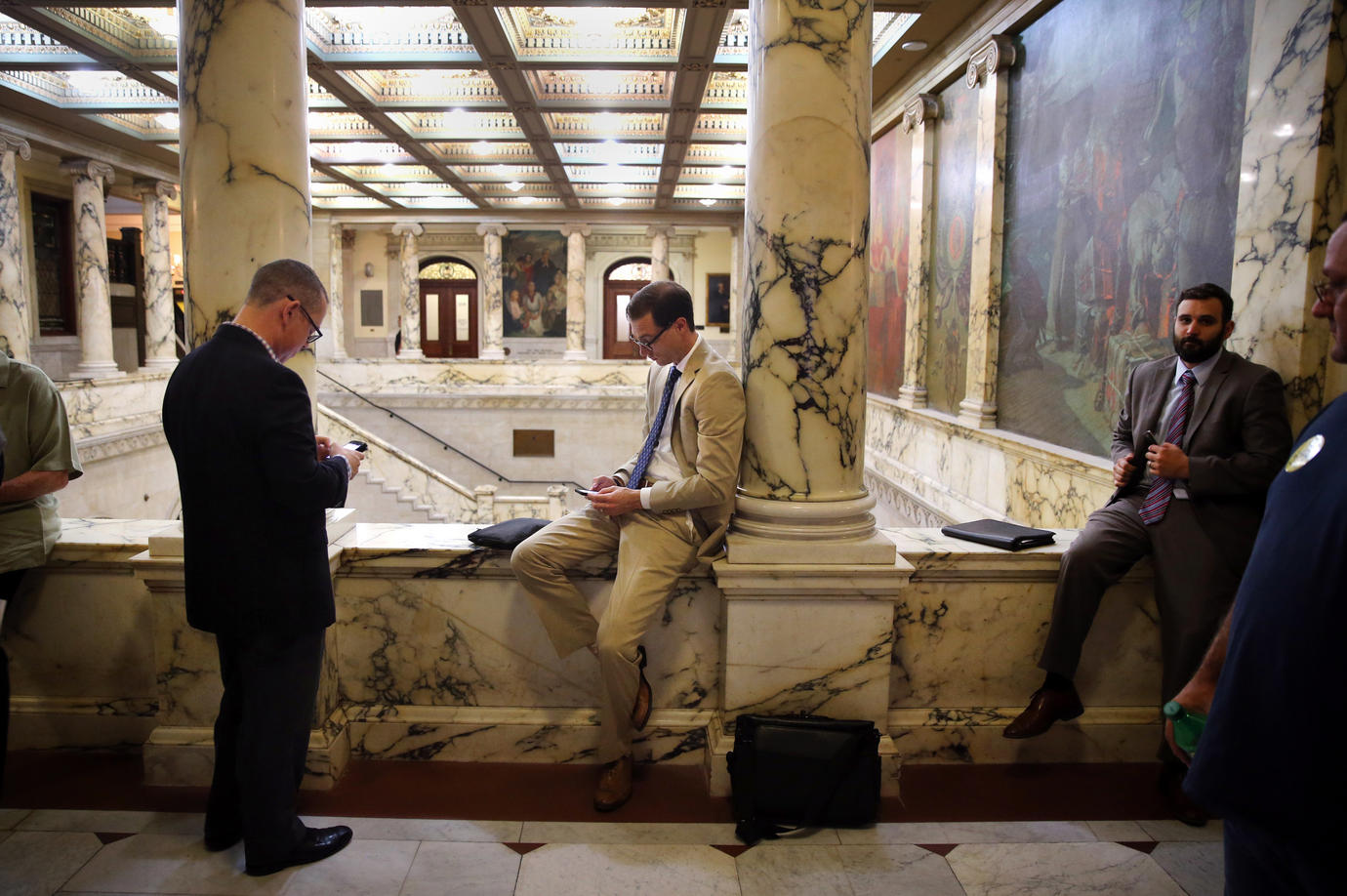
Massachusetts lawmakers on Saturday evening were frantically trying to hammer out a compromise on how to regulate ride-hailing firms such as Uber and Lyft, with the clock running out on the Legislature’s two-year session.
The legislation was among several high-profile issues still at play in the Legislature’s final hours. Also in the works, with no resolution Saturday evening: bills dealing with energy, economic development, and noncompete agreements between employers and employees.
Midday Saturday, House Speaker Robert DeLeo told reporters he couldn’t guarantee deals on all the major legislation still pending. “Can I promise a yes or no? I can’t do that,’’ he said.
House and Senate negotiators did come to an agreement Saturday evening on a measure dealing with municipal government — but it did not include a key priority of Boston Mayor Martin J. Walsh: granting the city direct authority over local liquor licenses.
The Uber and Lyft measure was among the most scrutinized — and highly lobbied — legislation of the session, testing Beacon Hill’s ability to grapple with a new industry and technology that have quickly upended the transportation economy in and around Boston.
Both the House and Senate passed their own versions of a bill that would regulate the industry earlier this year, and a joint conference committee was now trying to reconcile the differences. Lawmakers were in active negotiations on Saturday, after no agreement was reached on Friday.
The debate over how to regulate companies such as Uber and Lyft has been fierce, as taxi industry advocates insist that ride-hailing firms are not operating on a level playing field because they aren’t subject to the same stringent regulations as taxis. Ride-hailing firms, meanwhile, have pushed for legislation that largely allows them to run their businesses as they do now.
In the bills passed by both the Senate and the House, ride-hailing firms would need to subject drivers to state background checks, in addition to the private background checks that the companies already conduct. Both bills also stop short of requiring background checks that include fingerprinting, a measure pushed by the taxi industry but vehemently opposed by companies such as Uber and Lyft.
But there are several differences: Ride-hailing firms have blasted the House version for banning their vehicles from picking up rides from Logan International Airport and Boston Convention & Exhibition Center properties for five years, saying that such a move limits consumer choice. (Most ride-for-hire vehicles are already banned from Logan, except those with livery plates.) Taxi industry advocates have pushed for such limitations, amid hard times for their industry as Uber and Lyft become more popular.
The Senate version also introduces a 10-cent per ride assessment paid by Uber and Lyft to the municipalities where the rides originated. The House bill doesn’t have such a feature.
If state legislators reach no agreement on the Uber legislation, it will leave the city of Boston in a precarious position: Taxi medallion owners sued the city, arguing that taxis and companies such as Uber and Lyft must operate under the same rules because they essentially provide the same service.
Under a ruling that was largely favorable to the taxi industry, a judge ordered the city to revise its regulations on ride-hailing firms by Sept. 30.
If the Legislature passes a law regulating the industry, Walsh could fall back on those rules to help guide the city’s response to the judge. But if no such law exists after this session, Walsh and the city will have to tackle the controversial regulations on their own.
The energy bill, meanwhile, remained among the most contentious, with no conference compromise emerging as of 7:30 p.m. Saturday.
Both the House and the Senate agree on compelling the big utilities to buy large amounts of electricity from Canadian hydropower providers and from offshore wind farms proposed for waters south of Massachusetts. But the Senate set the stage for challenging negotiations by including a number of other measures in its version — ranging from a surcharge on heating oil for efficiency measures to a ban on electricity tariffs that would pay for natural gas pipelines.
Also still in play Saturday evening was legislation regulating noncompete agreements, which give companies the right to sue a former employee who starts a new company or joins a competing business. The contracts have become a source of bitter argument between powerful factions in the state’s business community.
House and Senate negotiators on Saturday disagreed over a so-called garden leave provision, which would require companies to pay former workers to stay out of the job market.
The House’s approach would limit the noncompete period to one year and require employers to pay half the worker’s salary. The Senate version would limit those leaves to three months and require a full salary.
The House version also would allow companies and workers to substitute any garden leave pay for some other mutually agreed-upon arrangement. But venture investors and startups argued that language was so vague that it could allow companies to provide essentially no compensation.
Governor Charlie Baker has said he supports limiting noncompete agreements, but favors the House’s approach.
Jon Chesto and Curt Woodward of the Globe staff and the State House News Service contributed to this report. Nicole Dungca can be reached at nicole.dungca@globe.com. Follow her on Twitter @ndungca.

