


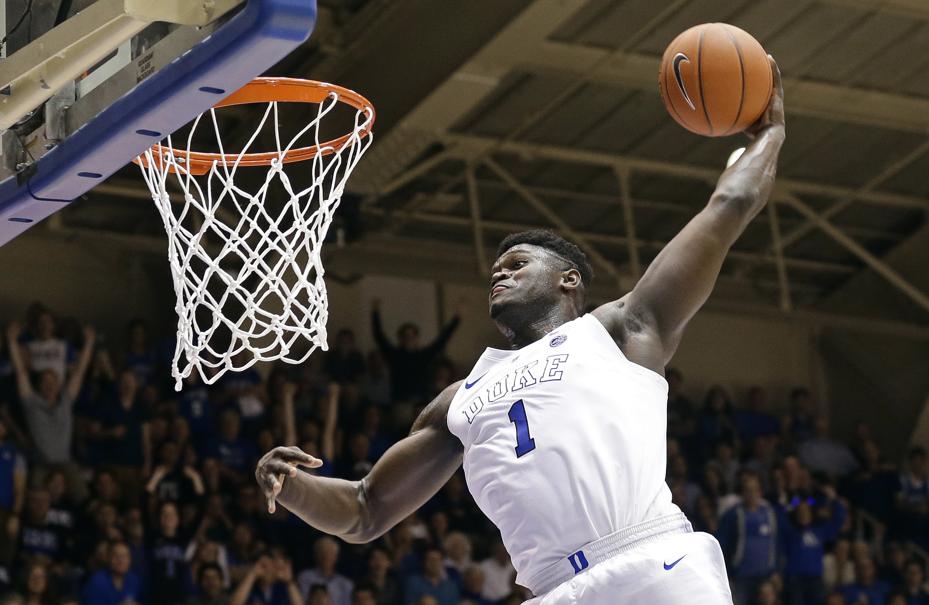
He is 6 feet 7 inches. He weighs 285 pounds. And he has a 45-inch vertical leap.
What?????
Those are the physical facts concerning Duke freshman Zion Williamson. The physical facts cannot convey the sight, the feel, the sheer Zionosity of his game, which in addition to a variety of rim-rattling dunks, includes artful drives replete with body control and a shooting range that extends to the 3-point line. Oh, and he can also pass. Is it going too far to invoke that dangerous word “unique’’?
Perhaps not. ESPN competitor Jay Bilas, not given to excess hyperbole in his analysis of players, said before the season that he had never seen anything like Zion Williamson. Not having seen any of the dunking videos that had already taken on legendary status, I snapped to attention. I’m here to say that Zion Williamson really is a never-seen-before basketball package.
We’ll see how it all turns out, but it’s safe to say he is basketball’s latest Next Big Thing.
Basketball has a history of Next Big Things, some of which turned out to be less than expected. These are players who were the recipient of extraordinary hype. Keep in mind that some of the all-time residents of basketball’s Mt. Olympus turned out to be far better than expected. Bill Russell and Michael Jordan come to mind, and are thus not on this list. Here is a brief rundown of basketball’s Next Big Things:
Hank Luisetti
No one ever changed basketball more than Luisetti, who popularized the one-handed shot while a three-time All-American and two-time collegiate scoring leader at Stanford. But he was just hype as far as the snobby Eastern basketball establishment was concerned. It wasn’t until he and his Stanford teammates came to Madison Square Garden on Dec. 30, 1936, and upended mighty LIU that the hype was fully validated. Luisetti predated the NBA but was esteemed enough to finish as runner-up to George Mikan as the greatest player of the mid-century when the poll was taken in 1950.
Bob Kurland-George Mikan
The 7-foot Kurland and the 6-10 Mikan were contemporaries and the first truly great “big’’ men. Kurland led Oklahoma A&M (now Oklahoma State) to back-to-back NCAA titles in 1945 and 1946. He spurned professional basketball, playing instead for the Phillips 66ers of the National Industrial Basketball League (NIBL) and also playing on gold medal-winning teams in the 1948 and 1952 Olympics (where he carried the flag at the Opening Ceremonies). He worked for Phillips Petroleum for 40 years and is the greatest of all non-pros. Mikan came out of DePaul to become the NBL and NBA’s first megastar, leading the Minneapolis Lakers to five NBA titles between 1949 and 1954, while being named the greatest basketball player of the half-century. Hype fulfilled in both cases.
Wilt Chamberlain
Even in a non-Internet, non-cable world, you heard of Wilt Chamberlain, the 7-1 phenom at Philadelphia’s Overbrook High School. After three years at Kansas, he entered the NBA in 1959 with the greatest advance publicity yet known. I trust I don’t have to annotate his accomplishments. He was not overhyped.
Oscar Robertson
If you hadn’t heard of this 6-5 guard after leading Crispus Attucks High School in Indianapolis to back-to-back state titles, you certainly knew he was coming into the NBA after his three years at Cincinnati, which featured a 33.8-point scoring average, two Final Four appearances, and a 1960 Olympic gold medal. Oscar remains in the discussion as the GOAT as far as some old-timers are concerned.
Jerry Lucas
There were no postseason high school all-star games. There were no shoe company camps. Also no Internet and no cable (see Chamberlain). But if you followed basketball you knew there was a 6-8 kid in Middletown, Ohio, whose team had gone 76-1 with two state titles when he entered Ohio State. He led the Buckeyes to the NCAA title in 1960, and to the final in 1961 and ’62. He spearheaded that 1960 Olympic gold medal team and then had a fine NBA career, further distinguishing himself as a memory expert who, among other things, memorized the Manhattan phone directory. Hard to overhype that.
Bill Bradley
The banker’s son from Crystal City, Mo., spurned all the biggies to attend Princeton, where he was a three-time All-American who took Princeton — Princeton! — to the 1965 Final Four. A solid NBA player who played on two championship Knicks teams, his fame rests with his college play, and let’s not forget those three terms as a US Senator from New Jersey.
Lew Alcindor (later Kareem Abdul-Jabbar)
Perhaps the most ballyhooed high school player ever. When his Power Memorial team lost to DeMatha on Jan., 30, 1965, it was national news. As is often said, this man needs no further introduction.
Tom McMillen
Cursed or blessed by being on the cover of Sports Illustrated as a high school player in Mansfield, Pa., the 6-11 McMillen became a national name. He was a good enough player at Maryland to get into the College Basketball Hall of Fame, but his 11-year NBA career was, well, spotty. It turns out there was a better high school big man at the other end of the country, a kid from La Mesa, Calif., named Bill Walton. But McMillen did become a Democratic congressman from Maryland.
Magic Johnson-Larry Bird
So dynamic was Earvin Johnson at Everett High School, Fred Stabley Jr. of the Lansing State Journal nicknamed him “Magic.’’ I think you know how it’s all worked out. The Bird hype was strictly collegiately oriented. There had been controversy about him making all-state in Indiana. Of course I paired them. How could I not?
Damon Bailey
As reported in John Feinstein’s “A Season on the Brink,’’ Bob Knight started recruiting this kid in the eighth grade. He was a great Indiana high school player in a giant spotlight and he was a fine collegian at Indiana, but he never played a second in the NBA.
Lloyd Daniels
So dazzling was this 6-7 kid that famed talent evaluator Howard Garfinkel declared, “Lloyd Daniels is the greatest junior ever — alive or unborn.’’ He was also an absolute child of the streets who never graduated from any of the many high schools he attended. He had drug and alcohol problems. Perhaps the saddest and greatest squandered talent of them all, he was the subject of both a book and a movie. Oh, what might have been.
LeBron James
He was on the cover of Sports Illustrated as a student at Akron’s St. Vincent-St. Mary High School. He was, pure and simple, the most hyped adolescent basketball player of the 21st century. It seems to be working out pretty well.
And now there is Zion Williamson. OK, young man. The stage is yours.
Bob Ryan’s column appears regularly in the Globe. He can be reached at ryan@globe.com.

