


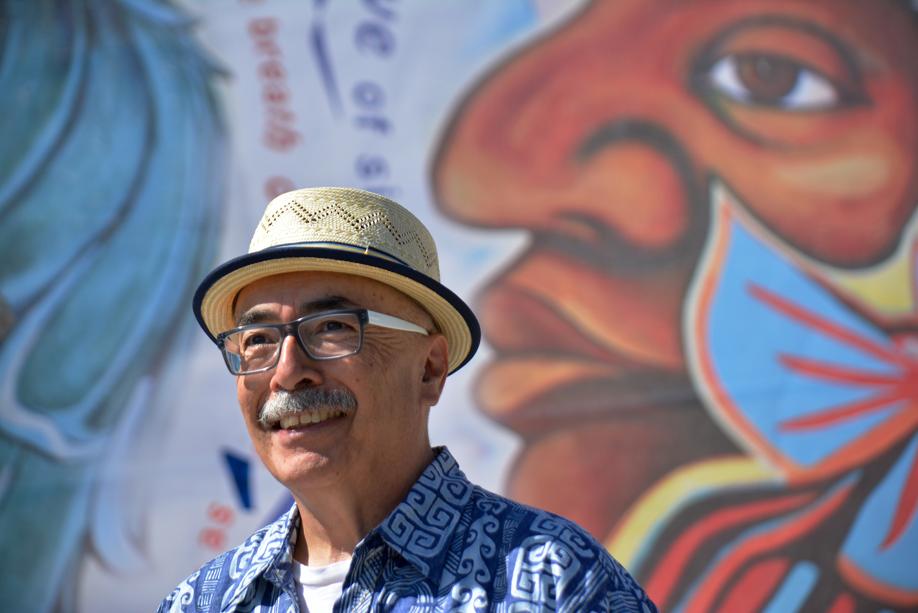
When Juan Felipe Herrera was named the 21st US poet laureate in 2015, he became the first Latino to be named to the post. The son of Mexican migrant farm workers, Herrera often combines Spanish and English in his poems, as he did in his most recent collection, “Notes on the Assemblage.’’ He has also written YA novels as well as short stories and children’s books. Herrera, whose term ends in April, spoke earlier this month at the Museum of Fine Arts, Boston.
BOOKS: What are you reading currently?
HERRERA: I’m an airport reader now. The most recent book that I picked up is Megyn Kelly’s new bestseller, “Settle for More.’’ I was very amazed at her writing style and how she creates her story.
BOOKS: When you buy a book in an airport, do you tend to buy books you normally would not?
HERRERA: Exactly. Sometimes I buy a book because of the person’s story, like Megyn Kelly’s, or because I know the book’s a real page turner. I don’t know the pulleys of dramatic arcs that novelists use so I’m interested in those kinds of books, like James Patterson’s. His books move like firecrackers. Same thing with Bill O’Reilly. You read the first line of one of his books, and you know you are going to eat that book.
BOOKS: Which poets have you been reading?
HERRERA: I went back to our friend the Nobel Prize-winner Czeslaw Milosz. I read “The Captive Mind’’ about the experience in Poland of Hitlerism and Stalinism. He talks about the writer who faces that kind of oppression.
BOOKS: Did becoming the poet laureate change you as a reader?
HERRERA: Yes, because I felt I had to expand my reading. I started reading new books, such as “Alamo Theory’’ by Josh Bell. His poetry reminded me of the poet Bob Hass, who I’ve been reading too.
BOOKS: Have you come across poets that you wish you were better known?
HERRERA: I think all of them need to be better known. A poet who I feel has not been recognized is Rigoberto González, one of the few Latinos who has dedicated himself to writing, among other things, young-adult gay novels.
BOOKS: When you were young was there any book that had a big impact on you?
HERRERA: I was reading an odd combination, which was the correct thing to do. A little bit of Jean-Paul Sartre, a bit of Simone de Beauvoir, Hermann Hesse, and Boris Pasternak. I remember reading his poems in Spanish.
BOOKS: Did you have books growing up?
HERRERA: Maybe one or two. My father had one volume from an encyclopedia set. My mother got Reader’s Digest and the local paper, but she told me all the family stories, almost daily, while we looked at photos in an album. We had that instead of Whitman or Hemingway.
BOOKS: Do you own a lot of books?
HERRERA: I’m a really rough guy when it comes to taking care of my books and art and photographs. I wouldn’t want to be owned by me. I have like 48 boxes up in the rafters and more in the garage. The cucarachas know more about them than I do.
BOOKS: What’s on your to-read list?
HERRERA: I want to get back to Ed Hirsch and my other buddies at the Academy of American Poets. I also want to read the new crop of poets like Evie Shockley and Giovanni Singleton. We are living in an ocean of beautiful words, and I want to take a nice swim and come out soaked in their wisdom.
BOOKS: Do you have suggestions for people new to reading poetry?
HERRERA: A lot of people say they don’t understand poems. Well that’s OK. Poems don’t like to be understood. Take a break from understanding things. It’s like picking up a beat-up piece of glass and the closer you get it to your eyes you notice it’s a diamond. That’s a poem. It’s a diamond just for you.
AMY SUTHERLAND
Follow us on Facebook or @GlobeBiblio on Twitter.

