


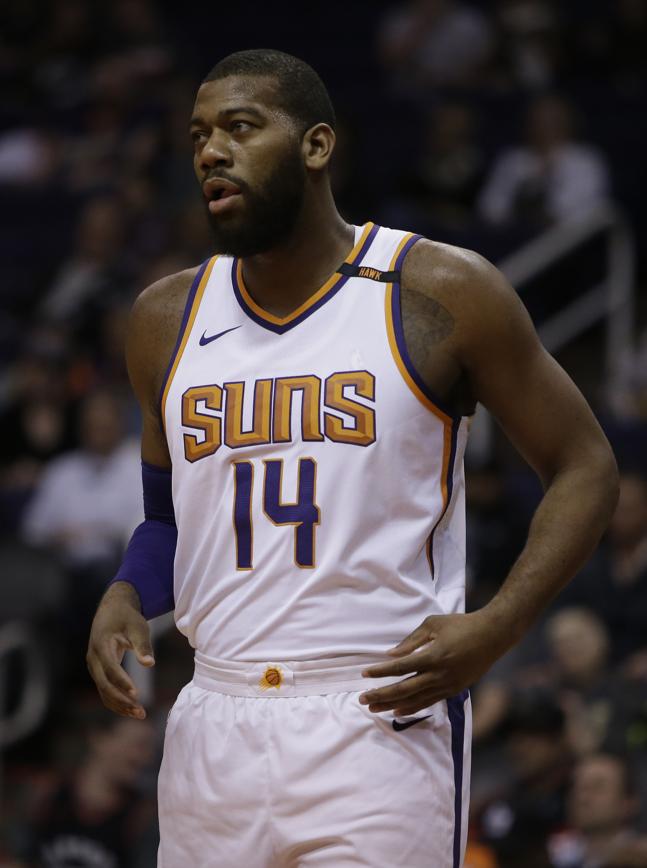
The Celtics were proactive in their pursuit of f0rmer Phoenix and Milwaukee center Greg Monroe, confirming their long-held interest in the traditional post player who has given them fits over the years.
The $8.4 million prorated disabled player exception enabled the Celtics to nab Monroe for $5 million. The Celtics were focused on Monroe the moment he agreed to a buyout from the Suns.
Why? Because Monroe is a polished post player and solid finisher around the basket. He isn’t going to stretch the floor or take 3-pointers, but he is going to demand double teams in the post because of his crafty moves.
The 6-foot-11-inch Monroe was considered a cornerstone during his years in Detroit, but the Pistons frontcourt became crowded with the emergence of Andre Drummond. Monroe became a marquee free agent, leaving for a three-year deal with the Milwaukee Bucks.
The Bucks also had a glut of big men and Monroe’s role quickly changed because the team decided to become more perimeter- and defense-oriented with Giannis Antetokounmpo. Monroe was relegated to the bench but he was still able to put up numbers as a reserve center.
He became expendable when the Bucks needed a point guard, and his $17 million salary was shipped to Phoenix in the Eric Bledsoe deal in November. In Phoenix, he worked himself into the starting lineup and averaged 11.3 points and 8.0 rebounds in 20 games.
Monroe has never been a high-volume rebounder but he’s efficient enough to help a team that is suffering in that area. Since Dec. 15, the Celtics are 22nd in the NBA in offensive rebounding and 12th overall after being one of the top rebounding teams through the season’s first two months.
The team lacks a low-post scorer besides Al Horford and lacks a consistent rebounder. Aron Baynes and Daniel Theis are solid rebounders,m but foul trouble prevents them from playing more minutes. Monroe will lighten that responsibility.
The book on Monroe early in his career was that he was a poor finisher. He had the moves to get to the rim but botched layups. In his first season with the Bucks in 2015-16, Monroe shot 59.6 percent on shots up to 3 feet away, the lowest clip of his career. That number jumped to 62 percent last season and 72 percent in 25 games this season.
Monroe is not an athletic freak or high flyer but he’s so experienced as a post player that he can get to the basket with an array of moves. And during his career, Monroe has punished the Celtics.
In 26 career games against Boston, Monroe has averaged 15.6 points (third-highest against any opponent) and 9.2 rebounds (eighth most). He scored 10 points with 6 rebounds in 17 minutes in Milwaukee’s season-opening win over the Celtics and added 8 and 6 eight days later against Boston in 17 minutes.
The Celtics have enough depth at center to where Monroe won’t need to log 30 minutes, but he may work his way into the starting lineup. The more Baynes plays, the more successful the Celtics are but he has trouble staying on the court because of foul trouble.
For example, Jaylen Brown is the Celtics’ leader in personal fouls with 132 in 1,476 minutes played. Baynes is second with 130 in 941 minutes. Theis is third with 123 in 692 minutes.
So it’s not that Baynes and Theis are falling short of expectations, it’s that they can’t stay on the court long enough to make the maximum impact, leaving coach Brad Stevens in lineup quandaries when both are in foul trouble. In the Celtics’ Jan. 23rd loss to the Lakers, Baynes picked up four fouls in a 4-minute-12-second stretch.
When Theis and Baynes are in foul trouble it places more pressure on Horford to play center. In that Lakers’ game, Horford couldn’t handle the physical Julius Randle, who went at the slight Horford at will. With Monroe now an option, the Celtics can use three bigs to accompany Horford, with Monroe being a definite post presence.
What the presence of Monroe does is offer Stevens more possibilities of mixing and matching his bigs and boosting the offense. The Celtics have had trouble all season scoring in the paint and the presence of Monroe could solve that issue. Also, Monroe, a consummate professional, has played in just six playoff games in eight years, so he is hungry for team success.
He chose the Celtics because of the chance for a long playoff run and also because the Celtics could offer more than his hometown New Orleans Pelicans. So that says he wants to be here, and Stevens will find a place to utilize his post and rebounding skills.
Gary Washburn can be reached at gwashburn@globe.com. Follow him on Twitter @GwashburnGlobe.

