


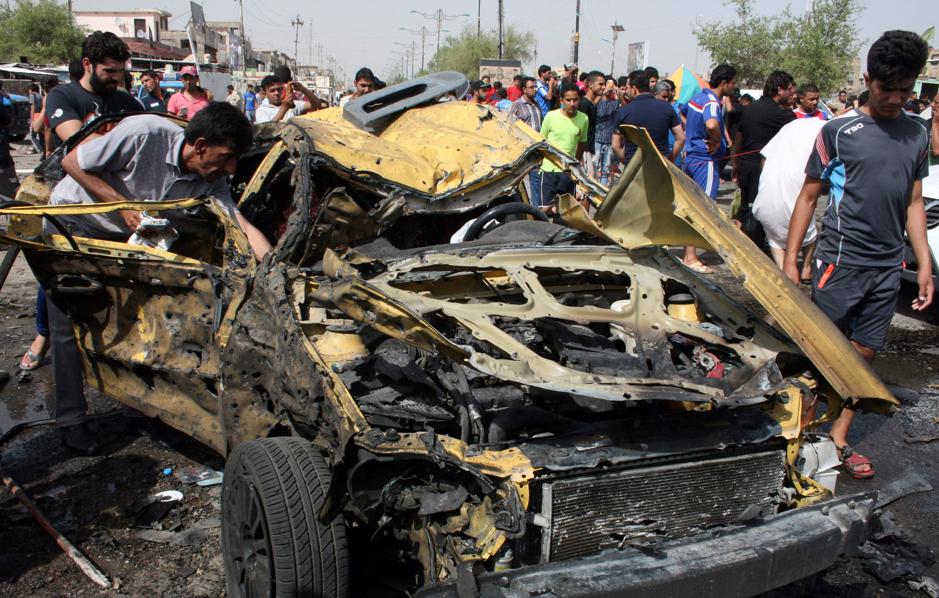
BAGHDAD — A wave of bombings struck outdoor markets and a restaurant in Shi’ite-dominated neighborhoods of Baghdad on Tuesday, killing at least 69 people, officials said — the latest in a string of attacks in and around the Iraqi capital that have left more than 200 dead in the past week.
The four separate bombings were a further challenge to the government of Prime Minister Haider al-Abadi, who is struggling to prove that his forces can maintain security in Baghdad and elsewhere.
One of the bombings Tuesday struck an outdoor market in the heavily Shi’ite district of Sadr City, a frequent bombing target. After the blast, influential Shi’ite cleric Moqtada al-Sadr, whose support runs deep in the district named after his father, issued a statement to his followers, saying the attacks ‘‘are the clearest evidence that your government has become unable to protect and provide you with security.’’
The Islamic State claimed responsibility for the attack in a statement posted to a militant website commonly used by the extremists.
Fighters with Sadr’s militia, Saraya Salam, deployed to the streets of Sadr City following the bombing, another indication of a lack of confidence in Iraq’s official security forces.
In an online statement, ISIS also claimed responsibility for the deadliest bombing of the day, which took place in Baghdad’s northeastern Shaab neighborhood, killing at least 34 people and wounding 75 others.
In that attack, a roadside bomb first exploded outside the concrete blast walls surrounding an open-air market, followed by a suicide bomber who blew himself up as people gathered to help the victims of the first explosion, a police officer said.
The militants’ statement said the attack was carried out by an Iraqi who targeted members of Shi’ite militias.
Later in the afternoon Tuesday, a suicide car bombing hit the outdoor market in Sadr City, killing 18 people and wounding 35 others. Sadr City has been one of the worst-hit districts as the Islamic State has increasingly employed terrorist attacks against Iraqi civilians far from frontline fighting. The attack came less than a week after a massive truck bomb in a crowded market in the capital killed more than 60 and wounded over 80.
Sadr led antigovernment protests last month that peaked with the breaching of the green zone, the highly fortified compound in the heart of Baghdad that’s home to many ministries and foreign embassies. Since then the Iraqi government has been largely paralyzed. Iraqi security officials say they are concerned political instability is distracting from the fight against ISIS. However, some analysts say the extremist group is launching the attacks at a time of political crisis in an attempt to further delegitimize the Iraqi government.
The uptick in bombings, many claimed by ISIS, also comes as the group has lost significant chunks of territory to Iraqi ground forces over the past year. As IS loses ground on the front lines, Iraqi and coalition officials say the group is increasingly turning to insurgency-style attacks to distract from their losses.
Tuesday morning, shortly after the Shaab attack, a parked car bomb struck a fruit-and-vegetable market in the Shi’ite-dominated neighborhood of Dora, in southern Baghdad, killing eight people and wounding 22 others, a police officer said.
In the afternoon in northeast Baghdad, a suicide bomber targeted a restaurant in the Habibiya neighborhood, killing nine and wounding 18.
Medical officials confirmed the casualty figures.

